9 Fine Motor Activities for Toddlers at Home That Build Gentle Hands
By Wellness Hub
Last Updated: April 8, 2026
If your toddler grabs, squeezes, or crashes toys a little harder than they mean to, you are not doing anything wrong. Many toddlers are still learning how much force their hands can use. The good news is that gentle fine motor activities at home can help your child practice “just enough pressure” in a way that feels like play, not a lesson. You do not need special tools, and you do not need long practice sessions. Small moments count.
Some days your child will look careful and coordinated, and the next day they will drop everything or squeeze the life out of a sponge. That up and down pattern is part of how toddler bodies learn. This article gives you nine low-pressure ideas you can rotate through, depending on your child’s mood and your energy.
Also read: It’s Okay if Your Toddler is Messy With Hands, Control Comes Before Neatness
What Does Gentle Hands Actually Mean for Toddlers?
First, using less force. Your child might squeeze a toy until it pops apart, press so hard they snap a crayon, or slam blocks down instead of placing them. Second, moving more slowly and on purpose. Some toddlers rush their hands, which can look like clumsy play, even when they are trying hard. Third, coordinating fingers so the hand does what the brain is asking. That can show up as dropping snacks, struggling to turn pages, or having trouble placing a piece where they want it to go.
In therapy terms, this sits under toddler fine motor control, but you do not need to think about it clinically. Think of it as learning the volume knob for hands. Too loud is crashing and squeezing. Too quiet is hesitating or barely holding on. “Just right” is a hand that can adjust.
It also helps to remember that toddlers often use their whole body to help their hands. If you see a tight jaw, raised shoulders, or a tongue sticking out during a hand task, it can simply mean, “This is hard, I am concentrating.” Over time, as control improves, the effort usually looks calmer.
When Your Child Is Rough or Drops Things, What Might Be Going On?
Rough hands are often a sign of enthusiasm plus a developing nervous system. Many toddlers are still figuring out how strong they are. They also learn through big movements first, then smaller, more precise ones.
If you find yourself thinking, why is my toddler so rough with toys, it can help to reframe it as experimentation. Your child is testing what happens when they push, pull, bang, twist, and squeeze. They are gathering information.
Frequent dropping can fit into this picture too. When a parent tells me, “My toddler drops things a lot,” I often ask what kinds of objects, and when. Dropping tends to increase when a child is excited, tired, distracted, or using a tricky grip. It can also happen when the object is the wrong size for their hand, or when they are trying to do two things at once, like walking and holding.
None of this means you should ignore it. It just means the most helpful support is usually gentle, steady practice in real life. Not pressure. Not perfection. Repetition in small doses.
Learn More: Why Does My Toddler Grip Everything So Tight, Even Soft Toys and Snacks?
9 Gentle Fine Motor Activities at Home That Build Control (Without Feeling Like Practice)
Below are nine ideas that support smoother, more controlled hand and finger movements. You will notice a theme: squeeze and release, press and stop, pull and return, pick up and place. Those patterns teach the hand how to grade force.
1) Playdough squeeze and shape
Playdough is forgiving. It gives resistance, but it also “gives” back, which helps toddlers learn how much pressure is needed. Many kids naturally start with big squeezes, then shift toward smaller pinches and presses as they get interested in details.
2) Sponge squeeze and release play
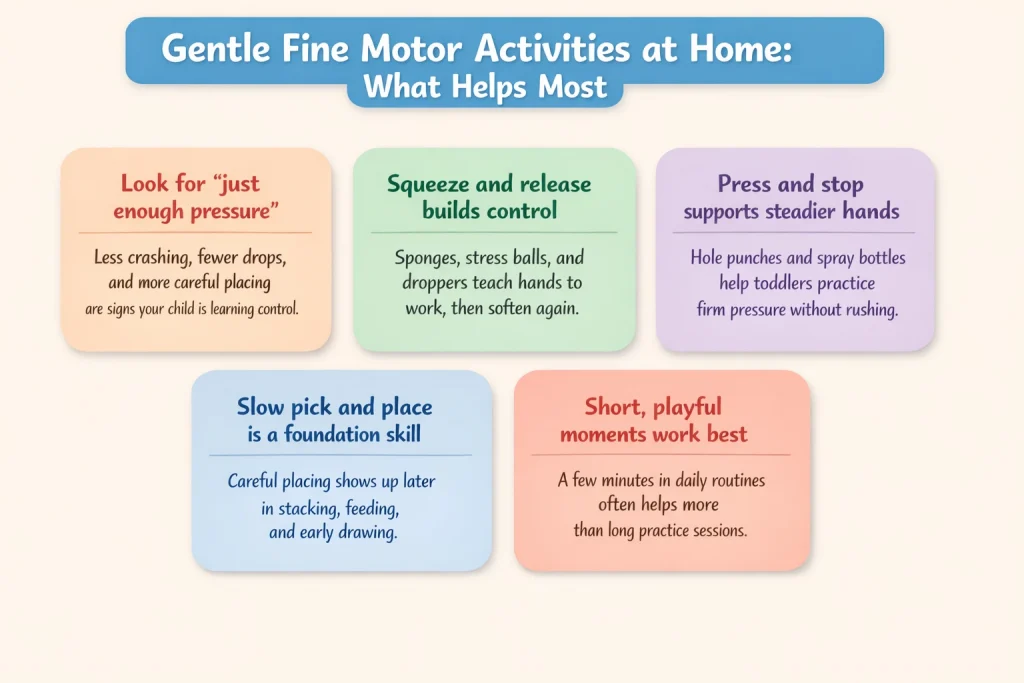
A sponge is a simple way to practice controlled squeezing without needing perfect finger skills. The open and close pattern is the point. Some toddlers love the sensory feel, and others prefer it dry. Either way, it is a gentle way to work on “squeeze, then let go.”
3) Stress ball squeeze control
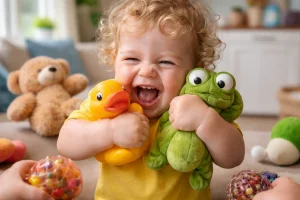
A soft stress ball can be a nice option for kids who seek strong input through their hands. The goal is not to stop squeezing. It is to help the squeeze become more intentional. You might notice your child start to pause between squeezes, which is a small but meaningful sign of control.
4) Crumple and release paper balls
Crumpling paper uses the whole hand, then asks the fingers to open again. That “open” part matters. Some toddlers keep their hand fisted after effort, so practicing release can support smoother movement in other tasks too, like letting go of a block gently instead of dropping it.
5) Bubble wrap pressure play
Bubble wrap gives instant feedback. Too much force pops everything at once. More controlled pressure pops one bubble at a time. Many toddlers enjoy the cause and effect, and you may see them naturally slow down as they try to “get just one.”
6) Spray bottle target play
Spray bottles are a classic for a reason. They encourage repeated finger movement and graded pressure. Some toddlers press too hard and fatigue quickly, so short, playful bursts tend to work better than long stretches.
7) Hole punch control press
A hole punch needs firm pressure, but in a very specific direction. It is a good example of “strong hands, calm body.” If your child tends to crash toys, this kind of tool can channel that strength into a more organized movement.
8) Dropper transfer control
Droppers are tricky in a good way. They combine squeeze, hold, and release. Many toddlers start by using two hands, then gradually experiment with one. That shift often shows up when their hands are getting steadier.
9) Slow pick and place sorting
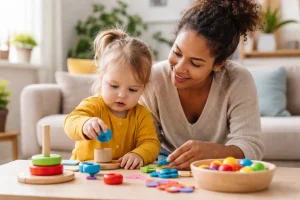
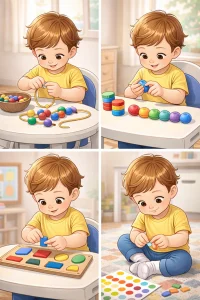
This is less about sorting and more about the “slow hands” part. Picking up an item and placing it carefully is one of the best foundations for later skills like stacking, feeding, and early drawing. If your child tends to toss or dump, this gives a different rhythm without needing you to correct them constantly.
A quick note on variety: it helps to mix “soft resistance” options (like playdough and sponges) with “firm press” options (like a hole punch). That contrast teaches the hand to adjust, which is the heart of control.
How to choose the right activity on a real-life day
Parents often tell me they want the “best” activity. Most of the time, the best one is the one your child will actually tolerate that day.
If your child is energetic and seeking big movement, choose something that gives resistance but has a clear start and stop, like playdough or a hole punch, and your child is tired or easily frustrated, pick something forgiving, like a sponge squeeze or paper crumple and release. If your child is in a “I do it myself” phase, droppers and spray bottles can feel empowering because they create a visible effect.
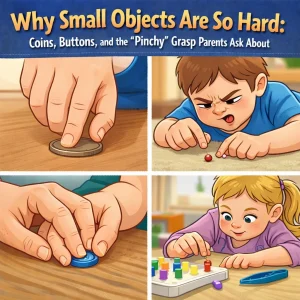
Also consider the object size. Bigger items are often easier to control at first. Tiny items can be frustrating if your child is still building finger coordination. You are not “behind” if small pieces are hard. It is just a sign to keep the challenge at a comfortable level.
If you are wondering how to improve toddler fine motor control without turning your day into therapy homework, this is usually the answer: match the activity to your child’s regulation and interest, keep it brief, and repeat it often in small ways.
Learn More: Your Toddler is Not Behind If Fine Motor Control Looks Rough Some Days
What to say and notice so your child stays motivated
Toddlers learn best when they feel successful, even if the result is messy. The words you use can gently guide the skill without making your child feel corrected.
Try noticing the quality of the movement, not the outcome. Comments like “That was careful,” “You used soft hands,” or “You slowed down” point your child toward control. They also help your child repeat the same body feeling next time.
If your child is rough in a moment, it can help to describe what you want in simple, neutral language. “Slow hands” and “soft squeeze” are often easier for toddlers to understand than “Be gentle,” especially when they are excited.
It is also okay to protect toys and siblings without making it a big emotional moment. Calm boundaries plus a quick reset tend to work better than repeated warnings. Many toddlers need to feel the difference between “too much” and “just right” hundreds of times before it sticks.
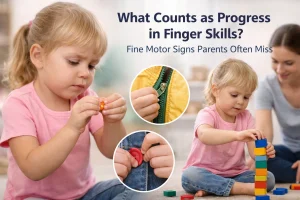
Look for tiny signs of progress, because they are easy to miss. A slightly lighter grip. One careful placement before the dumping starts. A pause between squeezes. Turning one page without tearing it. These are real wins. They are the building blocks of smoother control.
A gentle wrap-up: building gentle hands takes time, not pressure
If your child is still learning to handle toys, tools, and everyday objects with control, you are in very normal territory. Hands develop through use, and toddlers learn best through play that feels safe and doable. Gentle fine motor activities at home are not about creating perfect little movements. They are about giving your child repeated chances to practice squeeze, press, pull, and place with a calmer body and more “just right” force.
Pick one idea that fits your day, repeat it when you can, and give it time. You may be surprised by how quickly a small shift shows up in daily routines, like less crashing, fewer drops, or a more careful hand when placing something down.
Book your Free Consultation Today
Parent/Caregiver Info:
Client’s Details:
* Error Message