Why Does My Toddler Squeeze Everything So Hard?
Last Updated: April 9, 2026
Toddlers often squeeze everything hard because their hands are still learning pressure control, body awareness, and “just right” force. This matters because the same skill helps with feeding, toys, crayons, dressing, and gentle touch. For example, a toddler who crushes a banana may not yet know how softly to hold it.
What you will learn in this article
- Why toddlers squeeze too hard
- When squeezing is normal
- Age-wise red flags to watch
- Routines that teach softer hands
- When occupational therapy helps
You hand your toddler a banana slice. They want to eat it by themselves, but the moment it reaches their fingers, it turns into mush. Ten minutes later, they snap a crayon, squeeze a soft toy too hard, and press a puzzle piece until it bends.
In our clinic, parents often say, “He knows what gentle means, but he still squeezes too hard.” That is usually not the full truth. Many toddlers understand the situation better than their hands can control it.
The real issue is often not strength. It is force grading: the ability to use less pressure for soft things, more pressure for hard things, and adjust the hand quickly when the object changes.
What hard squeezing looks like in toddlers
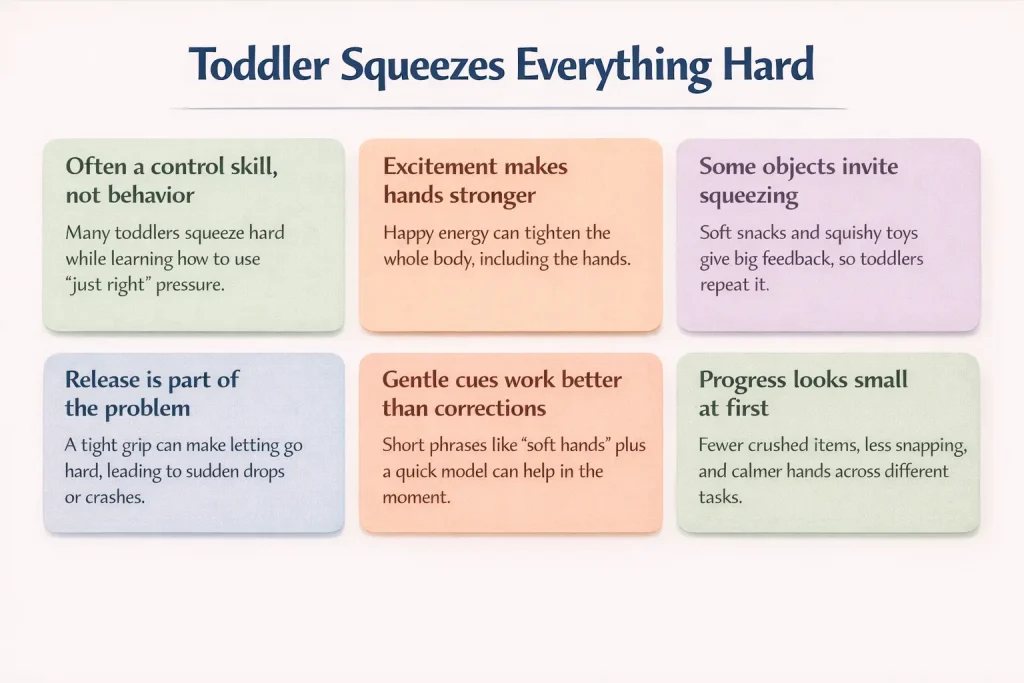
Hard squeezing in toddlers looks like using more hand pressure than the object or activity needs. It may show up as crushing food, snapping crayons, squeezing pets, breaking toys, pressing buttons too hard, or struggling to let go smoothly.
In occupational therapy, we do not look at one crushed snack and panic. We look for patterns. Does the child squeeze only when excited? Only when tired, only with soft food, only with crayons? Or across most play and daily routines?
Micro-example one: a 20-month-old squeezes a pouch too hard and spills it because they are excited to drink. That may be a learning phase. Micro-example two: a 3-year-old crushes food, snaps crayons, squeezes pets, and cannot adjust even after modelling. That needs closer attention.
| What parents see | What may be happening underneath |
|---|---|
| Crushes banana, bread, or crackers | Hand pressure is not graded yet |
| Snaps crayons or chalk | Pressing force is too high |
| Squeezes soft toys tightly | Seeking pressure or feedback |
| Presses buttons very hard | Poor force control or excitement |
| Holds spoon too tightly | Immature grip and wrist control |
| Drops objects suddenly | Release control is weak |
| Squeezes pets or siblings | Does not understand safe pressure |
| Crumples paper | Too much whole-hand force |
| Pushes puzzle pieces hard | Motor planning and frustration may be involved |
The CDC lists 2-year milestones such as holding something in one hand while using the other, trying switches, knobs, or buttons on toys, and playing with more than one toy at a time. These skills require growing control of hands, attention, and problem-solving.
What I tell families is simple: do not label the child rough too quickly. First ask what the hand skill is missing.
Why hard squeezing matters for speech and communication
Hard squeezing matters for communication because toddlers learn through play, feeding, gestures, imitation, and shared routines. If a child cannot control their hands, they may struggle to join play, take turns, use objects meaningfully, or show what they want.
In our clinic, rough hand pressure often appears alongside frustration. A child wants to open a container but squeezes it too hard, a child wants to draw but snaps the crayon. A child wants to play with a peer but grabs too tightly. The body’s pressure problem becomes a communication problem.
Micro-example one: a toddler squeezes a toy animal and cries when it breaks. They may need the word “help,” not more scolding. Micro-example two: a toddler crushes food and throws it. They may need a way to say “too soft,” “help,” “all done,” or “different.”
Hard squeezing can affect communication by reducing:
- Turn-taking during play
- Imitation with toys
- Gentle showing and giving
- Joint attention with objects
- Pretend play
- Feeding participation
- Early drawing and scribbling
- Social play with siblings
- Confidence during hand tasks
NHS guidance explains that fine motor skills involve small hand and finger movements used for tasks like drawing, buttons, zips, and scissors, and that under-developed fine motor skills may affect independence and confidence.
That is why we should not treat squeezing only as a messy habit. It can be part of a bigger picture involving fine-motor control, sensory processing, emotional regulation, play, and communication.
At what age does softer hand control develop?
Softer hand control develops gradually from infancy through preschool. Toddlers first use broad, strong, whole-hand movements, then slowly learn to adjust pressure for food, crayons, toys, clothes, and people.
A 1-year-old may squeeze, bang, drop, and mouth objects while exploring. A 2-year-old should begin using toys with more purpose, but pressure may still be inconsistent. A 3- to 4-year-old should show better control with crayons, blocks, utensils, books, stickers, playdough, and gentle touch.
| Age Range | What to expect | Red flag if missing |
|---|---|---|
| 6–12 months | Reaches, grasps, transfers, bangs, drops objects | Does not reach, grasp, or explore toys |
| 12–18 months | Uses whole hand, squeezes, releases, stacks simple objects | Only mouths, throws, or squeezes without purposeful play |
| 18–24 months | Begins adjusting force for simple toys, food, buttons | Cannot reduce pressure even with modelling |
| 2–3 years | Uses spoon, blocks, simple puzzles, crayons with improving control | Breaks items often or avoids hand tasks |
| 3–4 years | Better force control with crayons, beads, dressing, pretend play | Cannot use gentle touch with people, pets, or fragile objects |
| 4–5 years | More refined pencil, scissors, buttons, and construction play | Rough pressure affects preschool or independence |
| Any age | Skills improve steadily with practice | Loss of hand skills, one hand weakness, or sudden change |
The AAP’s motor delay clinical report states that earlier identification of motor delays allows timely referral for developmental interventions, diagnostic evaluation, and treatment planning. This matters when hand-control concerns affect daily routines or safety.
In our clinic, age is only one part of the decision. A 22-month-old who sometimes crushes food but also stacks, points, imitates, and self-feeds may simply need practice. A 3.5-year-old who cannot adjust force, avoids crayons, hurts pets, and melts down during hand tasks needs assessment.
During meals: teach soft hands with real food routines
Meals are one of the best places to teach pressure control because food gives immediate feedback. A banana crushes, a cracker breaks, a spoon spills, and a cup tips when the hand uses too much force.
In our clinic, we use meals carefully because parents already have enough stress around feeding. The goal is not to turn every bite into therapy. The goal is to create one or two safe chances for the child to feel “soft hold” and “firm hold.”
Micro-example one: your toddler crushes idli while picking it up. You model holding one piece with a relaxed hand and say, “Soft hold.” Micro-example two: your toddler squeezes a pouch too hard. You place your hand lightly over theirs and say, “Slow squeeze,” then release.
| Mealtime problem | What to try |
|---|---|
| Crushes soft fruit | Offer larger pieces and model “soft hold” |
| Squeezes pouch too hard | Use both hands and slow-count squeeze |
| Breaks crackers | Practise holding one cracker with open fingers |
| Throws food after crushing | Add a “no thank you” bowl |
| Grips spoon tightly | Use a thicker handle or shorter spoon |
| Spills cup by squeezing | Use a sturdy open cup with small water amount |
Use contrast. Give one food that can handle firm pressure, such as a thick dosa strip or toast piece, and one food that needs softer pressure, such as banana or soft bread. Say, “Firm hold” and “soft hold” so the child feels the difference.
Do not shame the mess. If the child hears, “You always crush everything,” they may avoid feeding tasks. Instead say, “That was too hard. Let’s try soft fingers.”
If your child coughs, chokes, gags often, refuses textures, eats very few foods, loses weight, or becomes distressed at meals, this is no longer only a hand-control issue. Ask a paediatrician, feeding therapist, speech-language pathologist, or occupational therapist for guidance.
During play: practise hard, soft, squeeze, and release
Play helps toddlers learn force control because it gives the hands safe practice with pressure, release, timing, and feedback. The best play routine includes both strong pressure and gentle control.
In occupational therapy, we do not only say “gentle hands.” We teach the contrast. A child needs to feel what hard means, what soft means, and how to move between them.
Micro-example one: give your child playdough and say, “Squeeze hard.” Then give a toy animal and say, “Soft touch.” Micro-example two: let your child push a large block tower down, then practise placing one block softly on top.
| Activity | What it teaches |
|---|---|
| Playdough squeezing | Strong pressure and hand awareness |
| Sponge squeezing | Squeeze and release |
| Bubble wrap pressing | Finger pressure control |
| Sticker peeling | Gentle pinch and release |
| Block stacking | Controlled placing |
| Toy animal soft touch | Gentle pressure with people/pets transfer |
| Clothespin play | Finger strength and graded squeeze |
| Water dropper play | Slow squeeze and release |
| Crayon pressure scale | Light vs dark pressure |
Use short phrases: “hard squeeze,” “soft touch,” “slow fingers,” “place down,” “let go,” and “try again.” Long lectures do not help toddlers regulate hand pressure.
NHS occupational therapy guidance links fine-motor development with tasks that require coordinated hand, finger, and eye movements, including in-hand manipulation. That is exactly the kind of control toddlers build through repeated hand play.
The mistake is giving only delicate tasks. If every activity requires gentle control, the child may fail repeatedly. Give safe heavy-hand activities first, then shift to softer control.
Also read: 9 Fine Motor Activities for Toddlers at Home That Build Gentle Hands
During sensory routines: give the hands safe heavy work
Some toddlers squeeze hard because their body is seeking strong sensory feedback. Safe heavy work can give the hands and body pressure in a way that reduces unsafe squeezing of food, toys, pets, or people.
In our clinic, we watch whether squeezing increases when the child is tired, excited, dysregulated, bored, or overwhelmed. If the child squeezes everything after a noisy outing, during transitions, or before sleep, sensory regulation may be part of the picture.
Micro-example one: your toddler squeezes toys hard after preschool pickup. Offer two minutes of pushing a laundry basket before quiet play. Micro-example two: your child squeezes your arm when excited. Teach them to squeeze a therapy ball or pillow instead.
Good heavy-work options:
| Heavy-work routine | Why it helps |
|---|---|
| Push laundry basket | Gives safe whole-body pressure |
| Carry books in a bag | Builds body awareness |
| Squeeze playdough | Gives hand pressure safely |
| Pull apart Velcro strips | Teaches pull force |
| Wipe table with cloth | Uses firm pressure functionally |
| Push wall with hands | Provides deep pressure |
| Animal walks | Uses hands and shoulders |
| Roll dough | Builds graded pressure |
A systematic review of Ayres Sensory Integration for autistic children found that the intervention met evidence-based practice criteria for autistic children aged 4–12 in the reviewed studies. This does not mean every toddler who squeezes needs sensory integration therapy, but it supports OT assessment when sensory needs affect function.
Do not create a random sensory plan from social media. Some children become more dysregulated when sensory input is too intense, too frequent, or poorly timed. If squeezing is constant, unsafe, or paired with meltdowns, get an occupational therapist to individualise the plan.
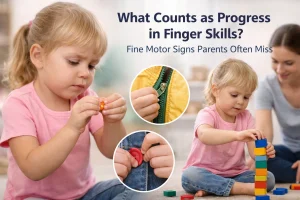
What progress looks like
Progress means your toddler begins using more controlled pressure across food, toys, crayons, touch, and daily routines. It does not mean squeezing disappears overnight.
In our clinic, we measure small changes. Can the child loosen their grip after a cue, Can they hold a banana for one second longe, Can they place a block instead of slamming it? Can they squeeze playdough hard but touch a pet softly?
| Sign of progress | What it means clinically |
|---|---|
| Crushes food less often | Pressure control is improving |
| Adjusts after “soft hands” cue | Body awareness is emerging |
| Holds crayon without snapping it | Fine-motor force grading is developing |
| Places toys down more gently | Release control is improving |
| Uses safe squeeze object | Sensory need is being redirected |
| Touches pet or sibling more softly | Social safety is improving |
| Handles soft food for longer | Gentle grasp is improving |
| Plays longer without frustration | Endurance and confidence are growing |
| Says or signs “help” | Frustration is shifting into communication |
| Uses different pressure for different objects | True force grading is developing |
Micro-example one: last month every banana was crushed immediately. This week your toddler holds one slice briefly before it breaks. That counts. Micro-example two: your child still presses crayons hard, but now stops when you say “lighter.” That is progress.
Track progress over two to four weeks, not one messy meal. Toddlers vary with sleep, hunger, illness, routine change, screen time, and sensory load.
Do not expect equal progress everywhere. A child may use gentle hands with food but still squeeze toys hard. Skill generalisation takes time.
What not to do
Do not treat hard squeezing as deliberate bad behaviour before checking skill, sensory, and communication needs. Toddlers often squeeze hard because they do not yet know how to adjust force.
This does not mean ignoring unsafe behaviour. If your child squeezes a pet, hurts a sibling, breaks sharp objects, or throws hard items, you must set a calm safety boundary immediately.
Avoid these common mistakes:
| What not to do | Better option |
|---|---|
| Say “stop squeezing” all day | Teach “soft,” “hard,” and “let go” |
| Shame the child for mess | Reset and model softer pressure |
| Force delicate toys too early | Start with sturdy objects |
| Remove all strong-pressure play | Give safe heavy-work options |
| Ignore pet or sibling safety | Block, redirect, and teach soft touch |
| Expect instant gentle hands | Practise in short routines |
| Compare with other children | Compare with the child’s own baseline |
| Assume it is only sensory | Check fine motor, attention, and frustration too |
Micro-example one: instead of “You broke it again,” say, “That was too hard. Try soft fingers.” Micro-example two: instead of letting your toddler squeeze the dog, block gently and say, “Dog needs soft touch. Squeeze pillow.”
Do not overcorrect every second. Constant correction can make the child anxious and tighter in their body, which may increase squeezing.
The clinical balance is this: give firm safety limits, but teach the missing hand skill.
When to seek professional help
Seek professional help when your toddler’s hard squeezing is frequent, unsafe, developmentally unusual, or affects feeding, play, crayons, dressing, social interaction, or daily routines. An occupational therapist can assess force grading, fine-motor control, sensory processing, hand strength, release control, and regulation.
In our clinic, we recommend OT assessment when parents feel stuck repeating the same correction for weeks with little change. We also refer sooner if squeezing hurts people, affects feeding, or appears with delayed play, poor gestures, or motor concerns.
| Warning sign | Recommended action |
|---|---|
| Squeezes pets, siblings, or adults hard enough to hurt | Set safety limits and consult OT |
| Crushes food so often meals become stressful | OT or feeding-therapy review |
| Breaks crayons, toys, or objects often after age 3 | Fine-motor and force-control assessment |
| Cannot release objects smoothly | Assess grasp-release and motor planning |
| Avoids puzzles, blocks, crayons, or utensils | OT fine-motor assessment |
| Constantly seeks squeezing, crashing, or pushing | Sensory processing assessment |
| One hand seems weaker or rarely used | Paediatrician and OT review |
| Loses hand skills they previously had | Prompt medical review |
| Squeezing appears with no pointing, poor play, or few words | Developmental and speech-language screening |
| Parent cannot manage routines despite trying strategies | Book OT consultation |
The AAP states that earlier identification of motor delays allows timely referral for developmental intervention, diagnostic evaluation, and treatment planning. Parents should not wait if hand-control concerns affect function or safety.
Here is the blunt clinical line: if squeezing is hurting others, blocking feeding, stopping play, or causing daily conflict, stop calling it “just a phase.” Get the skill profile assessed.
How speech therapy or occupational therapy works on hard squeezing
Occupational therapy works on hard squeezing by improving pressure control, body awareness, hand strength, release control, sensory regulation, bilateral coordination, and functional hand use. Speech therapy may help when squeezing is linked to frustration, limited communication, or difficulty asking for help.
In OT sessions, we may use playdough, tongs, blocks, stickers, sponges, feeding tools, crayons, dressing tasks, sensory play, and parent coaching. The goal is not to make the child sit still with “gentle hands.” The goal is to help the body feel the difference between hard, soft, squeeze, hold, push, and release.
Micro-example one: if a child crushes food, the OT may practise soft grasp with playdough first, then move to real snack practice. Micro-example two: if a child squeezes pets, the OT may teach safe deep-pressure alternatives and practise soft touch with stuffed animals before real-life carryover.
Speech therapy becomes relevant when the child squeezes because they cannot communicate. A child who cannot say “help,” “open,” “stop,” “all done,” or “too hard” may use their body instead.
Helpful therapy targets include:
- Soft vs firm pressure
- Squeeze and release
- Safe touch
- Hand strength
- Wrist stability
- Finger isolation
- In-hand manipulation
- Feeding participation
- Crayon pressure
- Sensory regulation
- Functional communication
- Parent routines
A good therapist should give you practical home routines, not only clinic activities. If the child can use soft hands in therapy but crushes everything at home, the plan is incomplete.
Comparing therapy approaches
Different therapy approaches support different causes of hard squeezing. The right plan depends on whether the main issue is fine-motor delay, sensory seeking, poor body awareness, emotional regulation, frustration, or communication difficulty.
| Approach | What it focuses on | Best for |
|---|---|---|
| Occupational Therapy Fine-Motor Training | Grasp, release, pressure control, hand coordination | Crushed food, snapped crayons, rough toy handling |
| Sensory Integration-Informed OT | Sensory processing, body awareness, adaptive responses | Constant squeezing, crashing, pushing, sensory seeking |
| Task-Oriented Motor Learning | Practising real routines like feeding, drawing, dressing | Skills that must improve in daily life |
| DIR/Floortime | Regulation, emotional connection, child-led engagement | Children who tense or resist when corrected |
| CO-OP Approach | Goal-plan-do-check problem-solving | Older preschoolers who can reflect on actions |
| Parent Coaching | Daily routines, language cues, home setup | Families needing practical carryover |
| Speech-Language Therapy | Help, stop, all done, request, repair, AAC | Squeezing linked to frustration or limited speech |
| Behavioural Support | Safety rules and replacement behaviours | Hurting others, repeated unsafe squeezing |
| Feeding Therapy | Oral-motor, sensory, and food-handling support | Squeezing, gagging, refusing, or distress during meals |
In our clinic, many children need a mixed plan. A toddler may need OT for hand pressure, parent coaching for meals, and speech therapy for “help” and “all done.” Another child may need sensory regulation before fine-motor practice works.
The wrong question is, “How do I stop squeezing?” The better question is, “What is my child trying to feel, do, or communicate through that squeeze?”
Questions Parents Ask
1. Why does my toddler squeeze food until it breaks?
Your toddler may be learning how much pressure soft food needs. Foods like banana, bread, idli, rice balls, and crackers change shape quickly, so they give strong feedback to the hands. Model “soft hold,” offer slightly sturdier pieces, and keep practice short. If meals become stressful or your child avoids many textures, ask an occupational therapist or feeding specialist for help.
2. Is squeezing everything a sensory issue?
It can be sensory, but do not jump there immediately. Some toddlers squeeze because of normal exploration, immature force control, excitement, frustration, or difficulty releasing. Sensory seeking is more likely if your child also craves pushing, crashing, deep pressure, tight hugs, or constant strong hand input. An OT can assess whether sensory processing is part of the pattern.
3. How do I teach my toddler gentle hands?
Teach gentle hands through contrast, not lectures. Let your child squeeze playdough hard, then practise soft touch with a toy animal, soft food, or stuffed toy. Use the same short cue every time, such as “soft hands” or “slow fingers.” Praise the smallest adjustment, even if it lasts only one second.
4. Should I stop my toddler from squeezing toys?
Stop unsafe squeezing, but do not remove all squeezing. Toddlers need safe ways to use pressure, such as playdough, sponges, pillows, pop tubes, or heavy-work play. If a toy can break or hurt someone, calmly replace it with a safer squeeze object. The goal is to redirect the pressure, not shame the child.
5. When is hard squeezing no longer normal?
Hard squeezing becomes a concern when it is frequent, unsafe, persistent beyond age expectations, or affects feeding, play, drawing, dressing, or social interaction. It is also concerning if your child hurts pets or siblings, breaks objects often after age 3, avoids hand tasks, or loses skills. If you see these patterns, book an occupational therapy assessment. Early support can prevent daily routines from becoming constant correction.
6. Can occupational therapy help with squeezing too hard?
Yes. Occupational therapy can help toddlers learn pressure control, hand strength, release, sensory regulation, and functional hand use. The therapist may use playdough, feeding practice, crayons, blocks, heavy work, and parent coaching. The goal is not perfect gentle hands in one session. The goal is safer, more controlled hand use across real routines.
A toddler who squeezes everything hard is not automatically being naughty, aggressive, or careless. Their hands may still be learning the pressure dial. Start with one routine today: during meals, play, or sensory work, teach the difference between hard squeeze and soft touch. If squeezing is unsafe, persistent, or affecting daily life, book an occupational therapy consultation.
Citations used in the article
- Centers for Disease Control and Prevention. “Milestones by 2 Years.” CDC, 2026. URL: https://www.cdc.gov/act-early/milestones/2-years.html
- American Academy of Pediatrics / Noritz GH, Murphy NA. “Motor Delays: Early Identification and Evaluation.” Pediatrics, 2013. URL: https://publications.aap.org/pediatrics/article/131/6/e2016/31072/Motor-Delays-Early-Identification-and-Evaluation
- Hampshire and Isle of Wight Healthcare NHS Foundation Trust. “Handwriting and Fine Motor Skills.” NHS. URL: https://hiowhealthcare.nhs.uk/our-services/a-z-list-of-services/childrens-occupational-therapy-service-isle-wight/handwriting-and-fine-motor-skills
- Just One Norfolk / NHS. “Fine Motor Skills.” NHS. URL: https://www.justonenorfolk.nhs.uk/occupational-therapy-for-parents-carers/learning-playing-exploring/skills-building/fine-motor-skills/
- Schoen SA, Lane SJ, Mailloux Z, May-Benson T, Parham LD, Smith Roley S, Schaaf RC. “A Systematic Review of Ayres Sensory Integration Intervention for Children with Autism.” Autism Research, 2019. URL: https://pmc.ncbi.nlm.nih.gov/articles/PMC6590432/
- American Academy of Pediatrics. “Motor Delays: Early Identification and Evaluation.” PubMed abstract, 2013. URL: https://pubmed.ncbi.nlm.nih.gov/23713113/
About Author:
Dr. Alka Riya Paul is an Occupational Therapist at Wellness Hub with experience supporting children in areas such as fine motor development, sensory regulation, attention, coordination, and daily living skills. With a Bachelor’s degree in Occupational Therapy from Manipal University and internship training at Kasturba Medical College, Manipal, she brings both academic grounding and hands-on clinical exposure to her work.
Her experience spans therapy centres, hospitals, and child-development programs, where she has worked with children with diverse developmental needs. At Wellness Hub, she provides online and offline therapy support while helping families use practical, child-friendly strategies in daily routines. Her approach is play-based, collaborative, and focused on meaningful progress in real-life settings.
Book your Free Consultation Today
Parent/Caregiver Info:
Client’s Details:
* Error Message