Your Toddler is Not Behind If Fine Motor Control Looks Rough Some Days
By Wellness Hub
Last Updated: April 8, 2026
If your toddler fine motor control inconsistent from one day to the next, you are not imagining it. One day they stack blocks carefully or bring a spoon to their mouth with surprising focus. The next day they are squeezing, dropping, or crashing toys like their hands forgot what to do. That up and down pattern is a very common part of how early hand skills grow, especially in toddlerhood when everything is changing quickly.
It can still feel unsettling, because parents naturally look for steady improvement. When progress looks messy, it is easy to wonder if you missed something or if your child is falling behind. Most of the time, those “rough days” are not a step backward. They are information about what your child’s body can handle that day.
Read More: Enhancing Kids Writing: Key Fine Motor Skills Development
Why do toddler hand skills look great one day and rough the next?
Toddlers do not build control in a straight line. Fine motor control is a mix of many small skills working together, like posture, shoulder stability, wrist position, finger coordination, attention, and the ability to use “just enough” force. When one piece is a little off on a given day, the whole thing can look clumsy.
Here are a few everyday reasons you might see a swing:
- Some days your child has more energy for careful movements. On tired days, hands often look heavier, faster, and less precise.
- Big feelings show up in the hands. Excitement, frustration, or being rushed can lead to squeezing, throwing, or banging, even if your child can be gentle at other times.
- Motivation changes the picture. A favorite toy can bring out surprising control. A less interesting task can look sloppy, not because your child cannot do it, but because they are not invested.
- New skills can temporarily make old skills look wobbly. When toddlers are working hard on climbing, running, or language bursts, you might see less patience for small hand tasks for a bit.
- The environment matters. A slippery plate, a heavy cup, a tiny crayon, or a toy that needs two hands can make a “good day” look like a “bad day.”
- A helpful way to think about it is this: your child is not choosing inconsistency. Their nervous system is learning how to grade force and coordinate movement, and it practices in short, uneven bursts.
When inconsistent is actually a good sign
It sounds strange, but inconsistency can mean your child is experimenting with control. Many toddlers start by using too much force because it is the easiest way to get results. They push hard, grab tight, and move fast. Over time, they begin to test lighter pressure and slower movements, but they cannot hold that level of control all day yet.
You might notice little “islands” of skill. For example:
- Your child can place a puzzle piece neatly when they are calm, but rushes and jams it when they are excited.
- They can pick up small snacks with two fingers at the start of a meal, then start scooping and grabbing when they get hungry or impatient.
- They can turn book pages gently when sitting close with you, but rip a page when they are trying to do it quickly on their own.
- Those moments still count. They show the skill is there, even if it is not reliable yet. Reliability comes later, after lots of real life repetition.
- If you are seeing even brief stretches of smoother hand use, that is meaningful progress. It is your child showing you what they are capable of when the conditions are right.
Lear More: Unlock Motor & Sensory Skills: Key to Child Development
Toddler fine motor control inconsistent? Look for patterns, not perfection
When parents tell me, “Yesterday was great and today was a disaster,” I usually ask a different question: “What was different about today?” Not to blame anyone, but to find the pattern. Patterns help you feel grounded, because they turn a confusing day into something you can understand.
A few patterns that often explain rougher hand days:
- Timing: Is it worse before meals, near nap time, or late afternoon?
- Speed: Does it fall apart when your child tries to go fast?
- Body position: Is it harder when standing or moving around, and better when seated and steady?
- Tool size: Do tiny items lead to frustration, while slightly bigger items bring out better control?
- Social pressure: Does it get rough when someone is watching, correcting, or asking for “one more try”?
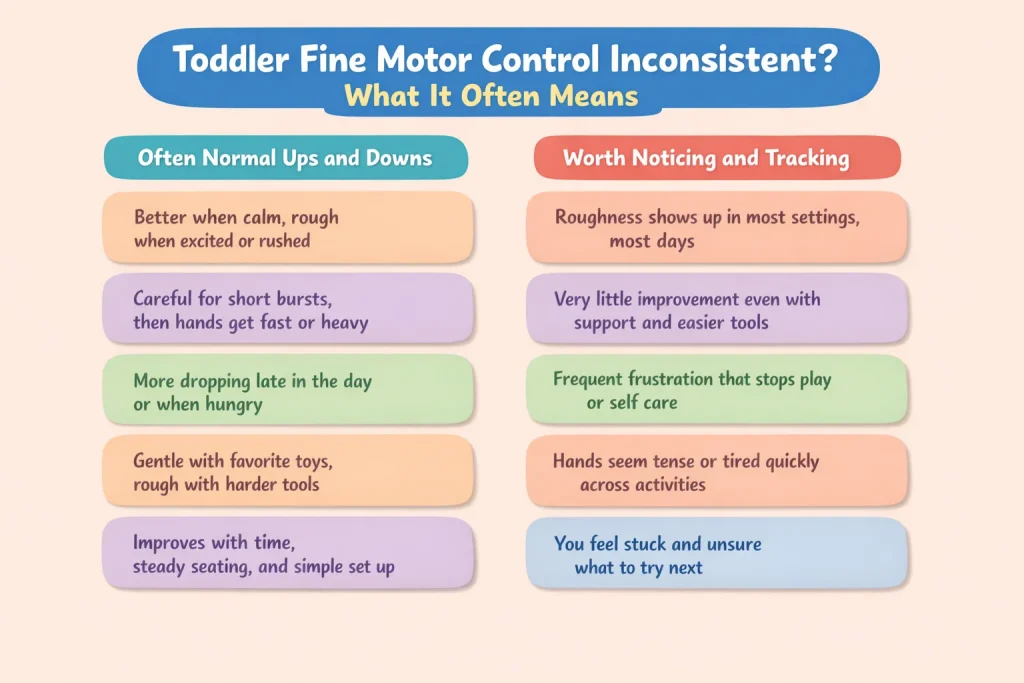
If your child’s hand use improves with calm, time, and supportive set up, that points to a skill that is still developing, not missing. Toddler fine motor control often looks like “I can do it sometimes” before it looks like “I can do it anytime.”
It can also help to separate two things that look similar:
- A rough day because your child is dysregulated, tired, or rushing.
- A rough day because the task is truly too hard right now.
Both are normal experiences in toddlerhood, but they call for different kinds of support. The first is often helped by slowing down and simplifying the moment. The second is helped by adjusting the tools or expectations so your child can succeed without fighting their hands.
What progress can look like over a week, even if today felt rough
When you are living the day to day, progress is easy to miss. It rarely shows up as a sudden, permanent change. More often, it shows up as small shifts in how your child approaches hand tasks.
Over a week or two, you might notice:
- Your child uses less force with certain objects, even if they still crash others.
- They drop things less during familiar routines, like snack time or bath play.
- They adjust their grip more easily, instead of holding everything in a tight fist.
- They place objects with a little more accuracy, like putting a toy in a container without dumping it.
- They stay with a hand based activity a bit longer before getting frustrated or tired.
Another quiet sign of growth is recovery. A toddler who is building control may still have a rough moment, but they bounce back faster. They try again. They accept help. They slow down when you pause with them. That flexibility is part of fine motor control too.
If you want a simple way to steady your own expectations, think in “weeks,” not “days.” A single rough day does not erase the careful moments you saw earlier. It is just one data point.
How to support smoother hand control without turning it into “practice”
Most toddlers learn best when hand skills are part of real play and real routines, not a performance. You do not need to correct every grip or stop every crash. In fact, too much correction can make a child tense, and tense hands are rarely controlled hands.
Support often looks like small changes that reduce pressure:
- Give time. Many rough moments come from rushing. A few extra seconds can be the difference between “crash” and “place.”
- Choose objects that match the day. On tired days, bigger and easier to manage items can help your child feel successful.
- Notice effort out loud. Comments like “You slowed your hands down” or “You put that in so carefully” guide your child toward control without demanding perfection.
- Let your child use two hands when needed. Two hands can bring stability, and stability supports finger control.
- Build in natural breaks. Short pauses help hands reset, especially if your child starts squeezing harder or dropping more.
If you are wondering about “how to improve toddler fine motor control” in a way that feels doable, start by looking for the moments your child is already calm and engaged. That is where control shows up first. You are not creating a new skill from scratch, you are giving it more chances to appear.
Learn More: In-Hand Manipulation Skills for Kids: 30+ OT-Backed Activities to Build Fine Motor Control
When should I seek extra support for rough or clumsy hand days?
Most families do not need to rush to get help just because skills are uneven. Still, you deserve support if you are feeling stuck or if daily life is starting to feel harder than it needs to.
It may be worth getting a second set of eyes if:
- Your child’s roughness or dropping happens in many settings and does not improve over time, even with easier objects and a slower pace.
- Meals, dressing, or play regularly end in frustration, and your child avoids using their hands.
- You notice your child tires quickly during hand tasks, or seems to work much harder than expected to manage simple objects.
- You keep thinking, “I do not know what else to try,” and you want a plan that fits your routines.
This does not mean something is “wrong.” It simply means you want guidance that is tailored to your child. Some families like starting with a parent guided option such as the BASICS App to explore goals and see what supports help. Others prefer direct coaching from a therapist, especially if everyday routines feel tense.
A gentle closing thought after a rough day
If you are ending the day replaying the messy moments, I want to offer this: toddler fine motor control inconsistent is often part of healthy learning. Your child is building the ability to use just enough force, coordinate fingers, and move with purpose. Those skills come and go before they stay.
Tomorrow may look smoother, especially with rest, time, and a calmer pace. Even if it does not, you can still look for one small win, like a careful placement, a softer grip, or a moment of trying again. Those are the building blocks.
You are not behind because today was rough. You are watching development happen in real time, and it is allowed to be uneven.
About the Author:
Anuradha Karanam
Speech-language pathologist (7+ years of experience)
Anuradha Karanam is a skilled speech-language pathologist with over 6 years of experience. Fluent in Tamil, Telugu, Hindi, and English, she specializes in parent counseling, speech sound disorders, fluency assessment, and speech-language evaluations. Anuradha excels at working with children with developmental disorders, offering creative and effective therapy programs. Currently, at Wellness Hub, she holds a BASLP degree and is registered with the RCI (CRR No A85500). Her patience, ambition, and dedication make her a trusted expert in her field.
Book your Free Consultation Today
Parent/Caregiver Info:
Client’s Details:
* Error Message