Should I Ask for Early Intervention if My Toddler Avoids Eye Contact Most of the Time?
By Wellness Hub
Last Updated: March 31, 2026
If you are wondering about early intervention for eye contact, you are already doing something important: paying attention to how connection feels in everyday moments. Many parents notice their toddler is busy with toys, looks away quickly, or seems to avoid faces, and they are not sure whether to wait it out or reach out for help. It can feel especially confusing when your child is affectionate in other ways, or makes eye contact sometimes but not often.
Support is not only for big concerns. Early support can also be a practical way to get a calmer plan, better understanding, and a few simple adjustments that make play and routines feel more back and forth again.
Read More: When To See a Speech Therapist About Eye Contact and Connection During Play
What Avoiding Eye Contact Can Look Like in Real Life (and Why It Can Be Hard To Interpret)
Parents describe this in lots of different ways. Some toddlers glance up only when they want something. Some look at a caregiver’s mouth or hair but not their eyes. Others look briefly, then quickly return to the toy. Some seem to make eye contact with one parent but not the other, or do it at home but not out in public. And some children look more during active games like chase, but less during quieter play.
It also helps to remember what eye contact is for at this age. It is often a quick “check in,” not a long look. A toddler might look up to share a smile, to see what you will do next, or to make sure you are still part of the moment. Many children do this in tiny flashes that are easy to miss, especially if you are multitasking or feeling worried.
There are also everyday reasons eye contact can dip for a while. A child might be deeply focused, tired, hungry, overstimulated, or adjusting to a new environment. Some toddlers are naturally more watchful and prefer to observe from the side. Others are constantly on the move and do not pause long enough to look up.
If you are asking yourself, “is it normal for toddlers to avoid eye contact?” the most helpful answer is usually: it depends on the pattern, not one moment. That is why getting support can feel relieving. You do not have to figure it out alone.
Early Intervention for Eye Contact: What It Is and What It Usually Helps With
Early intervention for eye contact is typically short term, relationship focused support that helps you understand what your child is communicating and how to make connection easier during play and daily routines. It is not about forcing eye contact or turning your child into a “good looker.” It is about helping those natural “shared moments” happen more often.
In practice, early support often focuses on things like:
A clearer picture of what your child is already doing well
Some toddlers are already checking in with a quick glance, a smile, or a body turn. A professional can help you spot those early signs so you can build on them.
Making play feel more back and forth
A lot of eye contact grows out of anticipation and turn taking. When play becomes more predictable and shared, many toddlers start looking up more naturally.
Adjusting routines so your child has a reason to look
This might mean small changes in timing, positioning, or pacing during meals, dressing, bath, or transitions. The goal is connection, not compliance.
Reducing pressure, for both of you
When parents are worried, it is very normal to start “watching for eye contact.” That can make interactions feel tense even when nobody means it to. Support often helps families return to a more relaxed rhythm.
If you have ever searched “why won’t my child make eye contact,” you have probably seen a wide range of explanations online. Early intervention can help you move from internet uncertainty to a real, individualized understanding of your child.
Learn More: The Truth About Saying Look at Me To Get Eye Contact During Play
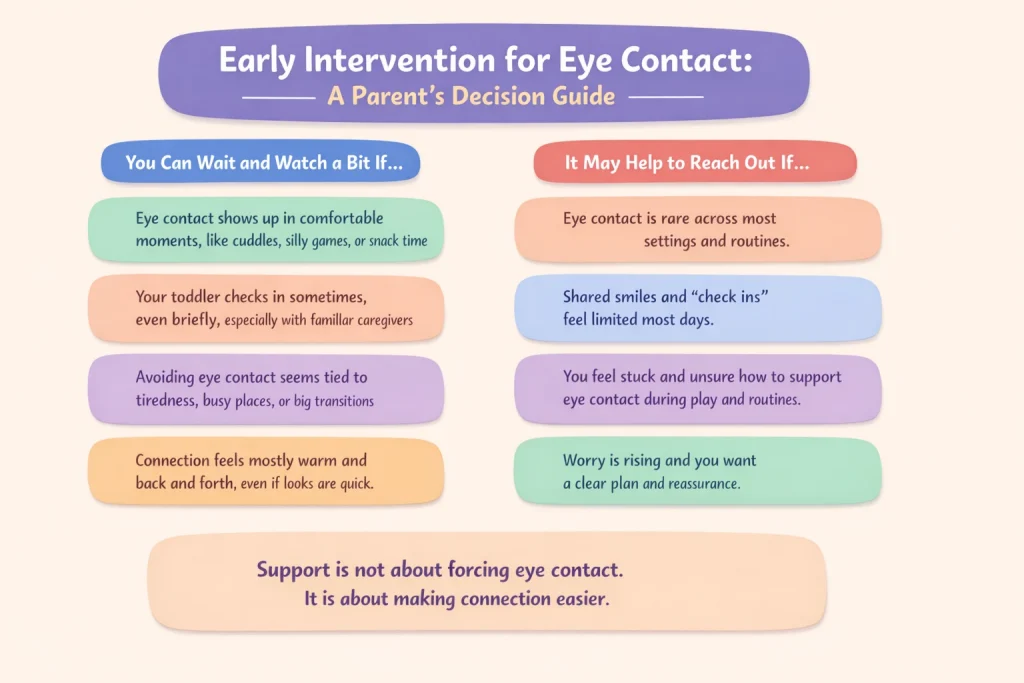
How to decide whether to reach out now, even if you are unsure
Many parents think they need to be certain before asking for help. You do not. Reaching out can simply mean you want a second set of eyes and a plan that fits your child.
Here are a few gentle questions that can guide your decision:
Do you feel like connection is hard to “catch” most days?
Not perfect eye contact, just that sense of shared play. If it often feels one sided, support can help.
Is eye contact rare across many situations, not just one?
Some toddlers avoid looking at new people but look plenty at familiar caregivers. Others avoid eye contact mostly when they are tired or in busy places. Patterns matter.
Are you noticing fewer shared smiles, fewer “check ins,” or fewer moments of showing you something?
Those social moments often travel together. If several of them feel limited right now, it can be useful to talk it through with a professional.
Is this worry starting to take up a lot of space in your day?
If you feel yourself monitoring, comparing, or second guessing every interaction, that is a valid reason to seek support. Peace of mind matters too.
Would coaching help you feel more confident during play and routines?
Sometimes parents simply want practical language and strategies that feel respectful. If you have been searching for how to encourage eye contact and nothing feels quite right, early support can be a good next step.
You can also choose a middle path. Some families reach out for an evaluation while also giving themselves a few weeks to observe patterns in a calmer way. There is no “wrong” choice here.
What To Say When You Call, Message, or Meet Someone About Your Concern
A lot of parents freeze when asked, “What are you concerned about?” because it feels like you need the perfect words. You do not. Simple, everyday language is best.
You might say things like:
- “I notice my toddler doesn’t look up at me much during play.”
- “Eye contact feels rare, even with me.”
- “My child focuses on toys and doesn’t really check in with my face.”
- “I get more connection during active play than during routines like meals or dressing.”
- “I’m not sure what’s typical, but I’d like help making play feel more shared.”
It can also help to mention what you do see. For example, “They smile when I sing,” or “They bring me toys,” or “They like being close.” Those details help a professional understand your child’s strengths, not just the worry.
If you are asked about “eye contact during play,” you can describe what happens in the moments right before and right after. Does your child look away when you speak? Do they look up when something exciting happens? Do they glance at you to request help? Those little clues are often more useful than trying to estimate how many seconds they look.
Read More: How Children Learn To Look Back and Forth Between a Toy and Your Face
How To Track Patterns Without Turning It Into a Daily Test
Parents often tell me, “I don’t want to obsess, but I also don’t want to miss something.” That is a very real tension. A simple way to approach this is to notice patterns in a light touch way, like you are collecting a few snapshots.
Consider these kinds of observations:
When does eye contact happen most easily?
Often it is during predictable, playful moments. Some families notice more connection during bubbles, peekaboo style games, songs, or snack pauses. You do not need to run “eye contact activities for toddlers” all day. Just notice which moments naturally invite a glance.
When is it hardest?
Busy environments, transitions, and times when your child is tired can make eye contact less likely. That does not automatically mean anything is wrong. It may simply mean your child’s system is working hard.
Who gets more eye contact?
Some toddlers look more at one caregiver because that person’s style is more playful, more predictable, or simply more familiar in certain routines. This can be useful information, not a sign you are doing anything wrong.
What counts as progress?
Progress might look like one extra glance during a routine, a shared smile after something funny, or your child looking up right before you do something exciting. Small changes matter.
If you decide to seek early intervention, these observations can help the first conversation feel more grounded. If you decide to wait a bit, they can also help you feel steadier about what you are seeing.
What Support Can Look Like, and How To Know It Is a Good Fit
Support should feel respectful and practical. You should never feel pushed to demand eye contact or to “train” your child. A good provider will focus on connection, shared attention, and making routines easier.
Here are signs the support is a good fit:
- You feel understood, not judged
- You can talk about your child as a whole person, not a list of concerns.
- The plan fits your real day
- Support should work in normal routines like meals, bath, dressing, play on the floor, and getting out the door. It should not require a perfect setup.
- Your child’s comfort is taken seriously
- A provider should notice what helps your child stay regulated and engaged. Eye contact is more likely when a child feels safe and not pressured.
- You are given options, not commands
- You should hear language like “try,” “notice,” and “see what happens,” rather than rigid rules.
It is also okay to ask what the sessions will look like. Will they coach you during play? Will they observe routines? Will they help you interpret what your child is communicating? Those are all reasonable questions.
Learn More: My Child Look at My Mouth but Not My Eyes
A gentle closing: you are not overreacting, and you are not alone
If you are considering **early intervention for eye contact**, it does not mean you are assuming the worst. It means you want support making connection feel easier and more enjoyable. Many families reach out simply because they want guidance, reassurance, and a plan that fits their child.
Keep your expectations kind and realistic. Eye contact often grows from comfort, anticipation, and shared joy. Brief glances count. Shared smiles count. A quick look that says “Did you see that?” counts.
If concerns persist, some families also consider a developmental screening to better understand communication delays or possible autism-related differences. This is not about jumping to conclusions. It is about getting clearer information and support that matches your child.
Whatever you decide next, you deserve help that feels calm, respectful, and practical. And your child deserves connection that never feels like a test.
About the Author:
Shravanaveena Gajula
M.Sc ., Speech and Language Pathology (5+ years of experience)
Shravanaveena Gajula is a dedicated Speech-Language Pathologist with a BASLP and an M.Sc in Speech and Language Pathology. With experience spanning multiple settings, including Wellness Hub , Veena specializes in a wide range of disorders from developmental issues in children to speech and language assessments in adults. Her expertise includes parent counseling, managing speech sound and fluency disorders, and creating individualized therapy programs. Veena is also PROMPT certified and an author of several insightful blogs on speech and language pathology, aiming to educate and assist caregivers in supporting their loved ones.
Book your Free Consultation Today
Parent/Caregiver Info:
Client’s Details:
* Error Message