My Child Doesn’t Look Where I Point Is, That Normal?
Last Updated: March 16, 2026
You point to something you’re sure your child will love— a dog outside the window, a bright balloon at the store, a truck rumbling by. You’re already smiling, waiting for that shared moment.
And then… nothing.
They keep looking at their toy. Or they glance at your hand and go right back to what they were doing. Or they walk in the opposite direction like your pointing didn’t happen at all.
If you’ve been wondering why your child doesn’t follow pointing when you try to share something interesting, you’re in very good company. Many parents feel a little jolt of worry when their child doesn’t look where they point especially when other kids seem to do it so easily. The reassuring truth is that following a point is a skill that often takes time, and it doesn’t show up the same way every day.
Is it normal if my child doesn’t follow pointing yet?
For many children, yes—this can be completely within the range of typical early development.
Following a point isn’t an automatic reflex. It’s a social skill that builds gradually as children learn, little by little, that your gestures are meaningful. In real life, it’s also a skill that comes and goes depending on the moment. Some days your child might follow your point quickly. Other days they might ignore it entirely, especially if they’re tired, hungry, deeply focused, or in a busy environment.
That inconsistency can feel confusing as a parent, but it’s often part of how early communication grows: unevenly, in small bursts, with plenty of “off” moments in between.
What “looking where I point” really involves
From the outside, it can look like a simple request: you point, they look. But for a child, there are several small steps happening under the surface.
They have to notice that you’re pointing in the first place. They have to understand that your finger is a clue (not just an interesting hand). They have to figure out where you mean, especially if the thing is far away or not obvious. And they have to shift their attention away from what they’re doing, which can be surprisingly hard for young children who are deeply engaged in play.
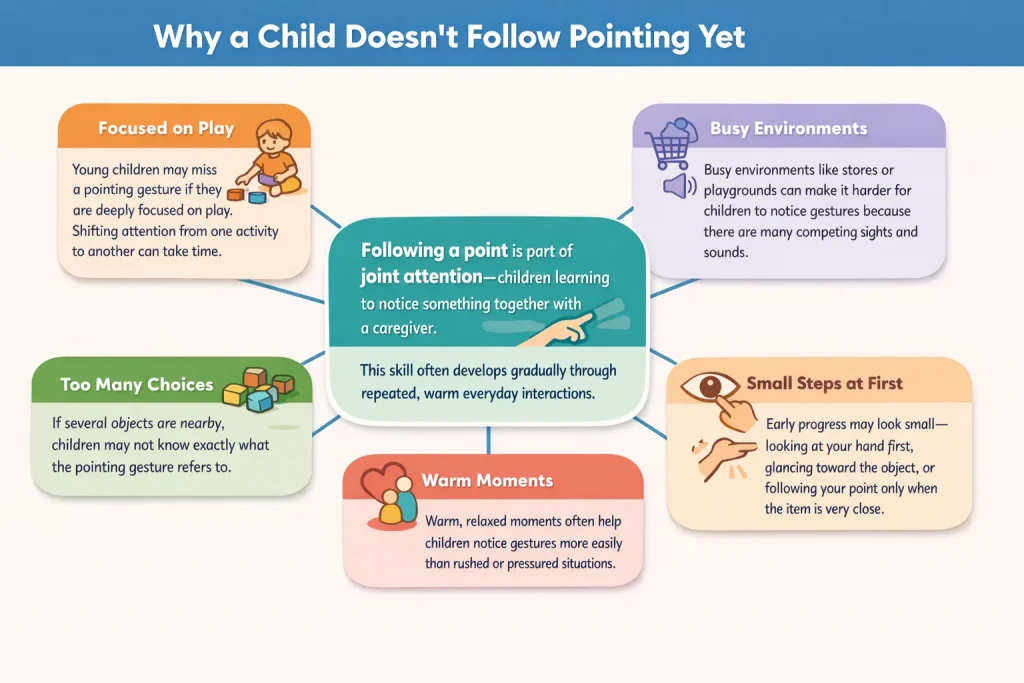
This is all part of a larger set of connection skills often called joint attention, the back-and-forth of sharing focus with a caregiver. Joint attention includes following your gaze, following your pointing, shifting attention between you and an object, and sharing interest in what’s happening around you. It’s one of the ways children learn, “We’re noticing the same thing together.”
And like most meaningful skills, it tends to grow through warm, repeated experiences not through pressure.
What progress often looks like (and what counts)
It’s easy to picture success as a perfect moment: you point, your child turns immediately, and you share a smile. Those moments do happen, but early progress is usually quieter.
You might notice your child looking at your hand first, like they’re trying to solve the puzzle. They might follow your point only when the object is very close. They might look after a long pause. They might glance toward the general area rather than the exact thing. They might look at the object and not look back at you yet.
All of that can be part of the learning process.
Over time, many parents start to see more of the “shared” feeling: their child looks where they point more often, shifts attention between the object and the caregiver, or seems to enjoy the moment—like you’re on the same team noticing the world together.
Why your child might ignore your point even if they can do it
Parents often assume that if a child doesn’t follow a point, they must not understand it. But there are many everyday reasons a child might not look, reasons that don’t mean anything is “wrong.”
Sometimes your child is simply absorbed. If they’re lining up cars, watching spinning wheels, or concentrating on a puzzle, their attention may be fully “locked in.” Shifting attention is a skill of its own, and it often develops slowly.
Sometimes the environment is doing the pointing for you. In a loud store, at a busy playground, or during a family gathering, there may be so many sights and sounds that your point gets lost in the mix.
Sometimes the “target” is unclear. If you point across the room and say “Look!” but there are ten possible things to look at, your child may not know what you mean.
Many children do better when what you’re pointing to is obvious, close by, or especially interesting to them.
And sometimes it’s just an off moment. Adults have off moments too. If you’ve ever been called from another room and needed someone to repeat themselves because your brain was elsewhere, you already understand this.
About the Author:
Shravanaveena Gajula
M.Sc ., Speech and Language Pathology (5+ years of experience)
Shravanaveena Gajula is a dedicated Speech-Language Pathologist with a BASLP and an M.Sc in Speech and Language Pathology. With experience spanning multiple settings, including Wellness Hub , Veena specializes in a wide range of disorders from developmental issues in children to speech and language assessments in adults. Her expertise includes parent counseling, managing speech sound and fluency disorders, and creating individualized therapy programs. Veena is also PROMPT certified and an author of several insightful blogs on speech and language pathology, aiming to educate and assist caregivers in supporting their loved ones.
Book your Free Consultation Today
Parent/Caregiver Info:
Client’s Details:
* Error Message