Why Your Child Imitates Sometimes but Not Other Times
By Wellness Hub
Last Updated: March 3, 2026
One day your child claps when you clap, and it feels like a tiny celebration. The next day you try again, same song, same moment, and they look right past you as if it never happened.
If you’ve found yourself in this confusing back-and-forth of inconsistent imitation, you are not alone. Many parents notice that imitation comes and goes: a wave to Grandma once, then not again; a high-five at the park, followed by a “no thanks” at home. It can feel personal, as if you are doing something wrong, or as though the skill has somehow disappeared.
Most of the time, inconsistent imitation is simply part of how this skill develops. Imitation is not a switch that turns on and stays on. It is more like a connection that strengthens when the moment feels right.
Also read: How to Encourage Imitation by Pausing Instead of Repeating the Gesture
What imitation really is at this age
When we talk about the goal of imitating simple actions and gestures, we usually mean things like clapping, waving, giving a high-five, shaking the head yes or no, or copying short sequences such as clap then wave.
These movements may be small, but they are meaningful. When a child copies a gesture, they are doing more than moving their hands. They are noticing you, taking in what you did, and choosing to join you in a shared moment. This is why imitation often appears during play and everyday routines, it is closely tied to connection. Because imitation is rooted in connection, it can change depending on how your child is feeling, what is happening around them, and whether the moment feels inviting enough to join.
Why inconsistent imitation can be inconsistent even when your child can do it
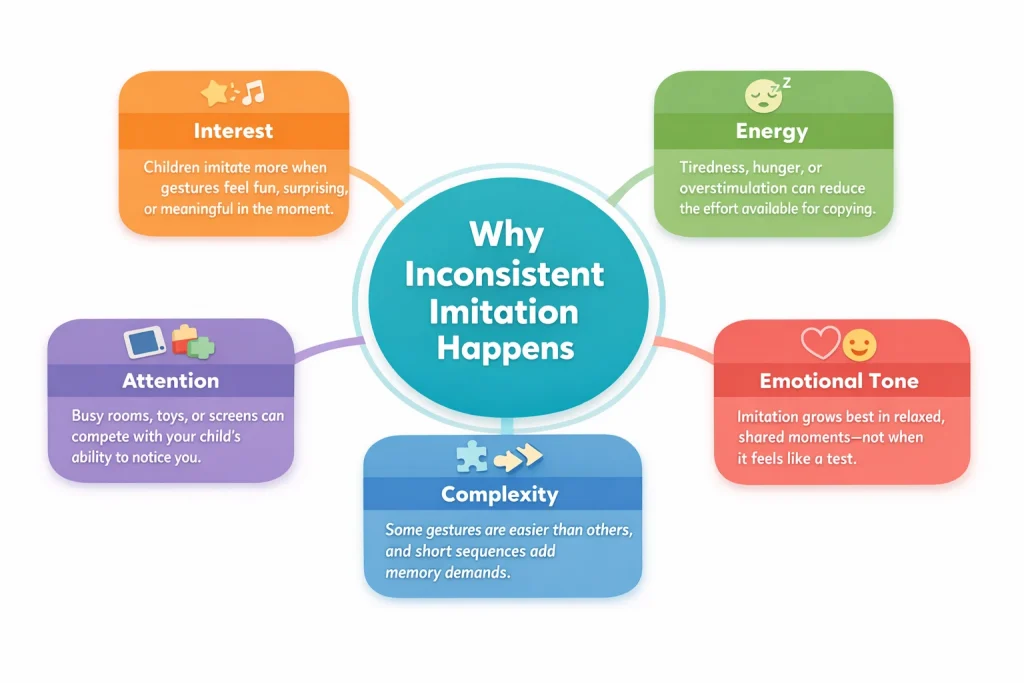
Parents often assume that if a child can clap once, they should be able to clap every time. But early skills rarely develop in such a straight line. Below are some very normal reasons inconsistent imitation may appear one day and not the next.
1. Interest changes quickly
Sometimes your child is not refusing to imitate—they are simply not interested in that particular action at that moment. Children are constantly drawn to what feels fun, surprising, or meaningful. A high-five may feel exciting when someone walks through the door, but not very motivating during a quiet afternoon.
You may notice your child imitates more when the gesture is part of something they already enjoy, such as a favorite song, a silly face, or a familiar game.
2. Energy and regulation matter
Imitation requires effort. Your child must notice you, shift their attention, and coordinate their body. If they are tired, hungry, overstimulated, or winding down, they may not have enough energy for copying, even if they have done it before.
This is why imitation often appears more during calm, connected moments and less during transitions, errands, or late in the day.
3. Distractions compete with connection
When your child is deeply focused on a toy, a screen, a new environment, or a busy room, imitation may fade. This is not stubbornness. It simply means their attention is already occupied elsewhere.
In a quiet living room, your clap may stand out clearly. In a noisy park, it may be much harder to notice.
4. Some gestures feel easier than others
Clapping is symmetrical and often easier for children to discover on their own. Waving, pointing, or shaking the head can be more complex and may take longer to become consistent. Short sequences like “clap then wave” add another layer: your child has to remember what comes next and stay engaged long enough to complete both steps.
It is common for one gesture to appear reliably while another seems to come and go.
The interaction may feel different to your child than it does to you
This is an important point. Parents often repeat a gesture because they feel excited or encouraging: “Do it again! Clap! Clap!” But to a child, repeated requests can begin to feel like a test.
Many children imitate best when the gesture feels like part of a shared moment rather than a performance. If your child senses pressure—even gentle, well-meaning pressure—they may look away, freeze, or change activities. This does not mean you did anything wrong. It simply means your child is sensitive to the emotional tone of the interaction, which is actually a social strength.
What progress can look like even when it’s not consistent
It can help to widen the idea of what “success” looks like. Consistency usually comes later, after many relaxed opportunities. Before that, progress often shows up in smaller ways.
You might notice your child watching your hands more closely, leaning toward you, smiling, or pausing as if deciding whether to join in. You may see them perform the gesture later in the day, in a different setting, or only with one familiar person. Some children look to a parent for cues before trying—almost as if they are asking, “Is this the moment?”
All of these are meaningful signs. Imitation often grows quietly before it becomes reliable.
Also read: 10+ Simple Home Activities to Encourage Clapping, Waving, and High-Fives
How to make imitation more likely without turning it into a task
Parents do not need a perfect strategy to support imitation. What matters most is the quality of the moment: calm connection, face-to-face interaction, and gestures that feel natural and relevant.
Many families notice imitation happens more easily when gestures are part of real life. A wave when someone leaves. A high-five after finishing something hard. A clap when the tower stands. A playful head shake during a silly “no, no, no” moment. When gestures match the emotion of the moment—excitement, pride, greeting, surprise—children often have more reason to join in.
It can also help to leave a little space after you make a gesture. Some children need a moment to process what they saw and decide whether to try. When the interaction is calm and you are not rushing to repeat the cue, your child may be more likely to participate.
And if your child does not copy, it is okay to let the moment pass. Each time they see a gesture in a warm, connected setting, they are still learning what it means.
Why not copying isn’t the same as not learning
This is often the hardest part for parents: learning is not always visible.
Children frequently practice internally before showing a skill outwardly. They may be watching more than you realize. They may save the gesture for a moment that feels safer, sillier, or more exciting. They may even experiment when you are not looking. So if your child clapped once and then stopped, it does not mean the skill is gone. It usually means it is still settling in.
When it helps to get a little extra support
Sometimes parents want reassurance or fresh ideas that fit their child’s personality. If inconsistent imitation feels hard to encourage, or if you are unsure how to create playful moments without adding pressure, it can help to talk with someone who understands early communication.
Some families find speech therapy app such as BASICS useful. It offers simple, everyday ways to support goals like imitating gestures through short videos and routine-based ideas. The focus is not on drilling skills, but on noticing opportunities for connection and making them easier to recognize.
Also read: What Counts as Imitation Even If It Doesn’t Look Perfect Yet
A calm reminder to take with you
Inconsistent imitation is very common. It usually reflects everyday factors, like interest, energy, distraction, and how inviting the interaction feels, rather than a lack of ability or connection.
Those early claps, waves, and high-fives are small bridges between you and your child. They do not need to happen on demand to matter. Each time you offer a playful gesture and respond warmly to even a tiny attempt, you are giving your child what this skill needs most: safety, time, and shared joy.
About the Author:
Shravanaveena Gajula
M.Sc ., Speech and Language Pathology (5+ years of experience)
Shravanaveena Gajula is a dedicated Speech-Language Pathologist with a BASLP and an M.Sc in Speech and Language Pathology. With experience spanning multiple settings, including Wellness Hub , Veena specializes in a wide range of disorders from developmental issues in children to speech and language assessments in adults. Her expertise includes parent counseling, managing speech sound and fluency disorders, and creating individualized therapy programs. Veena is also PROMPT certified and an author of several insightful blogs on speech and language pathology, aiming to educate and assist caregivers in supporting their loved ones.
Book your Free Consultation Today
Parent/Caregiver Info:
Client’s Details:
* Error Message