How to Model New Sounds Without Feeling Like You’re “Drilling” Your Baby
Last Updated: February 28, 2026
If you’ve ever caught yourself saying “ba ba ba” and then immediately thought, “Do I sound silly? Am I even doing this right?” you’re definitely not alone. Many parents trying sound modeling for babies want to support their baby’s early communication but feel strange repeating sounds on purpose. It can feel forced, almost like you’re testing your baby instead of simply enjoying them. And when your baby doesn’t copy you right away, it’s easy to think you must be doing something wrong.
You’re not. Sound play is meant to feel light and natural. The most helpful kind of sound modeling doesn’t look like a lesson at all. It looks like a warm, easy back-and-forth that fits into your everyday moments together.
Why repeating sounds can feel so uncomfortable (even when it’s helpful)
Most of us didn’t grow up watching adults make playful, exaggerated sounds with babies. We learned language through normal conversation, not through “mmm,” “buh,” and “puh” in the middle of the grocery store.
So when you try to model new consonant sounds like b, m, d, g, p, it can feel awkward. You might worry you’re being annoying, or that you should be doing it a certain way, or that you’re turning playtime into practice time.
Here’s a gentler way to look at it: your baby isn’t judging how you sound. They’re simply taking in what speech feels like, the rhythm, the mouth movements, the variety. Your calm, loving presence matters far more than getting the sound “right.”
What natural sound modeling for babies actually looks like
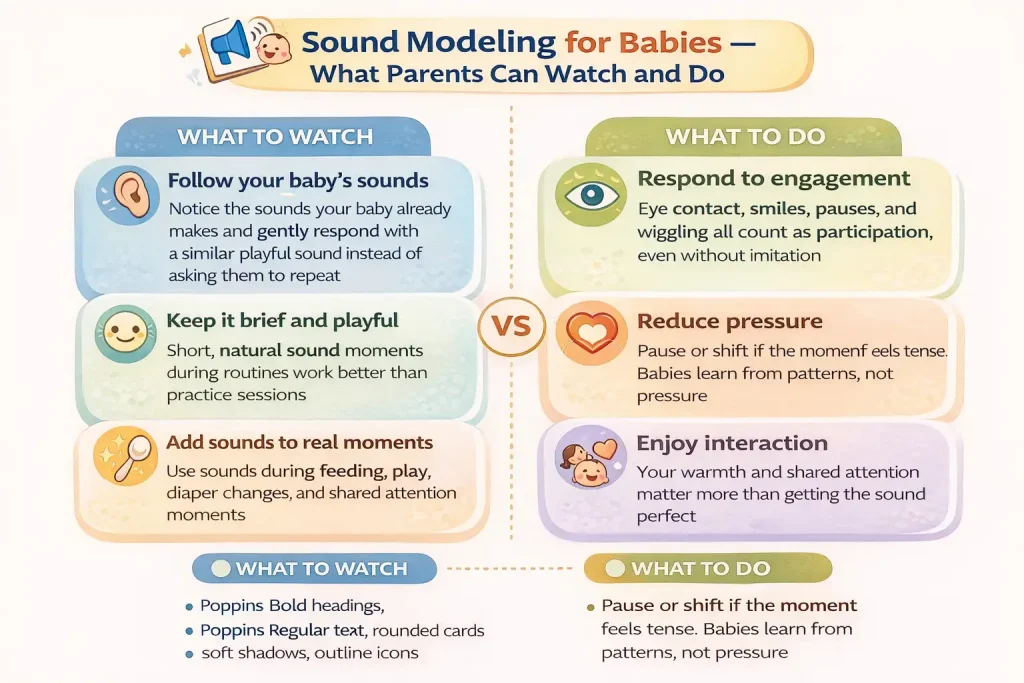
Natural sound modeling is usually brief, playful, and connected to whatever your baby is already doing. It’s less like “repeat after me” and more like “I hear you, and I’m adding something fun.”
It often slips into tiny moments. When your baby is already making sounds. When you’re face-to-face during a routine. When a toy almost asks for a sound on its own. You may notice you’re already doing it without thinking about it. A soft “mmm” at mealtime. A “buh-buh” when a ball rolls away. A cheerful “d-d-d” during a diaper change to keep things light. These little sound moments quietly build over time.
And your baby doesn’t have to copy you for any of this to matter. Just hearing new consonants and sound patterns helps them start experimenting with their own voice later on.
Also read: 10+ Simple Home Activities to Encourage More Consonant Sounds in Babbling
The goal isn’t perfection it’s variety and opportunity
When we talk about encouraging more sound variety, what we really mean is giving your baby many chances to hear and explore different consonants, different combinations, and even different voice styles, like a silly high voice or a calm, low one.
Slowly, you may notice their babbling becoming more playful and mixed. New sounds like b, m, d, g, or p might show up once in a while. Your baby may even look surprised or pleased with themselves when something new comes out.
That’s usually what progress looks like. Not a sudden jump, but a wider and richer “sound palette.”
How to keep it from feeling like drilling
Many parents feel more relaxed when they give themselves permission to stop before things start to feel awkward. Sound modeling works best when it stays small and responsive, more like sprinkling than pouring.
If you notice yourself repeating a sound and starting to feel tense, that’s a cue to soften the moment. You can pause, smile, follow your baby’s lead, or simply talk about what they’re doing. The connection stays warm, and your baby has still heard new sounds.
It also helps to remember that babies learn through patterns, not pressure. A few playful sound moments spread across the day often feel easier and more natural than setting aside a special “practice time.” This is the heart of sound modeling for babies.
What to do when your baby doesn’t copy you
This is where many parents lose confidence. You model “ba,” your baby looks at you quietly, and suddenly it feels like you failed a tiny test.
But copying is only one possible response, and often not the first one. Sometimes babies are listening. Sometimes they answer with a different sound. Sometimes they’re focused on a toy or just not in the mood to vocalize. A helpful way to see it is this: your baby is still participating if they’re engaged. A look, a pause, a smile, a wiggle, these all mean they’re taking you in. You can respond warmly to whatever they offer, even if it’s not the sound you modeled.
Often, that sound will show up later when you least expect it. During bath time. In the car. Or while they’re babbling to themselves in the crib.
Read more: Is It Normal If My Baby Mostly Makes Vowel Sounds When Babbling?
Making sound modeling feel like play not performance
Sound modeling usually feels easiest when it’s tied to something real, a toy, an action, a routine, or a shared joke. Then you’re not “doing sounds.” You’re enjoying a moment together that happens to include sounds.
During play, many parents naturally use toy noises that highlight consonants, like a bouncy “b-b-b” for a ball, a happy “mmm” for something yummy, or a gentle “p-p-p” for popping bubbles. Others like pairing a sound with a funny face, an exaggerated mouth movement, or a pause that invites their baby to respond in any way.
You can also play with your voice, high, low, slow, excited, because vocal range is part of sound exploration too. Babies often love the musical feel of it, even before they can copy the exact sound. It may help to think of yourself as a narrator of your baby’s world rather than a teacher. You’re offering sound “samples” they can explore when they’re ready. That’s another example of sound modeling for babies.
Signs you’re supporting sound variety in a healthy, low-pressure way
Parents often ask, How do I know I’m doing enough? In real life, it usually looks like this: you notice your baby’s sounds, you respond with interest, and every now and then you add a new consonant into the flow of your day.
You may start to feel your baby’s vocal play becoming more varied. They might try new combinations, repeat a sound they enjoy, or light up when something new slips out. Those little moments of surprise and delight are wonderful signs that sound play is becoming part of their communication.
And if some days are quieter than others, that’s normal too. Babies don’t develop on a schedule.
A simple mindset shift that helps many parents
If repeating sounds feels uncomfortable, try shifting from “I need to get my baby to say this” to “I’m giving my baby something interesting to hear.”
That small change often removes the pressure. You’re no longer measuring success by imitation at the moment. You’re building familiarity and confidence with a wider range of sounds through warm, everyday interaction. This gentle approach to sound modeling for babies supports communication development naturally.
Babies learn best when they feel safe, noticed, and enjoyed, not evaluated.
Optional support if you want more ideas without overthinking it
Some parents feel more confident when they can actually see what playful sound modeling looks like in real homes, with real babies, during real routines.
Tools like BASICS can be helpful if you want gentle guidance around communication goals, such as expanding sound variety, along with simple examples that fit naturally into daily life, without turning your day into a checklist. It’s there if you want a bit of structure, and completely optional if you don’t.
A calm reminder to end on
If you feel awkward modeling sounds, it doesn’t mean you’re doing a bad job. It means you’re a thoughtful parent who cares deeply about supporting your baby.
Keep it short. Keep it playful. Let your baby lead more than you try to teach. The goal isn’t a perfect “ba” on demand. It’s to create many warm, low-pressure chances for your baby to hear, explore, and enjoy new sounds with you. Those small moments, your baby watching your mouth, your shared smile after a silly “mmm,” the surprise of a new consonant appearing, are exactly how early communication grows.
About the Author:
Rajini Darugupally
M.Sc., Speech-Language Pathologist (9+ years of experience)
Rajini is a passionate and dedicated Speech-Language Pathologist with over 9+ years of experience, specializing in both developmental speech and language disorders in children and rehabilitation in adults. Driven by a desire to empower each individual to find their voice, Rajini brings a wealth of experience and a warm, genuine approach to therapy. Currently, at Wellness Hub, she thrives in a team environment that values innovation, compassion, and achieving results for their clients. Connect with Rajini to learn more about how she can help you or your loved one find their voice.
Book your Free Consultation Today
Parent/Caregiver Info:
Client’s Details:
* Error Message