What to Do When Your Child Grunts, Whines, or Yells Instead of Pointing
Last Updated: February 28, 2026
You’re in the kitchen. Your child is standing near the counter, and suddenly a sound bursts out, a grunt, a whine, or a sharp yell. You look around trying to decode it. Snack? Help? Up? A different cup? And while you’re still guessing, the sound gets louder. Many parents worry about child whining instead of pointing in exactly these moments.
Many parents find themselves stuck in this same uncomfortable moment. You want to meet your child’s needs, but you also don’t want to feel like the loudest sound always “wins.” If this is happening in your home, it doesn’t mean you’re doing something wrong, and it doesn’t mean your child is being difficult.
For many children, these sounds are communication. They’re using what works in the moment to request, protest, get attention, or release big feelings. The goal isn’t to shut the sound down. The goal is to help your child feel understood while slowly guiding those sounds toward clearer and calmer communication over time.
Why child whining instead of pointing can be communication not “bad behavior”
When children don’t yet have an easy way to show what they want, like pointing, bringing an item, using a word, or even making a consistent “help” sound, they fall back on what they do have: their voice and their emotions. Whining and yelling can be a fast way to say:
“I want that.”
“I need help.”
“No.”
“Stop.”
“Look at me.”
“I’m frustrated.”
“I’m excited.”
That’s why these moments feel so intense. Your child isn’t giving you a neat little message. They’re sending a strong signal that something matters right now.
And this is important to say clearly: responding to your child’s communication is not the same as “giving in.” You are not rewarding noise by acknowledging it. You are teaching your child that communication works best when it’s shared and understood.
Also read: How to Tell If a Sound Is Meaningful Communication Or Just Noise
The tricky parent worries: “If I respond, am I teaching them to whine?”
This is one of the most common concerns parents have. Many people end up stuck between two extremes, and neither feels good.
One extreme is jumping in quickly to stop the noise, handing the snack, picking them up, changing the show, just to restore calm. The other is trying to ignore the sound completely, hoping it will fade away, only to watch it escalate until everyone is upset.
There is a gentler middle path. You can acknowledge what your child is expressing without making volume the center of the interaction. Over time, your child learns, “My parents understand me, and there’s a better way to get what I need.”
What your child may be missing in that moment
When a child points, they are doing something surprisingly complex. They notice what they want, direct your attention, and wait for your response. When a child whines or yells instead, it often means one of those steps is hard right now, especially the part about directing your attention clearly.
Sometimes children also need more time to organize their message. The sound comes out before the signal does. Or the feeling is so big that the body jumps straight into protest.
This is where the larger goal, using sounds purposefully to communicate needs and feelings, becomes so important. Even if the sound is unpleasant, it can still be meaningful. Your child is practicing communication with the tools they have right now.
A calmer way to respond that doesn’t create a power struggle
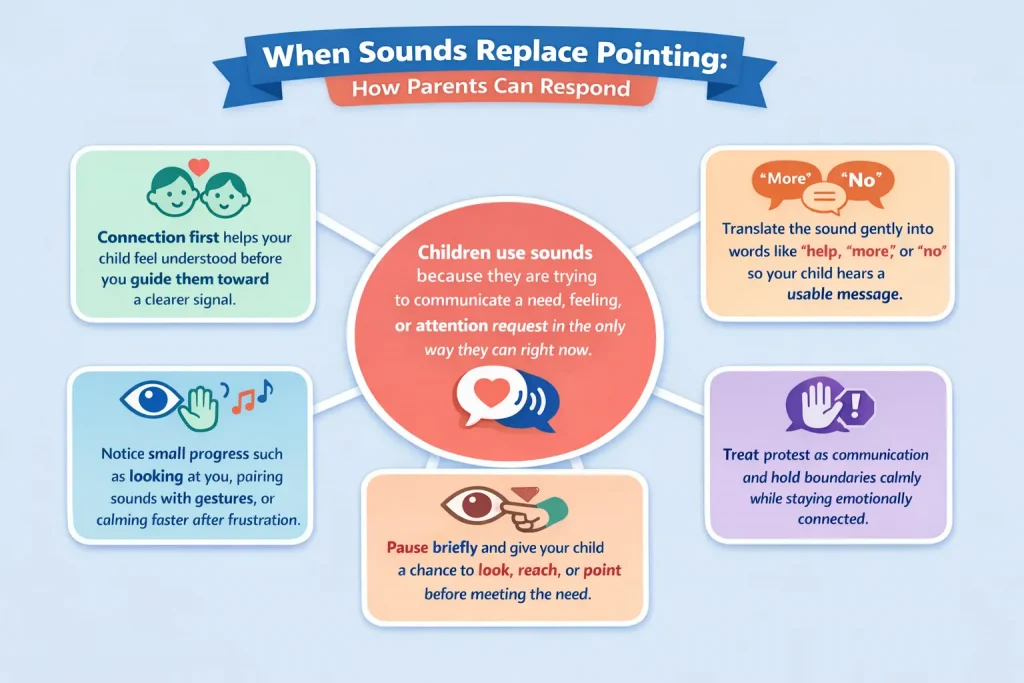
In the moment, it can help to think in two layers: connection first, clarity second.
Connections sound like, “I hear you,” “You’re upset,” or “You really want that.” This does not mean you are agreeing or giving the item immediately. It simply means your child knows their message landed.
Clarity comes next, and it can be gentle. You are translating the sound into a clearer message. Many parents find it helpful to respond as if their child is already communicating more clearly: “Oh, help,” or “You’re saying no,” or “You want more.”
You are not correcting or lecturing. You are offering a shortcut your child can borrow. Over time, many children begin to copy the clearer sound, gesture, or tone because it works and because it feels better than escalating.
Read more: My Child Only Makes Sounds When Playing Alone How Can I Encourage Sounds With Me?
When it’s a request: “I want that”
Requests are often the easiest place to build calmer communication because there is something motivating on the other side. Whining may show up when your child wants a snack, a toy, a screen, or your attention.
In these moments, slowing things down just a little can help, without turning it into a test. Some parents naturally pause, look expectant, or hold the item near their face so their child has a chance to look, reach, or make a more intentional sound. If your child can point sometimes but not in hard moments, that still counts as progress. Pointing often disappears when children are tired, hungry, overstimulated, or rushed. You are not starting over. You are supporting the skill when it is hardest to use.
When it’s a protest: “No,” “Stop,” or “Not that”
Protest sounds can be the most draining because they often show up during transitions, leaving the park, getting into the car seat, turning off the bath, putting on shoes. And protests can sound like yelling even when the child is simply trying to be heard.
It can help to treat protest as real communication. A child who can protest in a clearer way is learning self-advocacy. The goal is not to erase protest, but to make it safer and easier to understand.
Many parents notice that naming the protest reduces the intensity: “You’re saying no,” “You don’t like that,” “You want it to stop.” When children feel understood, they often don’t need to prove it with volume. And if you still need to hold a boundary, you can do that while staying connected: “I hear your no. It’s time to get in the car.” Calm, steady responses tend to soften the struggle over time because your child isn’t fighting to be understood and fighting the limit at the same time.
What progress can look like it’s often quieter than you expect
Parents sometimes expect progress to mean “no more whining.” But early communication growth usually shows up in small shifts, such as:
Your child makes a sound and then looks at you, as if checking whether you understood.
They use different sounds for different needs.
They vocalize to get your attention before melting down.
They calm faster after protesting.
They begin pairing a sound with a reach, a glance, or a point.
These are meaningful steps. They show your child is using sounds more purposefully, to request, protest, comment, and connect with you in real time.
How to protect your relationship while this skill grows
When whining and yelling happen often, it can start to feel personal. Parents may notice themselves tensing up, bracing for the next outburst, or feeling irritated before anything even happens. That is a very human response to repeated stress.
It helps to remember this: your child is not giving you a hard time. They are having a hard time communicating. When you respond with warmth and steadiness, you are not letting things slide. You are building a foundation where your child feels safe enough to try a different way.
And you don’t have to be perfect. Even one or two calmer responses a day can slowly change the tone of your home.
When extra support feels helpful
Sometimes parents simply want more ideas for how to respond in the moment, especially if whining and yelling are showing up in many routines or if you feel like you are constantly guessing what your child needs.
Tools like BASICS can be a helpful, optional support. They are designed to guide parents toward everyday communication goals, like using sounds purposefully to request, protest, get attention, or share excitement, through short, practical examples that fit into real life.
A gentle closing thought
If your child grunts, whines, or yells instead of pointing, it’s easy to worry that you’re reinforcing something you don’t want. But in many homes, these sounds are simply a child’s best way to connect right now.
When you treat the sound as communication, acknowledge the feeling, and calmly model a clearer message, you are doing something powerful. You are showing your child that being understood does not require a fight. And little by little, those loud moments can turn into shared moments, where your child’s voice feels less like a struggle and more like a bridge between you.
About the Author:
Rajini Darugupally
M.Sc., Speech-Language Pathologist (9+ years of experience)
Rajini is a passionate and dedicated Speech-Language Pathologist with over 9+ years of experience, specializing in both developmental speech and language disorders in children and rehabilitation in adults. Driven by a desire to empower each individual to find their voice, Rajini brings a wealth of experience and a warm, genuine approach to therapy. Currently, at Wellness Hub, she thrives in a team environment that values innovation, compassion, and achieving results for their clients. Connect with Rajini to learn more about how she can help you or your loved one find their voice.
Book your Free Consultation Today
Parent/Caregiver Info:
Client’s Details:
* Error Message