Dyspraxia Signs in Children: 10 Motor, Speech & School Red Flags
Last Updated: May 7, 2026
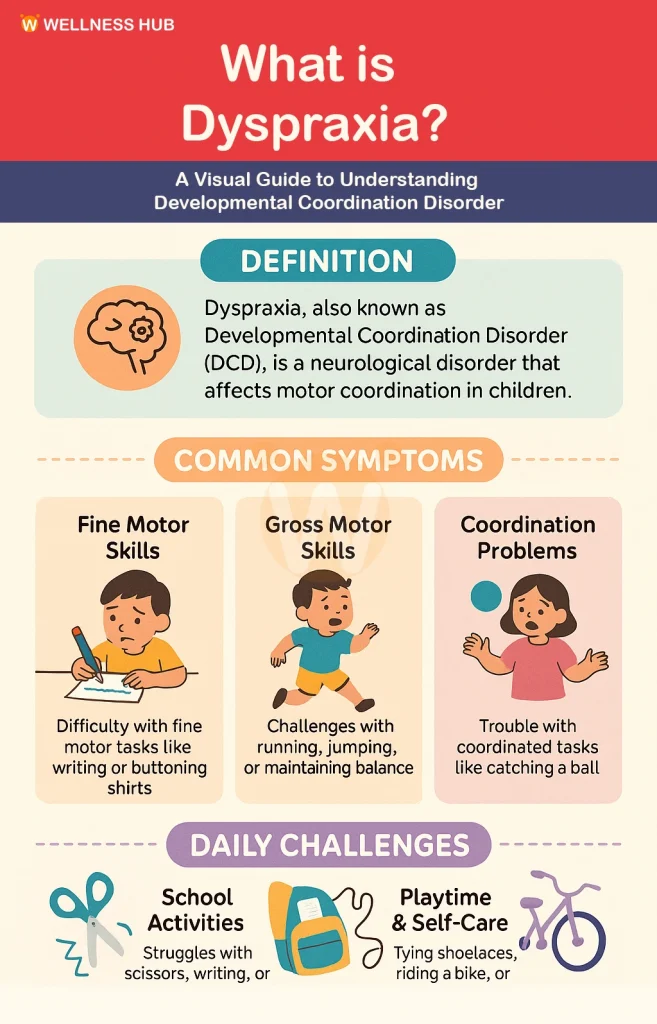
Does your child often seem clumsy, struggle with handwriting, avoid sports, drop things, or take longer to learn daily tasks like dressing, using cutlery, or tying shoelaces? These may be signs of dyspraxia, also called Developmental Coordination Disorder or DCD.
Dyspraxia is not laziness, poor effort, or low intelligence. It is a motor planning and coordination difficulty that can affect how a child learns and performs everyday movements. Some children mainly struggle with gross motor skills like running, jumping, or balance. Others struggle more with fine motor tasks like writing, buttons, scissors, or using utensils.
This guide explains 10 common dyspraxia signs in children, what they may look like at home and school, and when parents should consider an occupational therapy or developmental evaluation.
Source note: Dyspraxia is commonly referred to as Developmental Coordination Disorder or DCD. DCD affects movement, coordination, and motor planning, but it does not mean a child is lazy or less intelligent. Many children with DCD need support with daily activities, school tasks, confidence, and participation in play or sports.
CanChild notes that children with DCD usually have normal or above-average intellectual abilities, but motor coordination difficulties can affect academics, social integration, and emotional development.
Also read: Dyspraxia Explained: Impact & Strategies for Motor Skills
Quick Dyspraxia Signs Checklist for Parents
| Area | What Parents May Notice | Common Examples | Ask for Help If… |
|---|---|---|---|
| Coordination | Child seems unusually clumsy | Bumps into things, trips often, drops objects | It happens often and affects daily life or play |
| Gross Motor Skills | Difficulty with big body movements | Running, jumping, climbing, catching, balancing | Child avoids playground games or sports |
| Fine Motor Skills | Difficulty using hands and fingers | Handwriting, buttons, zippers, scissors, utensils | Schoolwork or self-care becomes frustrating |
| Motor Planning | Trouble learning new movement steps | Riding a bike, tying shoes, dance steps | Child needs much more practice than peers |
| School Tasks | Slow or messy written work | Poor handwriting, copying trouble, unfinished work | Teacher reports repeated motor-based struggles |
| Daily Living | Difficulty with self-care | Dressing, eating, brushing teeth, packing bag | Child needs more help than expected for age |
| Speech/Oral Motor | Difficulty with speech clarity or sequencing | Unclear speech, slow speech planning, word sequencing | Speech delays appear along with motor issues |
| Social Confidence | Avoids group games or physical play | Refuses sports, gets left out, low confidence | Child feels anxious, embarrassed, or isolated |
10 Common Dyspraxia Signs in Children
Dyspraxia signs can look different from child to child. Some children struggle mainly with handwriting and school tasks. Others find playground games, dressing, eating, or learning new physical skills difficult. Look for patterns over time, not one isolated mistake.
1. Poor Coordination
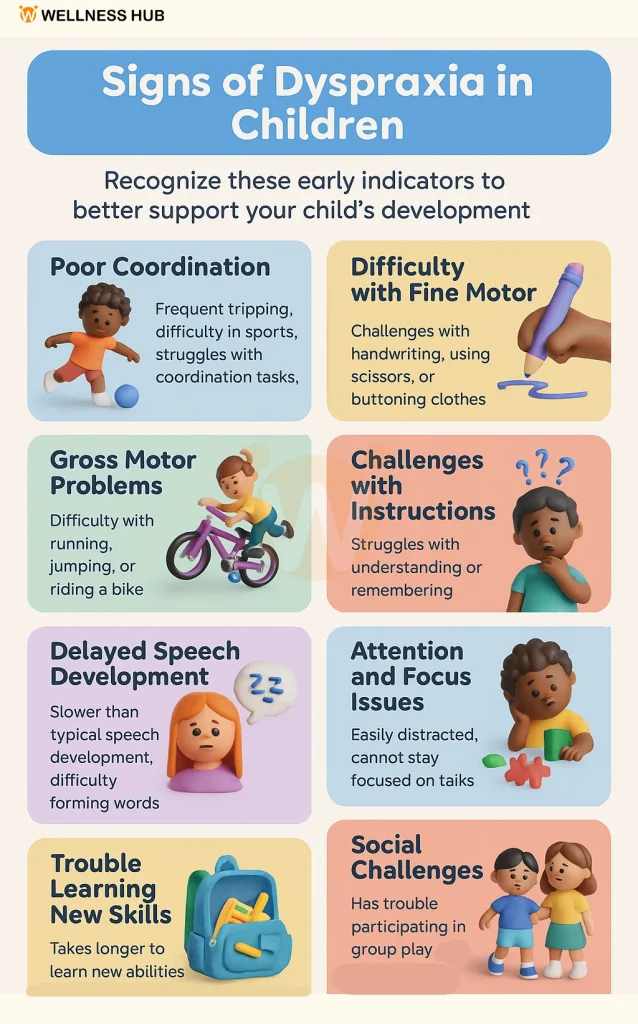
Children with dyspraxia may look more clumsy or awkward than other children their age. They may bump into furniture, trip often, drop objects, spill drinks, or struggle to move smoothly during play.
What it looks like at home:
Your child may knock things over, avoid messy movement games, struggle to carry items without dropping them, or seem unsure where their body is in space.
What it looks like at school:
Teachers may notice difficulty during physical education, playground games, classroom transitions, or activities that require moving around safely.
When to ask for help:
Ask for guidance if poor coordination happens often, affects safety, reduces confidence, or makes your child avoid play, sports, or daily routines.
2. Difficulty with Fine Motor Skills
Fine motor skills involve small hand and finger movements. Children with dyspraxia may find these tasks harder because they require coordination, planning, pressure control, and hand strength.
What it looks like at home:
Your child may struggle with buttons, zippers, shoelaces, using a spoon, opening lunch boxes, brushing teeth, or holding crayons.
What it looks like at school:
They may have messy handwriting, slow writing speed, difficulty cutting with scissors, poor coloring control, or trouble copying from the board.
When to ask for help:
Speak with an occupational therapist if fine motor difficulties affect schoolwork, dressing, eating, play, or your child’s independence.
CanChild lists handwriting, printing, copying, cutting, dressing, feeding, grooming, zippers, buttons, tying shoelaces, and ball skills as common areas of difficulty in DCD.
3. Problems with Gross Motor Skills
Gross motor skills use larger body movements. Children with dyspraxia may find running, jumping, hopping, climbing, balancing, throwing, or catching harder than expected.
What it looks like at home:
Your child may avoid climbing equipment, struggle with stairs, fall often, or prefer sitting activities over active play.
What it looks like at school:
They may avoid PE, struggle with team games, be picked last for sports, or find playground activities overwhelming.
When to ask for help:
Ask for professional support if your child avoids movement, frequently falls, cannot keep up with peers, or becomes anxious during physical activities.
4. Difficulty Following Movement-Based Instructions
Some children with dyspraxia understand instructions but struggle to plan and complete the movements in the right order. This is different from simply “not listening.”
What it looks like at home:
Your child may understand “put on your socks, shoes, and bag,” but get stuck, do steps out of order, or need repeated help.
What it looks like at school:
They may struggle with multi-step classroom tasks, craft activities, copying actions, dance steps, sports drills, or science activities that involve hand movements.
When to ask for help:
Ask for support if your child understands what to do but repeatedly struggles to organize the body movements needed to do it.
5. Speech or Oral Motor Difficulties
Some children with dyspraxia may also have speech or oral motor difficulties. This may affect how clearly they speak, how smoothly they sequence sounds, or how easily they coordinate mouth movements for speech.
What it looks like at home:
Your child may mispronounce words, speak less clearly than peers, pause often while trying to say words, or struggle with longer words.
What it looks like at school:
Teachers may notice that the child avoids speaking in groups, is hard to understand, or becomes frustrated when asked to explain ideas.
When to ask for help:
A speech-language pathologist can help if your child has unclear speech, delayed language, difficulty sequencing sounds, or frustration during communication.
Keep this section, but do not make speech the main focus of the page. Dyspraxia/DCD is primarily a coordination and motor planning issue.
6. Difficulty with Focus During Motor Tasks
Children with dyspraxia may seem inattentive when a task requires effortful movement planning. This can look like poor focus, but the real issue may be that the task is physically or mentally demanding.
What it looks like at home:
Your child may start dressing, writing, drawing, or cleaning up but stop quickly because the task feels too hard.
What it looks like at school:
They may leave written work unfinished, avoid craft activities, take longer than classmates, or need repeated reminders during tasks with several steps.
When to ask for help:
Ask for guidance if attention difficulties appear mostly during writing, dressing, sports, drawing, or other motor-based tasks.
Hard truth: do not casually label this as “attention difficulty.” That can blur dyspraxia with ADHD. Say difficulty with focus during motor tasks.
7. Trouble Learning New Physical Skills
Children with dyspraxia often need more practice to learn new motor skills. They may understand the goal but struggle to make their body do the steps smoothly.
What it looks like at home:
Your child may take longer to learn cycling, swimming, dressing, tying shoelaces, using cutlery, or brushing teeth.
What it looks like at school:
They may struggle with new sports, dance routines, handwriting patterns, craft work, or classroom activities that require hand-eye coordination.
When to ask for help:
Ask for support if your child needs much more practice than peers, becomes upset during new tasks, or avoids trying because they expect to fail.
NHS guidance says support can include teaching difficult activities by breaking movements into smaller parts and practicing them regularly.
8. Poor Organizational Skills
Dyspraxia can affect how a child organizes their body, belongings, time, and steps in a task. This may show up as messy work, lost items, or difficulty completing routines.
What it looks like at home:
Your child may struggle to pack a school bag, keep clothes organized, follow a morning routine, or remember the order of daily tasks.
What it looks like at school:
Teachers may notice a messy desk, lost books, incomplete work, difficulty copying homework, or trouble moving between activities.
When to ask for help:
Ask for help if organization problems affect school performance, daily routines, independence, or emotional confidence.
9. Poor Spatial Awareness
Children with dyspraxia may find it hard to judge space, distance, direction, or where their body is in relation to people and objects.
What it looks like at home:
Your child may bump into doorways, misjudge steps, spill things, stand too close to others, or struggle to move through crowded spaces.
What it looks like at school:
They may have trouble lining up, using playground equipment, copying from the board, spacing letters on a page, or participating in group games.
When to ask for help:
Ask for guidance if spatial awareness problems cause frequent accidents, frustration, handwriting issues, or avoidance of movement-based activities.
10. Social and Emotional Challenges
Dyspraxia can affect confidence and social participation. A child may avoid games, sports, group activities, or classroom tasks because they fear failure or embarrassment.
What it looks like at home:
Your child may say “I can’t do it,” avoid trying new activities, get upset during dressing or homework, or prefer activities where they feel safe.
What it looks like at school:
They may avoid PE, be left out of games, feel embarrassed about handwriting, or struggle to join fast-moving group play.
When to ask for help:
Ask for support if your child’s coordination difficulties are affecting confidence, friendships, school participation, or emotional well-being.
CanChild notes that DCD can affect social integration and emotional development, not just movement.
When to Seek Professional Help for Dyspraxia Signs
One or two clumsy moments do not mean your child has dyspraxia. Children spill, fall, and avoid tasks sometimes. The concern is a repeated pattern that affects daily life, school, play, confidence, or independence.
Consider speaking with a pediatrician, occupational therapist, or developmental specialist if your child:
- Frequently falls, trips, bumps into things, or drops objects
- Struggles with handwriting, buttons, zippers, scissors, or utensils
- Avoids playground games, sports, PE, or movement activities
- Takes much longer than peers to learn physical skills
- Gets frustrated during dressing, writing, drawing, or self-care
- Has trouble organizing school materials or daily routines
- Shows speech or communication difficulties along with motor concerns
- Avoids social activities because of coordination difficulties
- Loses motor skills they previously had
- Shows stiffness, weakness, pain, or sudden changes in movement
A professional evaluation can help identify whether your child’s difficulties are related to dyspraxia/DCD, another developmental concern, or a different medical issue.
How Occupational Therapy Helps Children with Dyspraxia
Occupational therapy is often one of the most useful supports for children with dyspraxia because it focuses on everyday skills. An occupational therapist can help your child improve independence, confidence, and participation in home, school, and play activities.
Occupational therapy may support:
- Handwriting and pencil grip
- Scissor skills and hand strength
- Dressing, buttons, zippers, and shoelaces
- Using cutlery and lunchbox items
- Balance, coordination, and body awareness
- Visual-motor skills
- Planning multi-step tasks
- Classroom participation
- Daily routines and independence
A therapist may also suggest simple adaptations, such as pencil grips, visual schedules, step-by-step routines, seating changes, or modified classroom tasks.
NHS guidance says a treatment plan for DCD may involve a pediatric occupational therapist, who can assess daily activities such as dressing, using cutlery, toileting, playing, and fine-movement tasks like writing.
How Parents Can Support a Child with Dyspraxia at Home
Supporting a child with dyspraxia does not mean forcing them to “try harder.” Most children with dyspraxia are already trying hard. They need tasks to be broken into smaller steps, repeated patiently, and adapted to their ability level.
Use these strategies at home:
1. Break Tasks into Small Steps
Instead of saying “get ready for school,” break it into steps:
- Put on socks
- Put on shoes
- Pick up bag
- Stand near the door
Practice one step at a time until your child feels more confident.
2. Use Visual Routines
Use pictures, checklists, or simple charts for morning routines, school bags, dressing, homework, and bedtime. Visual support reduces memory pressure and helps children follow steps more independently.
3. Practice Real-Life Skills
Practice the actual task your child struggles with, such as buttons, zippers, spoon use, handwriting, or packing a bag. Random exercises are less useful than practicing the daily skill your child needs.
4. Reduce Time Pressure
Children with dyspraxia often need more time. Rushing can increase mistakes, frustration, and avoidance. Give extra time for dressing, writing, eating, and school preparation.
5. Praise Effort and Strategy, Not Speed
Say, “You kept trying,” “You used the steps,” or “You found a better way.” Avoid comparing your child with siblings or classmates.
6. Work With the School
Ask teachers about handwriting, PE, classroom routines, copying from the board, and task completion. Children with dyspraxia may need classroom support, extra time, or modified tasks.
Support from Wellness Hub: Expert Help at Your Fingertips
At Wellness Hub, we’re committed to helping children with dyspraxia improve their communication and coordination skills. Our team of certified professionals offers personalized care through online speech therapy, making expert support accessible and convenient for families. Whether your child needs help with speech clarity, language development, or following instructions, our sessions are designed to meet their unique needs from the comfort of your home.
Conclusion
Understanding the signs of dyspraxia is crucial for helping your child thrive. At Wellness Hub, we offer resources and support to guide you through this journey. Early action is key—using tools like occupational therapies and educational guides can greatly enhance your child’s development. Don’t face these challenges alone; our community and experts are here to support you every step of the way.
Frequently Asked Questions:
1. What is dyspraxia in children?
Dyspraxia, known medically as developmental coordination disorder, involves difficulties with movement and coordination. It affects a child’s ability to perform everyday tasks, such as writing or tying shoelaces.
2. How can I tell if my child has dyspraxia?
Look for signs like clumsiness, trouble with fine motor skills like writing, or difficulties with sports. If these persist, consider an evaluation by a healthcare professional.
3. What are the first steps after a dyspraxia diagnosis?
Start by consulting with occupational and speech therapists who specialize in pediatric care. Utilize supportive resources like those offered by Wellness Hub to assist your child’s development.
4. Can dyspraxia affect a child’s learning at school?
Dyspraxia can make school challenging, especially tasks that require motor skills and organization. Collaboration with teachers to accommodate your child’s needs is crucial.
5. What treatments are available for children with dyspraxia?
Effective treatments include occupational therapy for improving motor skills, physical therapy for better coordination, and speech therapy if communication is affected.
6. How can parents support a child with dyspraxia at home?
Create a supportive home environment by simplifying tasks, using visual schedules, and encouraging activities that improve motor skills like drawing or playing with building blocks.
7. Are there any specific exercises to help children with dyspraxia?
Yes, exercises such as playing catch to improve coordination, using playdough for fine motor skills, and practicing simple yoga poses can be beneficial.
8. How does dyspraxia affect social interactions?
Dyspraxia may make it difficult for children to engage in group play, which can impact their social skills and friendships. Encouraging structured play can help.
9. Can dyspraxia be cured?
While dyspraxia is a lifelong condition, many children can improve their abilities significantly with tailored intervention and continuous support.
10. Where can I find more resources and community support for dyspraxia?
Wellness Hub’s Dyspraxia Resource Page offers a wealth of information, including treatment options, coping strategies, and a community forum where you can connect with other parents and professionals.
About the Author:
Shravanaveena Gajula
M.Sc ., Speech and Language Pathology (5+ years of experience)
Shravanaveena Gajula is a dedicated Speech-Language Pathologist with a BASLP and an M.Sc in Speech and Language Pathology. With experience spanning multiple settings, including Wellness Hub , Veena specializes in a wide range of disorders from developmental issues in children to speech and language assessments in adults. Her expertise includes parent counseling, managing speech sound and fluency disorders, and creating individualized therapy programs. Veena is also PROMPT certified and an author of several insightful blogs on speech and language pathology, aiming to educate and assist caregivers in supporting their loved ones.
Book your Free Consultation Today
Parent/Caregiver Info:
Client’s Details:
* Error Message