When To See a Speech Therapist About Eye Contact and Connection During Play
By Wellness Hub
Last Updated: March 30, 2026
If you have been searching when to see speech therapist for eye contact, you are probably not looking for a label. You are looking for clarity. Many parents notice that their child can talk, play, and learn, yet shared eye contact still feels rare, brief, or hard to catch. It can leave you wondering if you are missing something, or if you should just wait it out.
You are not overthinking it. Eye contact during play is one of those small skills that can quietly affect how connected routines feel, even in a loving home. Support is not only for big concerns. Sometimes it is simply for making everyday interactions feel easier and more back and forth.
Also read: The Truth About Saying Look at Me To Get Eye Contact During Play
What eye contact concerns often look like at home (and what still counts)
Parents usually describe this in very practical ways. It might sound like, “She plays beside me but doesn’t look up,” or “He only looks when he wants something,” or “I get more eye contact with songs than with toys.” Some children glance for a split second and then look away. Others look more during routines like snacks or bath, but not during floor play. Some make eye contact with one parent, but not with grandparents or at daycare.
It also helps to know what counts as progress, because many families miss it in the moment. Eye contact does not have to be long. It can be:
A quick look to your face right before you do something fun, like blowing bubbles
- A shared smile after something silly happens
- A “check in” glance during dressing or feeding
- Looking from a toy to you and back again, even if it is brief
Those tiny moments are meaningful. They show your child is noticing you as part of the interaction, not just the activity.
If you are comparing your child to another child who seems to “lock eyes” for long stretches, try to gently reset that picture. Many toddlers are busy. They are moving, exploring, and taking in a lot. A quick glance can be a very real sign of connection.
Why a speech therapist can help with connection, not just talking
It surprises a lot of parents to hear that speech therapy is not only about words. Many speech therapists also support early communication skills that happen before, alongside, and underneath speech. That includes shared attention, back and forth interaction, and the way a child uses their eyes, face, gestures, and sounds to connect.
If eye contact during play feels hard, a therapist may look at the whole “communication loop,” such as:
- Does your child notice when you pause and wait?
- Do they look toward you to share a moment, not only to request?
- Do they shift gaze between an object and your face?
- Do they respond more to movement, sound, or touch than to facial cues?
- Do routines feel connected, or do they feel like you are working to get their attention?
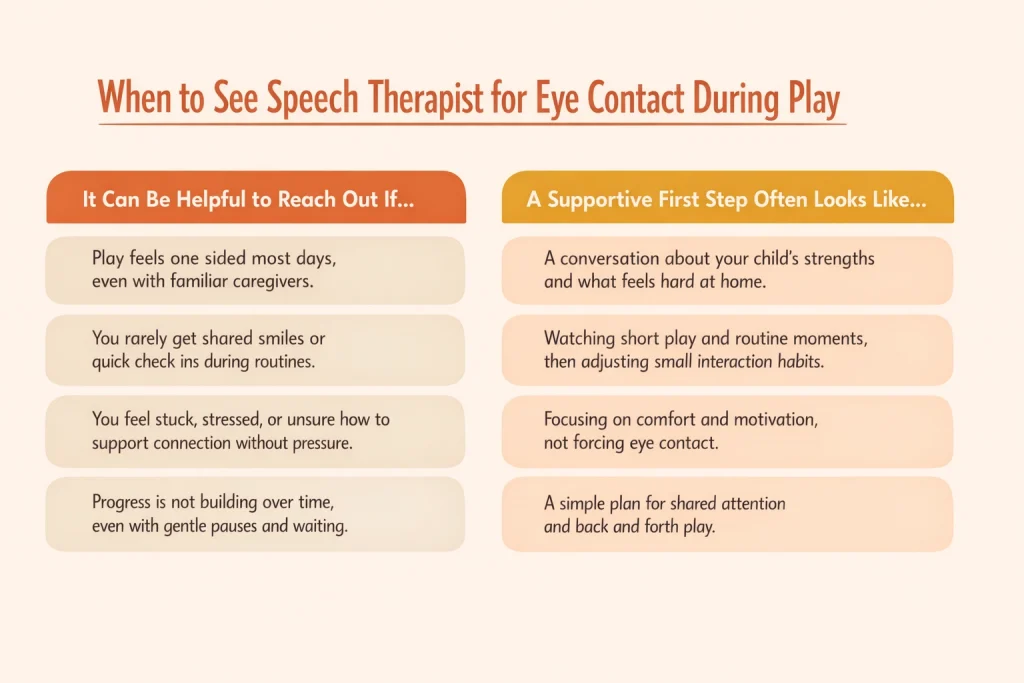
This is not about forcing eye contact. A supportive therapist focuses on comfort, trust, and motivation. The goal is more shared moments, not longer staring.
Learn More: How Children Learn To Look Back and Forth Between a Toy and Your Face
When to see speech therapist for eye contact: gentle reasons families reach out
Some parents wait because they think, “My child is talking, so we probably do not need speech therapy.” Others worry they will be judged for bringing up something that feels subtle. In real life, families reach out for many calm, practical reasons.
- You might consider an evaluation or a few coaching sessions if:
- Connection feels one sided most of the time
- You are working hard to get your child to notice you during play, and it is not getting easier
- Eye contact is very rare even with familiar caregivers, not just with strangers
- Your child enjoys activities, but does not often share the enjoyment with you through a glance or smile
- Routines like feeding, dressing, or bath feel rushed because your child is hard to engage
- You are avoiding playdates or family gatherings because it feels stressful to explain your child’s interaction style
- You have tried gentle “pause and wait” moments and you are not seeing more natural check ins over time
- You want support with how to encourage eye contact without turning it into “Look at me”
Another valid reason is simply your own experience as a parent. If you feel stuck, or if you find yourself getting tense during play because you are watching for a look, that is a good enough reason to ask for help. Support can be as much for your confidence as for your child’s skill building.
A speech therapist can also help you sort out what is typical temperament. Some children are naturally more observant and quiet. Others are more object focused. A good clinician will respect your child’s style while helping you find more comfortable ways to connect.
What to bring up at an appointment (so you do not have to “prove” anything)
Many parents worry they will not describe it “correctly.” You do not need perfect language. What helps most is a clear picture of daily life.
Consider sharing:
A couple of specific moments that feel hard, like “during blocks he stays focused on the pieces and does not look up”
Times when connection is easier, like “she looks more during songs” or “bath time is better”
What you have already tried, especially gentle strategies like pausing, getting at eye level, or using playful anticipation
Whether the challenge shows up across settings, such as home, daycare, or with relatives
How you feel during play, because your stress level matters too
If you can, a short video clip of everyday play can be useful. Not a “best performance” clip. Just a normal moment. Many therapists can learn more from 30 seconds of real life than from a long description.
It is also okay to say, “I am not sure if this is a problem. I just want to support connection.” That sentence alone sets the tone for a respectful conversation.
Also Read: My Child Look at My Mouth but Not My Eyes
What a supportive speech therapy approach usually looks like (no pressure, no forcing)
Parents sometimes imagine therapy as someone sitting across from their child asking for eye contact on command. That is not what good support looks like for most toddlers.
A relationship based approach is usually playful and practical. It may include:
- Following your child’s interests so they have a reason to “share the moment”
- Using small pauses in familiar routines so your child has time to look up
- Making it easier to notice faces by getting at eye level and keeping your expression warm and simple
- Responding right away when a glance happens, so your child learns that looking leads to connection
- Helping you find language that feels natural, so you are commenting and connecting rather than quizzing
Therapy can also help you troubleshoot the real world pieces that get in the way. Busy rooms, screens in the background, siblings needing attention, end of day fatigue, or a child who gets overwhelmed by too much talking or too much excitement. None of those are parenting failures. They are just context.
If your child is very active or very focused on objects, a therapist may help you build more “face checks” into play without interrupting the fun. The goal is not to pull your child away from toys. It is to help them include you in the experience.
Questions to ask so you feel confident choosing the right support
Not every therapist is the right fit for every family. You are allowed to ask questions that help you feel comfortable.
Here are a few that often lead to helpful answers:
- “How do you support eye contact and shared attention without pressuring a child?”
- “What would progress look like in the first month or two?”
- “How will you involve me, so I can use the same approach during eye contact during routines like meals or dressing?”
- “Do you offer coaching that fits into our day, or is it mostly clinic based activities?”
- “How do you adapt if my child is shy, very active, or gets upset when asked to perform?”
You can also ask what they will measure. A thoughtful therapist might talk about increased glances, more shared smiles, more back and forth moments, and fewer prompts needed. Those are practical outcomes that match real life.
If you leave a first visit feeling blamed, rushed, or pushed to demand compliance, it is okay to look for a different provider. Support should feel respectful and doable.
A gentle closing note: you are allowed to ask for help early
If you are still wondering when to see speech therapist for eye contact, here is a simple way to frame it. Reach out when you want play and routines to feel more connected, and you are not sure how to get there on your own. You do not have to wait until you feel desperate, and you do not have to convince anyone that your concern is “big enough.”
Many children build eye contact during play gradually, especially when adults use warm pauses and respond to small glances. If progress is slow or inconsistent, a few sessions of support can give you a plan that fits your child’s personality.
In the final third of this conversation, it is also okay to name a question some parents hold quietly. If concerns persist, some families consider developmental screening to better understand communication delays or possible autism-related differences. That is not a conclusion, it is simply one way to gather more information and support your next steps.
Most of all, remember what you are really aiming for. Connection. Shared smiles. Little check ins that say, “I see you.” And if you decide when to see speech therapist for eye contact is now, you are making a thoughtful, caring choice.
About the Author:
Shravanaveena Gajula
M.Sc ., Speech and Language Pathology (5+ years of experience)
Shravanaveena Gajula is a dedicated Speech-Language Pathologist with a BASLP and an M.Sc in Speech and Language Pathology. With experience spanning multiple settings, including Wellness Hub , Veena specializes in a wide range of disorders from developmental issues in children to speech and language assessments in adults. Her expertise includes parent counseling, managing speech sound and fluency disorders, and creating individualized therapy programs. Veena is also PROMPT certified and an author of several insightful blogs on speech and language pathology, aiming to educate and assist caregivers in supporting their loved ones.
Book your Free Consultation Today
Parent/Caregiver Info:
Client’s Details:
* Error Message