What Questions for Kids: A Simple Guide to Teaching “What” Questions at Home
By Wellness Hub
Last Updated: December 18, 2025
“What is this?”
“What are they doing?”
If your child understands these questions—or is starting to answer them—you’re seeing an important step in language development.
What questions for kids are often the first WH questions children learn. They help children name objects, understand actions, follow instructions, and build meaningful sentences. Strong “what” question skills support vocabulary growth, listening, and everyday communication at home and school.
This simple guide explains what “what” questions are, why they matter in early childhood learning, and how parents can teach them at home using pictures, examples, and printable pdfs. Whether your child is a toddler, preschooler, or has a speech delay or autism, this guide will help you build strong language skills step by step.
What Are “What” Questions in Early Childhood Learning?
What questions are simple questions that ask a child to identify, name, or describe something. These questions usually focus on objects, actions, or situations that the child can see or experience. Examples include “What is this?”, “What are you doing?”, or “What is happening here?”
Why “What” Questions Are the Foundation of WH Questions
“What” questions are often the first WH questions children understand and answer. They are concrete, visual, and easier to process than questions like why or how. Because of this, speech therapists and educators use what questions for kids to build early language skills, attention, and comprehension before introducing more complex WH questions.
Mastering “what” questions helps children:
- Understand spoken language
- Link words to objects and actions
- Begin forming short phrases and sentences
These skills create a strong base for answering where, who, and when questions later.
Everyday Examples of “What” Questions
Parents and caregivers use what questions naturally throughout the day, often without realizing it:
- What is this? (pointing to a toy or food)
- What are you playing with?
- What is the dog doing?
- What do we use a spoon for?
These simple interactions support early language skills, encourage verbal responses, and help children make sense of their environment through meaningful communication.
At What Age Should Children Learn What Questions?
Children learn “what” questions gradually as their understanding, vocabulary, and attention skills grow. While every child develops at their own pace, there are clear age-based patterns that help parents know what to expect and how to support learning at home.
What Questions for Toddlers (2–3 Years)
At this stage, children are just beginning to understand and answer simple what questions related to familiar objects and routines.
Common skills at this age include:
- Pointing to objects when asked, “What is this?”
- Naming familiar items like food, toys, or animals
- Responding with single words or short labels
Examples:
- What is this? → “Ball”
- What is that? → “Dog”
Focus on:
- Real objects and pictures
- Repetition during daily routines
- Keeping questions short and concrete
These toddler WH questions build early vocabulary and help children connect words with meaning.
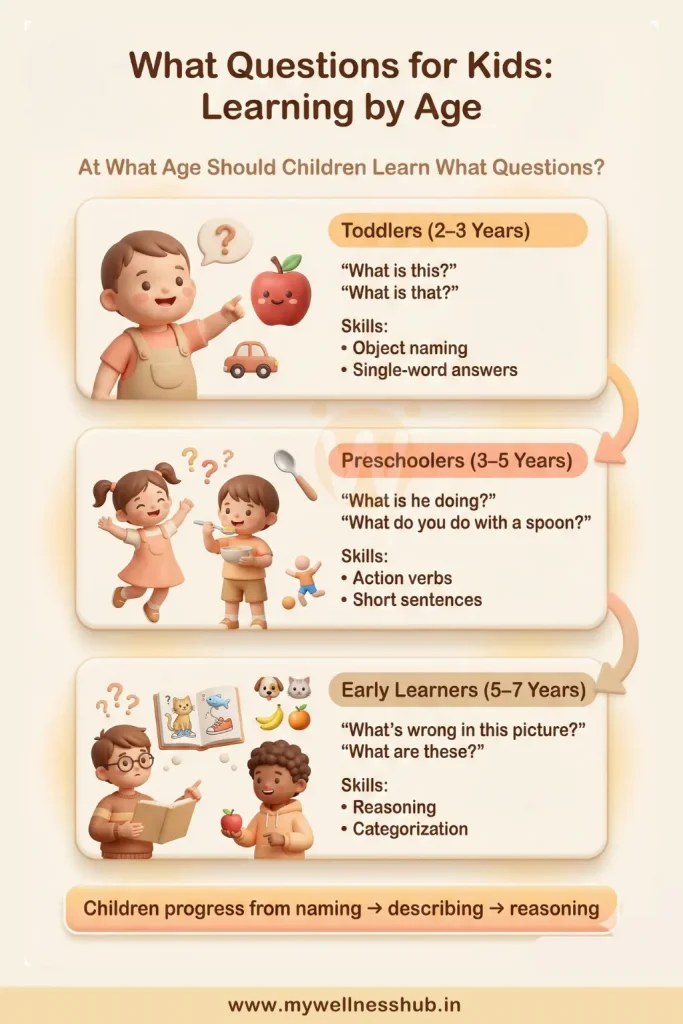
What Questions for Preschoolers (3–5 Years)
Preschoolers can answer what questions that involve actions, categories, and simple descriptions. Their responses become longer and more detailed.
Common skills at this age include:
- Naming actions in pictures
- Identifying object use
- Answering with short phrases or sentences
Examples:
- What is he doing? → “He is running.”
- What do you do with a spoon? → “Eat food.”
Focus on:
- Picture-based questions
- Action words and object use
- Encouraging full sentences
This stage supports preschool language development, sentence building, and classroom readiness.
What Questions for Early Learners (5–7 Years)
Early learners can handle more complex what questions that require reasoning, categorization, and explanation.
Common skills at this age include:
- Describing problems in pictures
- Identifying incorrect actions
- Grouping items by category
Examples:
- What’s wrong in this picture?
- What are these called? → “Vegetables.”
Focus on:
- Visual reasoning tasks
- Mixed question types
- Generalizing skills across settings
At this level, what questions by age move beyond naming and help strengthen comprehension, thinking skills, and expressive language.
Examples of What Questions for Kids (With Simple Answers)
Using examples of what questions for kids helps children understand how to listen, think, and respond correctly. Simple, clear questions with familiar words make learning easier—especially for toddlers, preschoolers, and children with speech delay or autism. Below are simple what questions with answers that parents and caregivers can use at home.
Object-Based What Questions
Object-based questions help children build vocabulary and improve object recognition.
- What is this?
This is a ball. - What is on the table?
A plate. - What do you see in the picture?
A cat. - What color is the car?
Red. - What is in your bag?
A book.
These what questions for kids support naming skills and early language development.
Action-Based What Questions
Action-based questions teach children to observe actions and use verbs in sentences.
- What is he doing?
He is running. - What is she doing?
She is eating. - What are they doing?
They are playing. - What is the dog doing?
The dog is sleeping. - What are you doing now?
I am drawing.
These examples of what questions help with verb usage, sentence building, and comprehension.
Daily Routine What Questions
Daily routine questions connect language learning to real-life situations.
- What do you do in the morning?
I brush my teeth. - What do we wear before going out?
Shoes. - What do you eat for breakfast?
Cereal. - What do we do at school?
We learn. - What do you do before sleeping?
I read a book.
These simple what questions with answers help children understand routines, follow instructions, and use language functionally.
Tip for Parents:
Start with short answers and model the correct response. As your child improves, encourage longer sentences to strengthen communication skills.
How to Teach What Questions Using Pictures
Using pictures is one of the most effective ways to teach what questions for kids, especially in early language learning. Pictures give children a clear visual clue, reduce confusion, and help them connect words with meaning. This approach works well for toddlers, preschoolers, and children with speech delay or autism.
1. Why Pictures Improve Comprehension
Pictures support visual learning for kids by showing information instead of only saying it. When children see an object or action, they can process the question faster and respond with more confidence. Visuals also help children stay focused, improve attention, and understand abstract language in a concrete way. This is why what questions with pictures are widely used in speech therapy and early learning activities.
2. Point–Ask–Answer Strategy
The point–ask–answer method keeps learning simple and structured.
First, point to the picture and name it clearly.
Next, ask a simple question like, “What is this?” or “What are they doing?”
Then, answer the question yourself if needed and encourage your child to repeat or respond.
This strategy models correct language and teaches children how to listen, think, and respond to what questions step by step.
3. Repetition and Consistency
Children learn best through repetition. Ask the same what questions with pictures multiple times across different days and settings. Use similar images, familiar objects, and everyday actions to build confidence. Consistent practice helps children remember words, understand sentence patterns, and use what questions naturally during daily routines.
Teaching what questions using pictures creates a strong foundation for language development. With visual support, clear questioning, and regular practice, children can build vocabulary, comprehension, and communication skills at their own pace.
Printable What Question PDFs for Kids
Printable what question pdfs make it easier for children to practice language skills in a clear, structured way. These pdfs give children repeated exposure to objects, actions, and everyday situations, helping them understand and answer “what” questions with confidence.
Benefits of Printable What Question PDFS
Printable what question pdfs for kids support learning by:
- Building vocabulary through picture-based questions
- Improving listening and comprehension skills
- Encouraging complete sentence responses
- Reducing guessing by offering clear visual cues
- Allowing repeated practice without pressure
Because children can see the question and the image together, printable pdfs help strengthen understanding and recall.
Home Practice vs Therapy Use
Printable what questions work well for both home practice and therapy sessions.
- At home, parents can use pdfs during short practice times, daily routines, or play-based learning.
- In therapy settings, structured what question pdfs help therapists target specific goals such as object identification, action verbs, and sentence formation.
This flexibility makes printables useful for consistent practice across environments.
Independent Learning Support
Printable pdfs also promote independent learning. Children can point, name, or say answers with minimal support, building confidence and self-correction skills. Over time, this independence helps children answer “what” questions more naturally in real-life conversations.
Using printable what question worksheets regularly helps reinforce language skills, making learning simple, visual, and effective for young learners.
Types of What Question PDFs for Kids
Structured what question pdfs for kids help children learn to answer questions in a clear, predictable, and visual way. These pdfs focus on common language areas such as actions, objects, places, and categories, making them ideal for home practice, classrooms, and speech therapy sessions.
Using consistent formats and pictures, what questions pdfs support vocabulary development, sentence formation, and comprehension—especially for toddlers, preschoolers, and children with speech delay or autism.
Table: What Question PDFs for Kids
| What Question Type | Focus Area | Download PDF |
|---|---|---|
| What’s Wrong? (Picture) | Visual reasoning & problem identification | Download “What’s Wrong?” PDF |
| What Do You Do at the…? | Daily routines & places | Get daily routine PDF |
| What Do You Do With…? | Object use & functional language | Download object-use PDF |
| What Are They Doing? | Action verbs & sentence building | Get action verbs PDF |
| What Are They Doing? (Mixed) | Mixed actions & generalization | Download mixed actions PDF |
| What is It Doing? | Object and animal actions | Get “It is doing” PDF |
| What is She Doing? | Gender-based sentence clarity | Download “She is doing” PDF |
| What Is He Doing? | Pronoun + action usage | Get “He is doing” PDF |
| What Are These/Those? (Vegetables) | Plurals & categories | Download vegetables PDF |
| What Are These/Those? (Toys) | Object naming & grammar | Get toys PDF |
| What Are These/Those? (School Items) | Classroom vocabulary | Download school items PDF |
| What Are These/Those? (Household Items) | Functional home vocabulary | Get household items PDF |
| What Are These/Those? (Animals) | Animal categories | Download animals PDF |
| What Are These/Those? (Fruits) | Food vocabulary | Get fruits PDF |
| What Is This/That? (Home) | Singular objects at home | Download home objects PDF |
| What Is This/That? (School) | School-based object naming | Get school objects PDF |
| What Is This/That? (Fruits) | Food identification | Download fruits PDF |
| What Is This/That? (Vegetables) | Category learning | Get vegetables PDF |
| What Is This/That? (Toys) | Play-based vocabulary | Download toys PDF |
| What Is This/That? (Animals) | Animal recognition | Get animals PDF |
Teaching What Questions at Home: Step-by-Step Strategy
Teaching what questions at home works best when learning feels natural, simple, and part of everyday routines. Parents do not need special training or long practice sessions. Short, consistent parent-led speech activities can help children understand and answer “what” questions with confidence.
1. Start With Real Objects
Begin by using objects your child sees and touches every day. Real items help children connect words with meaning and reduce confusion.
- Use household items like cups, toys, fruits, clothes, or books
- Hold up one object and ask, “What is this?”
- Wait patiently and allow time for your child to respond
- If needed, give a choice: “Is this a ball or a car?”
This step builds object recognition, vocabulary, and attention; all essential for learning what questions for kids.
2. Model Answers Clearly
Children learn language by hearing it repeatedly. Modeling correct answers helps them understand how to respond.
- Ask the question and answer it yourself if the child does not respond
- “What is this? This is a spoon.”
- Keep answers short and clear
- Repeat the same question across different days and situations
Modeling supports sentence structure, listening skills, and early language development, especially for children with speech delay or autism.
3. Encourage Verbal Responses
Once your child starts understanding the question, gently encourage spoken responses without pressure.
- Pause before helping to allow thinking time
- Accept single-word answers at first
- Expand their response naturally
- Child: “Car”
- Adult: “Yes, it is a red car.”
Praise effort, not perfection. Positive reinforcement helps children feel confident and motivates them to communicate more.
By starting with real objects, modeling answers, and encouraging verbal responses, parents can successfully practice teaching what questions at home in a calm, supportive way. These simple parent-led speech activities lay a strong foundation for vocabulary, comprehension, and everyday communication.
What Questions for Children with Speech Delay or Autism
Children with speech delay or autism often find WH questions challenging because they require listening, processing, and responding at the same time. Teaching what questions for children with autism works best when learning is structured, visual, and repetitive, rather than conversational or abstract.
1. Why Structure Matters
Children with speech delay or autism learn better when expectations are clear and predictable. A structured approach breaks down WH questions into small, manageable steps. Instead of open-ended questioning, children are guided to look, think, and respond. This reduces frustration and helps build confidence. Structured what questions speech therapy activities also improve attention, comprehension, and response accuracy.
2. Visual + Repetition Approach
Visual supports play a key role when teaching what questions autism strategies. Pictures help children connect words to meaning. Asking the same type of question repeatedly using different images allows children to recognize patterns. Over time, repetition strengthens understanding and helps children answer WH questions for speech delay more independently. Visual learning also supports children who struggle with auditory processing.
3. Focus on Functional Communication
The goal of teaching what questions is not memorization, but real-life communication. Functional questions focus on everyday objects, actions, and routines such as food, toys, people, and daily activities. When children practice meaningful what questions, they learn how to communicate needs, describe what they see, and participate in simple conversations at home and school.
With consistent practice, visual supports, and functional examples, what questions for kids with speech delay or autism can become an effective tool for building understanding, confidence, and expressive language skills.
Common Mistakes Parents Make When Teaching What Questions
Teaching what questions for kids can be very effective when done the right way. However, many parents unknowingly make small mistakes that can slow down language progress. Understanding these common errors can help you support your child’s WH question development more confidently at home.
Asking Abstract “What” Questions Too Early
One of the most common mistakes is asking abstract or imaginary questions before a child is ready. Questions like “What do you think will happen next?” require advanced thinking and language skills. Young children and toddlers need concrete, visible information first.
Start with simple what questions using real objects or pictures, such as “What is this?” or “What is she doing?” This approach supports early language skills, improves comprehension, and builds a strong foundation for more complex WH questions later.
Skipping Modeling the Correct Answer
Many parents ask a question and wait silently for an answer, even when the child does not yet know how to respond. This can lead to frustration or guessing. Modeling is essential when teaching what questions in speech therapy and at home.
If your child does not answer, say the answer clearly and encourage repetition. For example:
“What is this? This is a ball.”
Modeling helps children learn sentence structure, vocabulary, and correct responses through repetition.
Overloading the Child With Too Many Questions
Asking too many questions at once can overwhelm a child, especially children with speech delay or autism. Rapid questioning reduces focus and makes it harder for the child to process and respond.
Limit practice to one what question at a time, use visual support, and keep sessions short. Consistent, slow-paced practice leads to better understanding and stronger functional communication skills.
Helping Kids Master What Questions Confidently
Helping children learn what questions takes time, patience, and the right approach. Consistent practice in everyday situations helps children understand what is being asked and respond with confidence. Asking simple what questions for kids during play, meals, and daily routines builds natural communication skills without pressure.
Visual support plays a key role in learning. Using pictures, real objects, and visual worksheets makes abstract language easier to understand, especially for toddlers, preschoolers, and children with speech delay or autism. Visual cues improve attention, comprehension, and accurate responses.
Most importantly, structured practice helps children succeed. Predictable question formats, repeated exposure, and age-appropriate what question worksheets strengthen vocabulary, listening skills, and sentence formation. When parents combine consistency, visual learning, and structured activities, children develop strong foundations in WH questions and everyday communication skills that support classroom readiness and long-term language growth.
Frequently Asked Questions
1. What are “what” questions for kids?
What questions for kids are simple WH questions that ask a child to identify objects, actions, or situations. Examples include “What is this?” and “What are they doing?”. These questions help children build vocabulary, understanding, and sentence skills.
2. Why are what questions important for language development?
Teaching what questions improves vocabulary, listening skills, and comprehension. They help children connect words with objects and actions, which supports early communication and school readiness.
3. At what age should children learn what questions?
Most children begin responding to what questions between 2 and 3 years. By preschool age (3–5 years), children usually answer object- and action-based what questions more consistently.
4. How can parents teach what questions at home?
Parents can teach what questions at home by using real objects, pictures, and daily routines. Asking simple questions, modeling answers, and repeating the same question patterns helps children learn faster.
5. Are what questions suitable for toddlers?
Yes. What questions for toddlers should be simple and concrete, such as naming familiar objects or actions. Visual support and short answers work best at this stage.
6. How do pictures help children answer what questions?
What questions with pictures support visual learning. Pictures make it easier for children to understand the question, stay focused, and choose the correct answer, especially for young learners and visual processors.
7. Can what questions help children with speech delay?
Yes. What questions for speech delay focus on functional language and predictable patterns. Structured practice helps children process language, build confidence, and improve expressive skills.
8. Are what questions helpful for children with autism?
Yes. What questions for autism work best when they are visual, structured, and repeated. Picture-based pdfs and clear routines support comprehension and reduce confusion.
9. What are printable what question pdf?
Printable what question pdfs are structured activities that help children practice identifying objects, actions, and categories. They are useful for home practice, therapy sessions, and independent learning.
10. What mistakes should parents avoid when teaching what questions?
Common mistakes include asking abstract questions too early, skipping modeling, and asking too many questions at once. Children learn best when what questions are simple, visual, and repeated regularly.
Book your Free Consultation Today
Parent/Caregiver Info:
Client’s Details:
* Error Message