What Joint Attention Looks Like at Home Small Signs You Might Be Missing
By Wellness Hub
Last Updated: January 28, 2026
If you’ve ever found yourself watching your child play and thinking, “Are we actually connecting right now?” you’re not alone. Many parents picture joint attention as a big, obvious moment: your child points, you look, they look back, you both smile, and it’s clear you’re sharing the same experience.
But at home, joint attention often starts much smaller than that.
It can look like a quick glance that lasts half a second. A tiny “check-in” look while they’re busy. A shared smile that seems to say, “Did you see that?” These moments are easy to miss, especially when you’re tired, distracted, or comparing your child’s play to what you think it “should” look like.
This article is here to help you notice the early signs that joint attention is emerging, so you can feel more confident tracking progress in everyday life—without pressure, testing, or constant second-guessing.
What joint attention really means (in real life)
Joint attention is your child’s growing ability to share focus with you—on an object, an event, or something happening around them. It includes things like following your gaze, noticing where you point, shifting attention between you and something interesting, and sharing interest in what you’re both seeing.
At its heart, joint attention is about connection. It’s the feeling of, “We’re in this moment together.” And that can happen in very quiet ways. It also helps build early communication skills, because your child is learning that your attention and their attention can meet in the same place. Over time, those shared moments can support social interaction, emotional connection, and the simple joy of feeling understood.
Why parents often miss the early signs
A lot of us are looking for proof. Something clear enough that we can confidently say, “Yes—there it is.” But early joint attention isn’t usually consistent, polished, or predictable.
It may show up more when your child is calm than when they’re excited. It may happen during a favorite routine but disappear when the environment changes. And it may be so brief that you only notice it later, when you replay the moment in your head.
That doesn’t mean it “didn’t count.” Early joint attention is often made of tiny pieces that gradually add up.
Small signs of joint attention you might be missing
The quick glance that seems like nothing
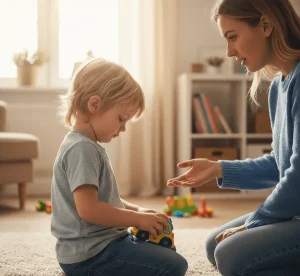
Your child is playing with a toy, and for a split second they look toward your face—then go right back to what they were doing. It’s easy to assume they were just scanning the room.
But that quick glance can be a meaningful check-in. It can be your child’s way of making sure you’re still there, or quietly sharing the moment without needing to stop playing.
The “look–thing–look” pattern (even if it’s subtle)
Sometimes joint attention looks like your child noticing something interesting, looking toward you briefly, and then returning to the object. Or the other way around: they look at you, then look at the toy, as if inviting you into what they’re doing.
It doesn’t have to be dramatic. It might happen while they’re stacking blocks, flipping through a book, or watching something outside the window. The important part is the shifting—your child is beginning to move attention between you and what interests them.
Following your gaze without making it obvious
Parents often expect that if they look at something, their child will turn their head in a clear, unmistakable way.
In real life, it might be smaller. You look toward the dog walking by, and your child’s eyes flick in the same direction. You glance at a picture in a book, and they pause and look there too. Sometimes it’s less of a “turn” and more of a quiet noticing.
Noticing your pointing (even if they don’t point back)
Joint attention includes following pointing, but early on, your child might not respond with a big head turn or a point of their own. They might simply look toward what you indicated for a moment, then continue what they were doing.
If you point out something across the room and your child’s attention shifts, even briefly, that’s a meaningful sign that they’re starting to connect your gesture with something in the environment.
Shared smiles that happen “around” something
One of the sweetest early signs is when your child smiles at you in a moment that feels connected to what’s happening, like a toy does something funny, bubbles float by, or a snack surprises them.
That shared smile can be a form of emotional joint attention: your child is not only noticing something, but also sharing the feeling of it with you. It’s a quiet way of saying, “This is fun,” or “Did you see that?”
Checking back with you during play
Some children “check back” with a look when something changes: a toy gets stuck, something makes a sound, or they’re unsure what happens next. Even if they don’t ask for help, that glance can be a sign they’re beginning to include you in their experience.
It’s not about dependence. It’s about connection, your child is learning that you’re part of the moment, not just nearby.
What progress often looks like over time
Joint attention usually grows in a gradual, uneven way. You might notice it appearing more often during certain activities, like reading together, snack time, bath time, or watching something outside. Then it may seem to “disappear” for a while when your child is tired, overstimulated, or focused on something new.
Progress might look like your child looking where you point more often, or shifting attention between you and an object more naturally. You may notice more shared smiles, more moments where they seem curious about what you’re looking at, or more little “check-ins” during play.
And sometimes progress is simply that the moments feel easier. Less forced. More like you’re naturally sharing the day.
A gentle reminder about comparison
It’s hard not to compare—especially when other children seem to do these things in big, obvious ways. But joint attention doesn’t have one “right” look.
Some children are expressive and outward with their attention. Others are quieter and more internal. A child who doesn’t point dramatically may still be sharing focus through glances, body orientation, or the way they bring an object closer to you. The goal isn’t to chase a specific performance. It’s to notice the growing connection.
If you’re seeing small moments—brief looks, shared smiles, attention shifts—those are real signs of learning.
How to support joint attention without turning it into a test
Most children build joint attention best when it’s part of warm, everyday life—not something they’re asked to “do.” Simple moments like looking at a picture together, noticing something outside, or sharing a small surprise during play can create natural opportunities for shared focus.
Many parents find it helpful to slow down just a little in those moments—giving their child time to notice what they’re noticing, and responding warmly when connection happens. The tone matters more than the technique. Joint attention grows through repeated, low-pressure experiences of “we’re sharing this.”
If you’d like extra support, tools like BASICS can help parents recognize goals like joint attention and understand what progress can look like at home, using short, everyday examples. It’s not something you need just an option if you want a little more clarity and structure.
When it might help to get extra guidance
Sometimes parents simply want reassurance that they’re noticing the right things, or they want ideas that fit their child’s personality and daily routines. Getting support doesn’t mean something is wrong. It can just mean you want a clearer path and someone to think it through with you.
If you feel stuck, unsure what counts as progress, or like you’re working hard but not seeing change over time, it’s okay to reach out for professional guidance or a structured home-based support plan.
The takeaway: tiny moments are still real moments
Joint attention isn’t only the big “look at that!” moments. It’s the small, easy-to-miss signs that your child is beginning to share their world with you—one glance, one smile, one check-in at a time.
When you start noticing those tiny wins, something shifts. You stop waiting for a dramatic milestone and begin seeing the quiet progress that’s already happening. And that confidence, your ability to recognize connection as it grows, can make everyday life feel a little lighter, a little warmer, and a lot more hopeful.
Book your Free Consultation Today
Parent/Caregiver Info:
Client’s Details:
* Error Message