10+ Simple Home Activities That Build Turn-Taking (No Prep, No Pressure)
By Wellness Hub
Last Updated: March 3, 2026
Turn-taking can sound like a “big” social skill, but at home it often starts in the smallest ways: a quick back-and-forth sound, a shared giggle over a block tower, a pause before you hand something over.
If you’ve been wondering how to help your child practice turn-taking through simple turn-taking activities at home without setting up a game night or buying anything new, you’re in the right place. The truth is, many of the best turn-taking moments are already hiding inside what you do every day. And they don’t have to be long. A few warm, playful exchanges, three to five back-and-forths, absolutely count.
This is an idea bank, not a checklist. Pick what fits your child’s mood and your day, and let “good enough” be the goal.
Also read: My Child Won’t Take Turns During Play Is That Normal?
What turn-taking activities at home really look like
When parents picture turn-taking, they often imagine a child patiently waiting while someone else plays. That can be part of it, but early turn-taking is usually much simpler and much more relational.
At home, turn-taking can include vocal turn-taking (you make a sound, your child responds), toy turn-taking (you each get a moment with the same object), rolling something back and forth, waiting briefly, and staying in the exchange for a few rounds. It’s less about perfect sharing and more about learning the rhythm of “me, then you” in a way that feels safe and fun.
If your child grabs, protests, or wanders off after one turn, that doesn’t mean it isn’t working. It often means the skill is still growing and that your child is learning through real life, not a scripted lesson.
Turn-taking can sound like a “big” social skill, but at home it often starts in the smallest ways: a quick back-and-forth sound, a shared giggle over a block tower, a pause before you hand something over.
If you’ve been wondering how to help your child practice turn-taking through simple turn-taking activities at home without setting up a game night or buying anything new, you’re in the right place. The truth is, many of the best turn-taking moments are already hiding inside what you do every day. And they don’t have to be long. A few warm, playful exchanges, three to five back-and-forths, absolutely count.
This is an idea bank, not a checklist. Pick what fits your child’s mood and your day, and let “good enough” be the goal.
Read more: How to Teach Turn-Taking Without Power Struggles or Forced Sharing
What turn-taking activities at home really look like
When parents picture turn-taking, they often imagine a child patiently waiting while someone else plays. That can be part of it, but early turn-taking is usually much simpler and much more relational.
At home, turn-taking can include vocal turn-taking (you make a sound, your child responds), toy turn-taking (you each get a moment with the same object), rolling something back and forth, waiting briefly, and staying in the exchange for a few rounds. It’s less about perfect sharing and more about learning the rhythm of “me, then you” in a way that feels safe and fun.
If your child grabs, protests, or wanders off after one turn, that doesn’t mean it isn’t working. It often means the skill is still growing and that your child is learning through real life, not a scripted lesson.
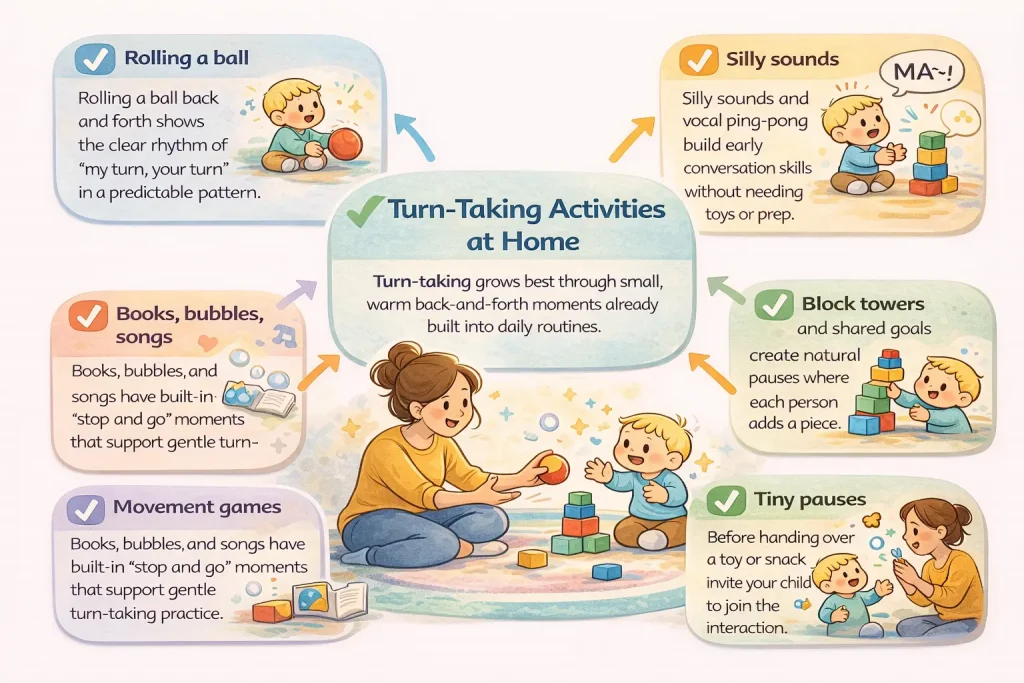
10+ no-prep activities that naturally build turn-taking
Rolling ball turns
A simple roll across the floor is one of the clearest ways to show “back to you, back to me.” What makes it powerful isn’t the ball, it’s the shared attention and the predictable pattern. Even a couple of rolls can be a meaningful turn-taking moment.
Vocal ping-pong
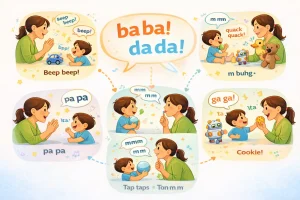
Some days, the easiest “toy” is your voice. A silly sound, a hum, a whisper, an animal noise, anything your child enjoys. When your child responds (even with a look, a grin, or a new sound), you’ve started a back-and-forth. These tiny sound exchanges are early conversation practice in disguise.
Block tower turns
Block play naturally invites turns because there’s a shared goal: building something together. One person adds a block, then the other. If your child prefers to do it all, you can still be part of the rhythm by being the “helper” who gets a moment too. The point is the shared experience, not the tallest tower.
Turn-taking with a favorite toy
A beloved toy can be tricky because it feels important to your child. That’s okay. Turn-taking here might be very brief just a moment of “my turn, your turn” with lots of warmth. For some children, it helps when the turn is about a small action (like pushing a button or making the toy jump) rather than giving up the toy for long.
Toy exchange routine
This is the gentle cousin of “sharing.” Instead of focusing on giving something up, the focus is on the friendly exchange: you offer, your child offers, and the interaction stays light. Many families find this works best when the items are similar in value (two cars, two cups) so it doesn’t feel like a loss.
Action turn-taking (clap, tap, jump)
If your child isn’t interested in toys at that moment, movement can be a great bridge. A clap, a stomp, a jump, a spin, then a pause that invites your child to take a turn. Action games often feel easier because there’s nothing to “hand over,” just a shared pattern and a shared laugh.
Gesture turn-taking (point, show, give)
Turn-taking isn’t only about objects, it’s also about attention. “You show me, then I show you” can happen with pointing at a picture, holding up something interesting, or bringing an item to the other person. These moments build the idea that interaction goes both ways.
Book page-turn turns
Books are full of built-in turns: you read, your child points; you comment, your child flips a page. Many children love being in charge of page turning, and that’s a perfectly valid “turn.” If your child closes the book after two pages, that can still be a successful mini-exchange.
Snack-time turn routine
Snack time already has a natural rhythm: offer, receive, pause, repeat. Small moments like letting your child choose between two options, handing over one piece at a time, or taking turns with a “dip” or “pour” can create easy back-and-forth without making snacking feel like a task.
Pause-then-give moments
One of the simplest ways to support turn-taking is a tiny pause before you hand something over, bubbles, a toy, a crayon, a cup. That brief wait creates space for your child to look, reach, vocalize, or gesture. The pause isn’t a test. It’s just an invitation for your child to take their turn in the interaction.
Family circle turn game
If you have siblings or another adult around, a simple “around the circle” routine can make turn-taking feel social and fun. This might be passing a soft toy, taking turns making a funny sound, or doing one action each. The group energy can help some children stay in the exchange longer, especially when everyone keeps it relaxed.
Pause before pleasure (bubbles, chase, songs)
The most motivating activities often come with natural “start and stop” moments: bubbles need re-blowing, chase has a reset, songs have a pause before the next verse. Those little breaks can become gentle turn-taking opportunities, your child signals “again,” you respond, and the back-and-forth continues.
If turn-taking feels hard right now, you’re not doing anything wrong
Many children need time to feel comfortable with waiting, sharing space, or giving someone else a moment. And many parents are trying to support turn-taking while also managing real life at dinner, siblings, work, fatigue, and a child who may be very passionate about doing things their own way.
It can help to remember that turn-taking is not an obedience skill. It’s a relationship skill. It grows best when your child feels safe, understood, and successful in small doses. If your child only manages one exchange today, that’s still a starting point. If your child tolerates a tiny pause without melting down, that’s progress too. If your child comes back for “one more” tomorrow, you’re building something real.
What progress can look like often quieter than you expect
Turn-taking progress usually shows up in small shifts: your child waits a beat longer, brings an item to you, looks at your face during a pause, or stays for three or four back-and-forths instead of one. Some days will feel smooth, and other days your child may not be available for it at all. That up-and-down pattern is a normal part of learning.
The goal isn’t perfect sharing or long games. It’s growing comfortable with the rhythm of interaction, little moments of “we’re doing this together.”
When you want a little extra support
Some parents enjoy having a simple way to choose a goal and get ideas that fit daily life. Tools like BASICS can offer gentle guidance for building skills like turn-taking through short, everyday routines, without turning your home into a therapy space. It’s optional support, not a requirement.
A calm reminder to end on
Turn-taking is built in the ordinary: a page turned, a ball rolled, a sound copied, a snack offered, a pause shared. These are small moments, but they add up, because they’re really about connection.
If you try one idea and it flops, it doesn’t mean your child “can’t” take turns. It just means today needed something else. Keep it light, keep it warm, and trust that short, playful exchanges are meaningful practice, exactly as they are.
About the Author:
Rajini Darugupally
M.Sc., Speech-Language Pathologist (9+ years of experience)
Rajini is a passionate and dedicated Speech-Language Pathologist with over 9+ years of experience, specializing in both developmental speech and language disorders in children and rehabilitation in adults. Driven by a desire to empower each individual to find their voice, Rajini brings a wealth of experience and a warm, genuine approach to therapy. Currently, at Wellness Hub, she thrives in a team environment that values innovation, compassion, and achieving results for their clients. Connect with Rajini to learn more about how she can help you or your loved one find their voice.
Book your Free Consultation Today
Parent/Caregiver Info:
Client’s Details:
* Error Message