10+ Simple Home Activities That Encourage Your Child to Initiate Interaction With You
By Wellness Hub
Last Updated: February 11, 2026
Simple Home Activities That Help Your Child Initiate With You
Explore simple, everyday home activities that naturally invite your child to start interactions like bringing items, smiling, or calling you to play.
10+ Simple Home Activities That Encourage Your Child to Initiate Interaction With You
There’s a particular kind of moment many parents quietly hope for: your child looks up, smiles, and starts something with you. Maybe they bring you a toy without you asking. Maybe they call out from the next room just to see if you’ll come. Maybe they do that little “again!” look—before they even have the words. If your child tends to wait for you to begin, you’re not doing anything wrong. Initiating interaction is a skill that grows over time, and it often shows up in small, easy-to-miss ways first: a glance, a pause, a grin, a toy held out toward you. Those count. They’re your child’s way of saying, “Join me.”
This article is a simple menu of home activity ideas that can gently invite your child to initiate, without special tools, perfect timing, or turning your day into a project. No step-by-step directions here, just calm options you can weave into real life.
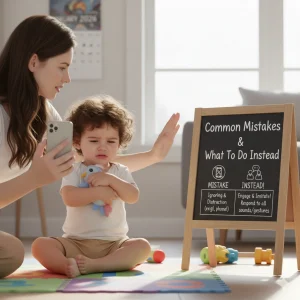
Read More: Common Mistakes That Can Quiet Babbling (And What to Do Instead)
What initiating interaction can look like at home
Initiating doesn’t have to mean using words. For many children, it starts with actions and expressions. You might notice your child initiating when they bring something to you for shared play, smile to start a familiar routine, call out to get you to come closer, or hand you an object as an invitation.
Over time, these moments often become more frequent and more confident, especially when your child learns that their “reach” toward you is noticed and welcomed.
A gentle mindset shift that helps: leave a little space
Many of these ideas have one thing in common: they create a small, comfortable pause where your child has a reason to start the interaction. Not a test. Not a demand. Just a natural opening.
If your child doesn’t jump in right away, that’s okay. Some children need extra time to notice the pause, decide what they want, and then act. Your calm presence and warm response matter more than how quickly they initiate.
10+ simple home activities that invite your child to start the interaction
1. Turn-Taking Tease and Pause
This is the classic “something fun is happening… and then it waits.” Think of any back-and-forth play your child already enjoys—stacking, dropping, pushing cars, tapping blocks, making silly sounds. When you briefly pause at a natural moment, it gives your child the chance to look at you, gesture, vocalize, or hand you something to get it going again. Many kids initiate best when they’re already enjoying themselves.
2. Hand-Over Toy Invitations
Some children are more likely to initiate when the invitation is physical and simple: a toy offered, a piece handed over, an object shared. Activities that naturally involve passing things back and forth—without making it a “lesson”—can make initiating feel easy. Often, the first “initiation” is just the hand reaching out with the item. Your warm, interested reaction is the payoff.
3. Bring It to Me Treasure Path
If your child likes moving around the house, you can lean into that. Choose moments where your child has something interesting. Pick anything from a toy to a household item they’re curious about, and create a playful expectation that it comes to you to be admired, opened, or used together. The goal isn’t to control what they bring, but to make “bringing it to you” feel like a natural next step in the fun.
4. Smile and Start Routine
Many children initiate through routines long before they initiate through play. Little repeated moments, like a familiar greeting, a silly face, a bedtime phrase, a “ready-set-go” before a lift, can become something your child starts with a smile, a look, or a body lean that says, “Do it.” When you notice those early cues and respond like they matter, routines become a safe place for initiation to grow.
5. Peek-Inside Surprise Bags
You don’t need fancy materials for this, just the idea of “something is in here.” A bag, a box, a pouch, even a pillowcase can hold a few familiar objects. The magic isn’t the surprise item; it’s the shared curiosity. Many kids will initiate by bringing the bag to you, pointing, reaching, or looking at you as if to say, “Open it.” It’s a simple way to encourage your child to recruit you into the moment.
6. Roll-to-Start Ball Game
Ball play is naturally social because it doesn’t work as well alone. Even children who prefer independent play often enjoy the predictable rhythm of rolling something back and forth. The “start” of the game is where initiation can bloom: your child may bring the ball, place it near you, or look at you expectantly. Those are meaningful bids for connection, even if they’re quiet.
7. Calling Game with Distance
Some children initiate more when you’re not right next to them. A little distance—across the room, around a corner, from the hallway—can create a reason to call out, vocalize, or come find you. This can be especially natural during everyday moments when you’re both doing your own thing. When your child calls, you’re teaching them that their voice (or sound, or shout) can bring you back into connection.
8. Bring and Show Picture Cards (or Family Photos)
If your child enjoys looking at pictures, you can make “showing you” part of the experience. This could be a small book, printed photos, or pictures on your phone. Many children love being the one who chooses what to show. Initiation might look like them bringing the picture over, tapping it, holding it up, or pulling you closer to look. It’s a gentle way to help your child share attention with you, without needing a lot of words.
9. Stop–Start Routines with Props
Some of the strongest initiation happens in playful stop–start moments: bubbles that pause, a wind-up toy that “needs help,” a song that stops right before the best part, a blanket game that freezes. The prop is helpful, but the real driver is the pattern; your child learns that they can restart the fun by looking, gesturing, smiling, or bringing the item to you.
10. Initiation Through Helping
A surprising number of children initiate best when they feel useful. “Helping” can be as simple as carrying something, bringing you an item, or being the one who gets to hand something over. When helping becomes a shared moment instead of a chore, your child has a reason to approach you, check in, and start an interaction—often with a proud look that says, “I did it.”
11. Bring-to-Request in Daily Routines
Daily routines are full of natural opportunities for your child to initiate without anyone making it a big deal. A snack container that needs opening, a toy that needs winding, a marker with the cap on, shoes that need help—these moments can invite your child to bring the item to you as a clear, practical initiation. Over time, many children begin to seek you out more often because they’ve learned you’re a helpful, responsive partner.
What progress can look like even if it’s subtle
Initiating interaction often grows quietly. You might notice your child brings you toys more often, smiles to start a familiar game, calls for you from another room, or checks your face before continuing play. You may also notice more shared laughter—those easy, connected moments that feel like you’re on the same team.
And sometimes you may notice progress when your child initiates once, then not again for a while. That’s normal too. Skills don’t usually appear in a straight line.
If your child rarely initiates, you’re still building connection
Some children are naturally more observant, cautious, or independent in their play. Others are happy to interact but prefer you to take the lead. None of that reflects your bond or your effort as a parent. A helpful focus is simply noticing and warmly responding to the small initiations that are already there, because those responses teach your child that reaching out works, and it feels good.
If you’d like extra support choosing activities that fit your child and your day, tools like BASICS can offer gentle guidance and simple ideas to try at home, without pressure or perfection.
The big picture is this: initiating interaction is your child learning, in their own way, “I can start something with you, and you’ll meet me there.” And that’s a beautiful foundation for communication and connection.
About Author
Rajini Darugupally
Speech-Language Pathologist
Rajini is a passionate and dedicated Speech-Language Pathologist with over 9+ years of experience, specializing in both developmental speech and language disorders in children and rehabilitation in adults. Driven by a desire to empower each individual to find their voice, Rajini brings a wealth of experience and a warm, genuine approach to therapy. Currently, at Wellness Hub, she thrives in a team environment that values innovation, compassion, and achieving results for their clients.
Book your Free Consultation Today
Parent/Caregiver Info:
Client’s Details:
* Error Message