Signs Your Child Is Getting Closer to Imitating Sounds Even If They’re Not Copying Yet
By Rajini D
Last Updated: March 2, 2026
You make a silly “brrrr” sound. Or a squeal. Or a raspberry.
You pause, hoping your child will copy it back.
And when they don’t, it’s easy to wonder: Are we stuck? Are they not getting it? Should they be doing this by now?
If this has been on your mind, you’re in very good company. Many parents imagine sound imitation as a clear echo, where their child repeats exactly what they did, right away. But for many children, imitation does not arrive like a light switch. It builds quietly through small, easy-to-miss changes: a look, a pause, a new noise that was not there last week, or a moment that feels like they are almost joining in.
Those “almost” moments matter. They are often stepping stones toward coos, squeals, raspberries, animal-like sounds, and other playful vocalizations that become part of your back-and-forth connection.
If you’re looking for signs of sound imitation, they often show up before a clear “copy.”
Read more: The Best Times of Day to Try Playful Noises (Bath, Meals, Diaper Changes, and More)
Why imitation often shows up later than parents expect
Imitating sounds is not only about making a mouth movement. It is also about noticing you, staying engaged long enough to try, feeling comfortable experimenting, and learning the rhythm of “my turn, your turn.” That is a lot for a young child to coordinate, especially in busy and exciting everyday life.
So if your child is not copying yet, it does not automatically mean they are not learning. It may simply mean they are still building the pieces that make imitation feel doable and fun.
Signs of sound imitation your child is getting closer even without copying
These signs of sound imitation can be subtle, but they add up over time.
They watch your mouth more than they used to
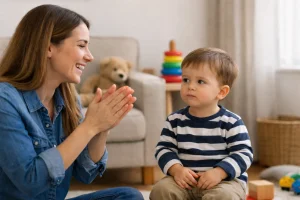
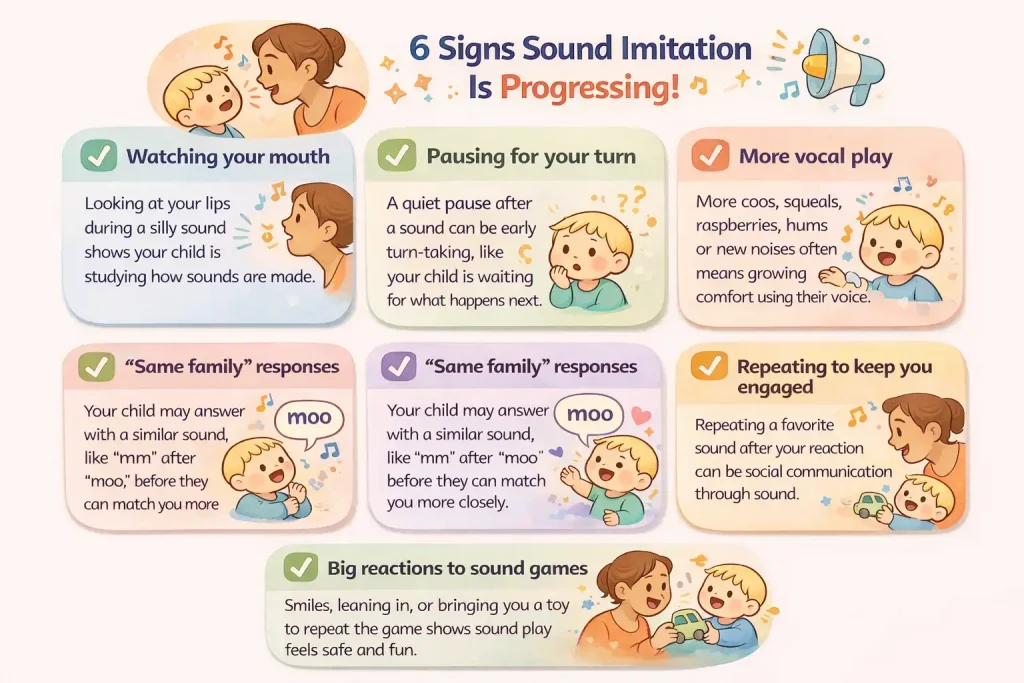
One of the earliest positive signs is visual attention. If your child starts looking at your mouth when you make a sound, especially during playful moments, this is meaningful progress. It suggests they are studying how sounds happen.
You might notice this when you lean in during play, sing a silly sound during bath time, or make an animal noise while reading. Even a quick glance can be a sign your child is collecting information and getting ready to try it themselves.
They pause like they’re waiting for something
Sometimes the biggest change is not a sound, it is a pause.
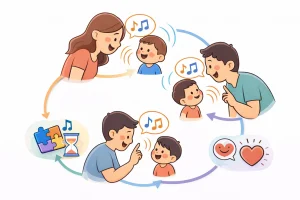
If your child makes a noise and then looks at you, or goes quiet and holds still for a moment, they may be experimenting with the idea of turn-taking. That little pause can be their way of saying, “Did you hear that?” or “What happens next?”
This is part of the rhythm of conversation. Long before children use words, they often learn that communication has a back-and-forth flow. A pause can be the beginning of that.
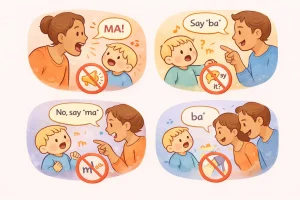
Also read: What Not to Do When Encouraging Sound Imitation (Common Mistakes Parents Make)
Their vocal play is increasing, even if it is not an “echo”
Parents often look for copying, but an important earlier step is simply using their voice more. If your child is cooing more often, squealing during excitement, trying out raspberries, humming, growling, or making new playful noises, that is not random. It is practice.
Think of it like warming up an instrument. The more comfortable your child feels making sounds, the easier it becomes to try matching yours later. Increased vocal play is often a sign that confidence is growing.
They experiment with new sounds after you make one
Imitation does not always look like a perfect copy. Sometimes it looks like a response in the same “sound family.”
You make a raspberry, and your child makes a breathy “puh” sound. You squeal, and they do a shorter, quieter version. You say “moo,” and they try “mm” or a small hum.
These are not failures. They are attempts. Many children start by approximating, trying something close, and then refine over time as they become more comfortable and more aware of how their mouth and voice can change.
They repeat their own sound to keep the interaction going
Another easy-to-miss sign is when your child discovers a sound they like and repeats it, especially if they seem to be doing it with you rather than just to themselves.
For example, they squeal, you smile, and then they squeal again, almost like they are replaying the moment. Or they make a funny noise, notice your reaction, and do it again to keep the connection going.
That is not just sound-making. That is social communication through sound, and it is a wonderful foundation for imitation.
They seem delighted by sound games, even if they stay quiet
Some children are enthusiastic observers before they become participants. If your child lights up when you do playful noises, smiling, leaning in, bouncing, widening their eyes, or bringing you a toy to “do it again,” that engagement counts.
Enjoyment is a powerful ingredient. When sound play feels safe and fun, children are more likely to take risks with their voice later.
They “answer” you with a look, a gesture, or a movement
Not every response is vocal at first. If you make a silly sound and your child responds by moving closer, offering a toy, touching your face, laughing, or making eye contact, they may be showing you they are connected and participating in the interaction in their own way.
Those responses help keep the back-and-forth going, which is exactly the space where imitation tends to grow.
What success can look like over time
As this skill develops, you may begin noticing more moments where your child’s sounds resemble yours during play. They might try coos, squeals, raspberries, or animal-like noises that feel like they belong to the same “game” you started. You may also see more frequent vocal turn-taking, where your child makes a sound, looks at you for your reaction, and the two of you build a tiny sound conversation.
Over time, some children begin combining sounds in new and creative ways, almost like they are inventing their own playful language. This is often how confidence shows up, not just in copying, but in experimenting.
When these signs of sound imitation keep showing up, it often means the skill is taking root.
Keep celebrating the signs of sound imitation, even when the copy is not exact yet.
How to support this gently in everyday life (without turning it into a test)
Most parents do not need more things to do. What helps most is a small shift in what you notice and how much pressure you remove.
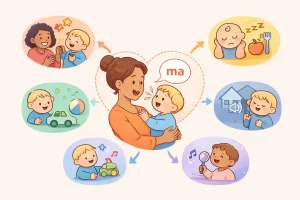
Sound imitation grows best in warm, face-to-face moments where your child can see you and feel your enjoyment. Routines like meals, diaper changes, bath time, getting dressed, or driving in the car often create natural pockets of connection. When playful sounds show up there, they tend to feel easy and repeatable.
It also helps to remember that waiting, just a little, can be surprisingly powerful. Many children need extra time to process what they heard and decide whether they want to try. If your child does not copy right away, it does not mean they did not understand. They may simply be taking it in.
And when your child makes any sound at all, whether it matches yours or not, your warm reaction matters. A smile, a gentle “I heard you!”, or shared laughter can make vocal play feel rewarding, which encourages more of it.
If you’re unsure what counts, revisiting the signs of sound imitation can help you notice progress sooner.
When you might want extra support
Sometimes parents feel unsure what counts as progress, or they want fresh ideas for keeping sound play light and enjoyable. If you find yourself second-guessing or feeling stuck, it can help to have a simple way to track skills and see what to focus on next.
Speech and Autism therapy appps like BASICS are designed to support parents with everyday communication goals through short videos and simple guidance, so you can feel more confident without turning your day into “practice time.” It is optional, but for many families, it is reassuring to have a clear path and a way to notice the small wins.
A calm reminder to take with you
If your child is not copying sounds yet, you are not behind, and your child is not “not trying.” Early imitation is often built from tiny steps: watching your mouth, pausing for your reaction, playing with new noises, and sharing small moments of back-and-forth joy.
Those steps are real progress.
If you keep seeing signs of sound imitation, you are building the foundation for clearer back-and-forth later.
And when you start noticing them, you may realize something important: your child may be closer than it look.
About the Author:
Rajini Darugupally
M.Sc., Speech-Language Pathologist (9+ years of experience)
Rajini is a passionate and dedicated Speech-Language Pathologist with over 9+ years of experience, specializing in both developmental speech and language disorders in children and rehabilitation in adults. Driven by a desire to empower each individual to find their voice, Rajini brings a wealth of experience and a warm, genuine approach to therapy. Currently, at Wellness Hub, she thrives in a team environment that values innovation, compassion, and achieving results for their clients. Connect with Rajini to learn more about how she can help you or your loved one find their voice.
Book your Free Consultation Today
Parent/Caregiver Info:
Client’s Details:
* Error Message