Signs Your Baby Is Getting Ready to Babble More Even If You’re Not Hearing Much Yet
By Wellness Hub
Last Updated: January 31, 2026
It’s a surprisingly common worry that you notice other babies make “ba-ba” and “da-da” sounds, and your baby is just quiet. Or maybe you hear a few little noises here and there, but not the steady stream of babbling you expected by now. If you’ve been wondering, “Are we making progress if there aren’t many sounds?”, this is for you. And you’re not behind for asking.
Babbling is one of those skills that often grows in small, easy-to-miss steps before it becomes obvious. Many babies show clear signs they’re getting ready to babble more long before parents hear lots of syllables. The trick is knowing what “early progress” can look like in real life, during play, routines, and those ordinary moments that make up your day.
Babbling doesn’t usually appear out of nowhere
When parents picture babbling, they often imagine the classic repeating sounds, “ba-ba-ba”or mixed sounds like “ba-da.” Those are real milestones, and they’re exciting. But for many babies, there’s a warm-up period first.
Think of it like your baby is learning that sounds can be part of connection. Before the bigger babbles show up, you may see your baby becoming more socially tuned-in, more playful, and more interested in back-and-forth moments. Those are meaningful signs, even if the sounds themselves are still small. Babbling during play and social interaction isn’t just about making noise. It’s about your baby discovering, “When I do something, look, smile, make a sound, my parents respond.” That feeling of being “in it together” is often what fuels more vocal experimenting later.
We’re not hearing much yet —what progress can look like anyway
If your baby isn’t babbling much right now, it can help to widen the definition of progress. Early communication growth is often subtle, and it doesn’t always sound like syllables at first.
Here are a few gentle signs many parents notice before babbling becomes frequent and clear.
Your baby is watching your face more closely
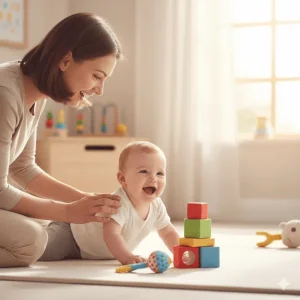
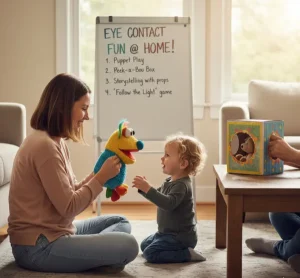
One of the earliest “green lights” is increased eye contact and face-watching during play. You might notice your baby studying your mouth when you talk, pausing to look at you when you sing, or checking your expression during a familiar routine.
This matters because babbling is social. Babies often babble more when they’re engaged with a person, not just a toy. When your baby starts seeking your face, they’re showing you that you’re part of the play, and that connection is a powerful foundation for more vocal play.
Read More: When Do Babies Start Babbling During Play? A Parent-Friendly Timeline
You’re seeing more excited facial expressions during interaction
Sometimes the biggest sign isn’t a sound; it’s the look right before it.
You might see your baby’s eyes widen, their eyebrows lift, or their whole face light up when you start a familiar game. Maybe they grin when you pause during a song, or they look thrilled when you appear during peekaboo. That excitement often signals, “I know this moment. I want you to keep going. I’m ready to participate.”
Babbling often grows in these playful routines because babies learn the rhythm of interaction: you do something, they react, you respond back. Even if their reaction is mostly facial right now, it’s still communication.
Your baby is making more attempts, even if they’re not clear syllables
Not all early vocal attempts sound like “ba” or “da.” Some babies start with breathy sounds, squeals, growls, soft coos, or little bursts of voice that come and go. Parents sometimes dismiss these as “just noises,” but these experiments are often part of the path toward more structured babbling.
You may notice your baby making sounds more often when they’re excited, when you’re close, or when you’re doing something they enjoy. That’s an important clue that they’re starting to connect sound with social energy.
And if you’re hearing any repetition at all, like little strings of sound, even if they’re not crisp consonants yet, that can be another early sign that more classic reduplicated babble (“ba-ba”) may be on the horizon.
Your baby pauses like they’re waiting for you to respond
This one can be easy to miss, but it’s a big deal.
During play, you might notice your baby makes a sound, then looks at you—almost like they’re checking what you’ll do next. Or they might vocalize, stop, and hold still for a beat, as if leaving space for your turn.
That pause for you is the beginning of back-and-forth communication. It’s the social shape of conversation, even before words. Babies who are starting to understand turn-taking often become more motivated to keep the exchange going, sometimes with more frequent babbling as they realize it works.
Sounds show up more during routines than during practice
Many parents try to listen carefully during quiet moments: “Say ‘ba’ for me!” And then… nothing.
But babbling often shows up when babies are relaxed and engaged, during bath time, diaper changes, feeding, or a familiar game where your baby already knows what’s coming. In those moments, your baby isn’t being asked to perform. They’re simply participating.
So if you’re not hearing much during “let’s see if you can babble” moments, but you do hear little sounds during playful routines, that still counts as progress. It often means your baby is learning that vocal play belongs inside the connection.
Your baby is getting more animated with you even without many sounds
Some babies are big movers before they’re big babblers. You might see more kicking, bouncing, arm waving, or full-body excitement when you talk or play. You may also notice your baby leaning toward you, reaching for you, or turning their body to keep you in view.
Those are social signals. They show your baby is engaged and wants interaction. And once that social motivation is strong, vocal play often becomes more frequent because babbling is one more way to “join in.”
What success can look like as babbling grows
As babbling becomes more established, many parents start noticing a few changes: the sounds become more frequent during play, the syllables may start repeating (“ba-ba,” “da-da”), and then you may hear more variety (“ba-da,” mixed strings of sounds). You might also notice your baby looking at you while babbling, almost inviting you into the moment.
But you don’t need to wait for perfect “ba-ba” to feel encouraged. The early wins—more connection, more attempts, more back-and-forth—are real steps in that direction.
How to notice early communication wins in everyday play without turning it into a test
If you’re the kind of parent who worries you’ll miss something important, you might find it comforting to simply start noticing patterns rather than counting sounds.
For example, you might begin to recognize: “My baby is more vocal when we do peekaboo,” or “They make the most sounds when I’m face-to-face,” or “They get quiet when they’re concentrating on a toy, but vocal when we’re being silly together.” This isn’t about tracking every noise. It’s about seeing the context where your baby feels most connected and realizing that connection itself is progress.
And when your baby does make a sound, even a tiny one, it helps to treat it like communication. A warm look, a smile, a gentle response can be the ones. Not because you’re trying to “teach” babbling, but because you’re showing your baby that their voice matters in your relationship. That feeling—“my sound changes the moment”—is often what encourages more sound-making over time.
When you might want extra support without assuming the worst
Sometimes parents feel stuck because they’re not sure what counts as progress, or they’re not sure how to read their baby’s signals. Getting support can be helpful simply for clarity and confidence, not because something is necessarily wrong.
Some families like having a simple, structured way to understand early communication goals and what to look for during daily routines. speech therapy app like BASICS App can support parents by breaking down skills (like babbling during play and social interaction) into understandable milestones and showing what “small steps” can look like in real life. It’s optional support, just a way to feel less alone in the wondering.
A gentle reminder: quiet doesn’t mean not developing
If you’re not hearing much babbling yet, it doesn’t mean your baby isn’t moving forward. Many babies build the social pieces first: the eye contact, the excitement, the turn-taking, the desire to connect. Those are meaningful foundations.
Try to give yourself credit for what you’re already doing, like talking, playing, responding, loving your baby through ordinary moments. Babbling often grows out of that safety and joy.
And when those bigger “ba-ba” moments start showing up more often, it can feel like they arrived overnight. But very often, they were being built quietly, one look, one grin, one tiny vocal attempt at a time.
Book your Free Consultation Today
Parent/Caregiver Info:
Client’s Details:
* Error Message