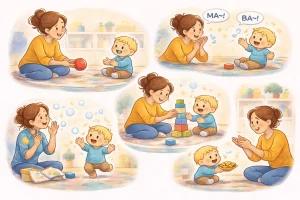
Common Myths About Getting Kids to Initiate And What Helps More Than Prompting
Last Updated: March 5, 2026
If you’ve ever caught yourself thinking, “Why won’t they just come to me and start?”—you’re in good company. Many parents searching for ways to help a child initiate interaction find themselves hearing lots of advice that sounds simple but doesn’t always work in real life.
Many parents are told things like “Just ask more questions,” “Make them say it first,” or “Don’t help until they initiate.” And while that advice is usually well-intended, it can quietly turn everyday moments into a tug-of-war. Instead of more connection, you get more stalling. Instead of confidence, you get a child who hangs back, watches, or melts down.
Initiating interaction is a tender skill. It’s your child starting play, calling out to begin a back-and-forth, smiling to kick off a familiar routine, or bringing something to you to share. These moments are less about “getting it right” and more about your child learning, over time, that reaching out works that you’ll meet them warmly when they do.
Let’s clear up a few common myths that can make initiating harder than it needs to be, and talk about what tends to help a child initiate interaction more naturally than constant prompting.
Also read: Common Mistakes That Can Make Gestures Less Likely Without Realizing It
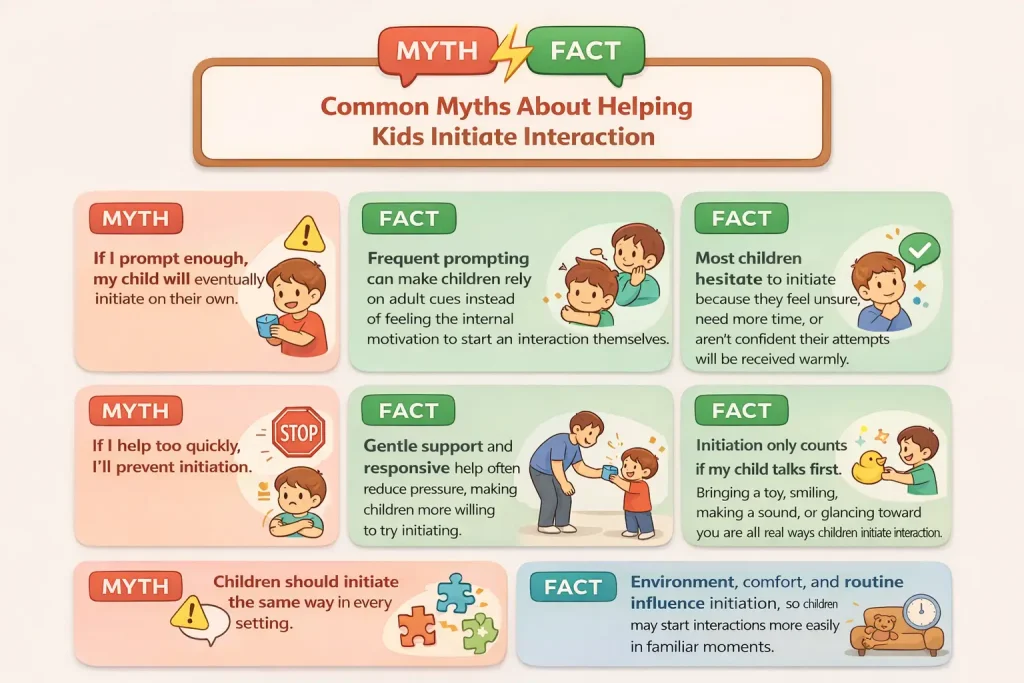
Myth 1: “If I prompt enough, they’ll learn to initiate.”
It’s understandable to try this. You want your child to practice. You want to give them chances. So you ask: “What do you want?” “Tell me.” “Say hi.” “Ask me.” “Use your words.” And you wait… and wait… and then it starts to feel tense.
The tricky part is that frequent prompting can accidentally teach a different lesson: that interaction happens when the adult cues it. Your child may begin to rely on your questions as the “starter pistol,” rather than feeling the internal nudge of “I want to share this with you.”
What often helps more than prompting is a sense of space and invitation. Many children initiate more when they don’t feel watched, tested, or rushed, when the moment feels playful and safe. A small pause, a warm look, and a predictable routine can do more than a string of questions.
Myth 2: “They’re not initiating because they’re being stubborn or ignoring me.”
When a child doesn’t initiate, it can feel personal, especially when you’re trying so hard to connect. But most of the time, a lack of initiation isn’t refusal. It’s uncertain.
Some children aren’t sure how to start. Some need a little extra time to warm up. Some are deeply focused on what they’re doing and don’t yet think to “bring you in.” And some have learned that when they reach out, the moment can become demanding (“Say it again,” “Not like that,” “Use the right words”), so they play it safe and stay quiet.
A helpful reframe is this: initiating is a confidence skill. It grows when your child experiences, again and again, that their small attempts work. A glance, a smile, a sound, a toy held up toward you, these are real openings. When they’re met with warmth, they tend to happen more often.
Myth 3: “If I help too quickly, I’m preventing initiation.”
Parents are often told to “wait them out.” And yes—waiting can be powerful. But only when it still feels kind.
If waiting turns into a standoff, your child may feel stuck rather than supported. The goal isn’t to withhold help until your child performs. The goal is to make it easy and pleasant for your child to take a first step toward you.
In real life, supportive waiting looks gentle. It’s the pause that says, “I’m here. I’m available. Take your time.” It’s not the pause that says, “I’m not helping until you do it my way.”
Many children initiate more when they trust that you’ll meet them halfway. When help is available, the pressure drops and the willingness to try often rises.
Read more: Progress You Can Feel: Signs Your Child Is Starting to Initiate
Myth 4: “Initiation means talking first.”
Initiation can include words, but it’s much broader than that.
A child might initiate by bringing you a toy, tugging your sleeve, smiling to start a familiar game, making a sound to get your attention, or looking at you with that “ready?” expression before a routine.
When we only count spoken requests, we miss dozens of meaningful attempts. And when attempts aren’t noticed, children sometimes stop offering them.
If your child brings you an object, that’s communication. If they hover near you with a playful grin, that’s communication. If they call out from another room—even just a sound—that’s communication. These are all ways of saying, “Come be with me.”
When parents start responding to these early forms of initiation, without immediately demanding “the right words”, children often become more eager to reach out again.
Myth 5: “They should initiate the same way in every setting.”
A child who initiates happily at home may seem like a different kid at the park, at daycare, or at a family gathering. That doesn’t mean the skill disappeared.
It usually means the environment changed.
Initiation is sensitive to timing and comfort. Busy spaces, transitions, new people, noise, or even excitement can make it harder for a child to start an interaction.
Some children initiate best during calm routines. Others initiate most when play is already rolling. And many initiate more with one caregiver than another because the rhythm feels familiar.
It can help to think of initiation as something that becomes more consistent over time, not something a child “has” or “doesn’t have.”
Progress often looks like more frequent small starts during everyday moments—like more bringing, more smiling, more calling out—especially when the moment is relaxed.
What helps more than prompting: connection, timing, and playful waiting
When initiating is the goal, the biggest support is often the emotional tone around communication. These approaches often help a child initiate interaction more comfortably during everyday moments.
Connection means your child experiences you as responsive. When they offer anything, you receive it warmly. You don’t have to throw a party, and you don’t have to turn it into a lesson.
A smile, a simple comment, joining their play for a moment, or sharing their excitement can be enough to teach: “When I start, you come.”
Timing matters because children initiate more when they’re already close to regulated and engaged.
If your child is tired, hungry, rushing out the door, or overwhelmed, initiation is less likely. That’s not a character issue—it’s just real life.
Many parents notice the best “starts” happen during predictable routines: getting dressed, snack time, bath time, or a familiar silly game.
Playful waiting is different from pressure. It’s the small pause that leaves room for your child to step in.
Think of it as giving the moment a little breathing space. In that space, your child may look up, smile, bring the toy over, or make a sound to pull you in. And when they do, your warm response is the payoff that makes initiation worth trying again.
Over time, these moments add up. You may notice your child calling out to start play, bringing objects to you more often, or sharing more smiles that clearly mean, Let’s do our thing.
Initiations become a more regular part of your time together—and they often happen with less and less prompting.
A gentle way to think about “success”
It’s easy to measure success by big moments: a clear request, a perfect “Mom, look!” or an enthusiastic “Come play!”
But for many children, success begins smaller and quieter.
Success might look like your child moving closer with a toy instead of staying across the room. It might look like a quick grin before a routine you usually start. It might be a sound from the hallway that clearly means, “Where are you?”
These are real initiations, and they’re worth noticing.
When parents focus on the joy of connecting rather than tracking every attempt, children often feel that difference. They feel less evaluated and more welcomed.
If prompting has become a habit in your home
If you realize you’ve been prompting a lot, you haven’t done anything wrong. Prompting is what most of us were taught. And it comes from a good place: you want to help your child grow.
You can always soften the approach. You can trade some questions for more pauses. You can respond to early attempts more quickly.
You can aim for moments that feel easy rather than moments that feel like a test. Small shifts in tone often make a big difference.
If you’d like extra support, tools like BASICS can help parents focus on goals like initiating interaction in a way that fits naturally into daily life, with short videos and simple guidance that keeps things calm and doable.
It’s not about doing more—it’s about feeling clearer on what helps.
Initiation grows best in relationships that feel safe. And every time your child reaches out—by bringing, smiling, calling, or simply inviting you into their play—they’re building that foundation.
Your warm response is what turns a small start into a skill that keeps coming back.
About the Author:
Shravanaveena Gajula
M.Sc ., Speech and Language Pathology (5+ years of experience)
Shravanaveena Gajula is a dedicated Speech-Language Pathologist with a BASLP and an M.Sc in Speech and Language Pathology. With experience spanning multiple settings, including Wellness Hub , Veena specializes in a wide range of disorders from developmental issues in children to speech and language assessments in adults. Her expertise includes parent counseling, managing speech sound and fluency disorders, and creating individualized therapy programs. Veena is also PROMPT certified and an author of several insightful blogs on speech and language pathology, aiming to educate and assist caregivers in supporting their loved ones.
Book your Free Consultation Today
Parent/Caregiver Info:
Client’s Details:
* Error Message