6 Eye Contact Activities for Toddlers That Fit Into Short Play Bursts
Last Updated: March 26, 2026
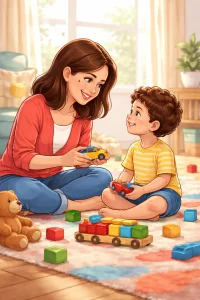
If you are searching for eye contact activities for toddlers, you are probably not looking for a long, sit still play session. You want something that works when your child is on the move, busy with toys, or done after thirty seconds. That is completely okay. Eye contact in real life is often quick. A tiny glance, a shared smile, a look that says, “Did you see that?” Those small moments still build connection, and they can happen in the middle of everyday play.
This article gives you six playful activity themes that naturally invite brief looks, without turning it into a drill. Think short, light, and easy to repeat.
Also read: It’s Okay if Your Toddler Only Gives Quick Glances During Play
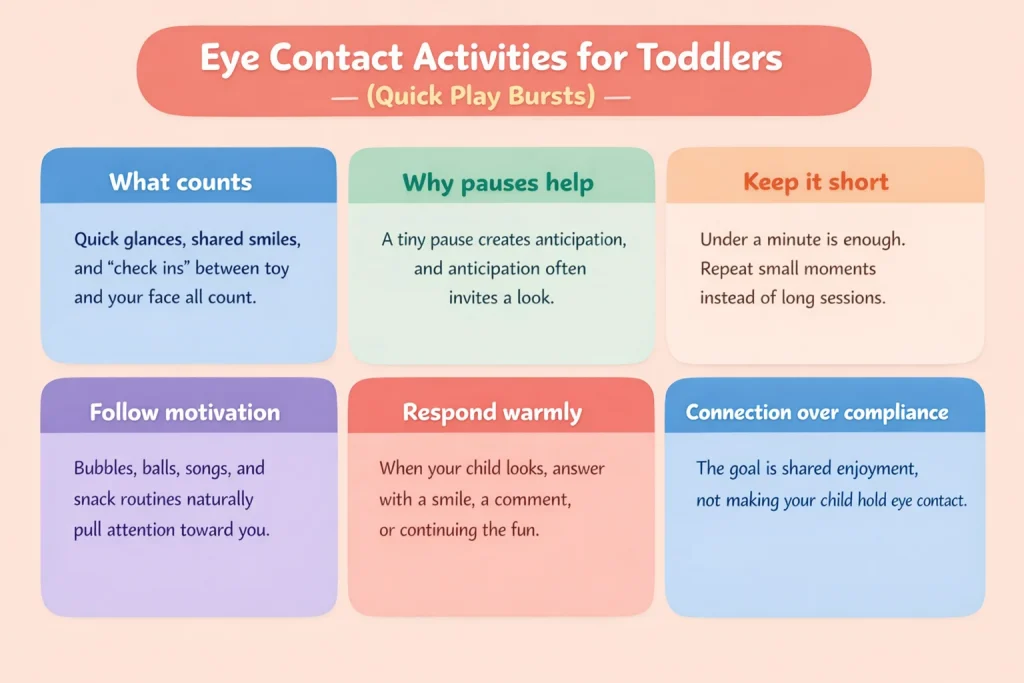
What counts as eye contact during play for a busy toddler
Many parents picture eye contact as steady looking, almost like a photo pose. Toddlers rarely play that way, especially when something interesting is happening in their hands.
In day to day life, eye contact during play often looks like:
- A quick glance up right before you do something fun, like blowing bubbles or rolling a ball
- Looking from a toy to your face and back again, almost like a check in
- A grin that comes with a split second look
- A look that happens during a pause, when your child is waiting to see what you will do next
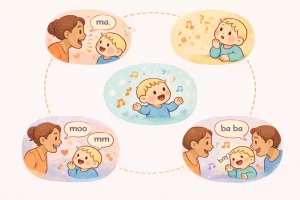
If your child looks for one second and then goes right back to the toy, that can still be meaningful. It is the back and forth that matters. You are building the idea that play is shared, not solo.
It also helps to remember that some toddlers avoid direct looking when they are excited, concentrating, or regulating their bodies. They may listen and connect in other ways first, like moving closer, handing you an object, or copying a sound. Eye contact can grow alongside those skills.
Why short play bursts work better than practice sessions
Short bursts match how toddlers are built. Their attention shifts quickly, their bodies want to move, and their play changes minute by minute. When parents try to create a formal practice moment, it can accidentally add pressure. Pressure often makes looking less likely, not more likely.
Short bursts work because they are:
- Predictable: your child starts to learn the pattern, “When I look, something fun happens.”
- Low effort: you can repeat them many times a day without planning
- Motivating: the activity itself pulls a glance, instead of you asking for one
- Easy to stop: you can end on a good note before anyone gets frustrated
If you have ever noticed your child look at you right as you pause, that is your opening. Pauses create anticipation, and anticipation invites a check in.
6 Eye Contact Activities for Toddlers You Can Do in Under a Minute
These are not meant to be done in a perfect way. They are simply themes that tend to invite a quick look. Pick one that fits your child’s personality today.
1) Peekaboo style pauses
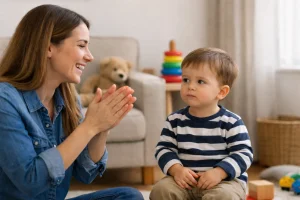
Peekaboo works because your face is the “surprise.” Some toddlers love the classic version, others prefer a gentler approach like hiding behind a book, a scarf, or your hands for a second. The key is the tiny pause before the reveal. That pause is where many toddlers glance up to see what is coming.
2) Bubbles with a “wait” moment
Bubbles are naturally motivating for many toddlers, and they create an easy reason to look up. The bubble wand comes near your face, you pause, and your child often checks your expression. Even if your child is watching the bubbles more than your eyes, a brief look toward your face counts as connection.
3) Rolling a ball back and forth
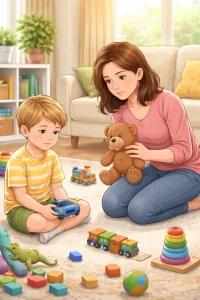
A simple roll creates a clear turn taking pattern. Many toddlers glance up right before they roll, or right after they receive the ball, as if to say, “Your turn now.” If your child prefers movement, this can feel better than sitting with a toy between you.
4) Funny faces and playful sounds
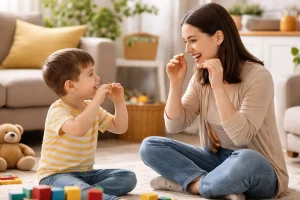
This one is about being interesting, not performing. A silly sound, an exaggerated surprised face, or a playful whisper can pull your child’s attention toward your face for a moment. For some toddlers, this works best when it is brief and spaced out, so it stays fun instead of overwhelming.
5) Songs with face to face moments
Songs are helpful because they are predictable. Toddlers often look up at the part they know is coming. Some families notice more looking during a pause right before a favorite word, or during a familiar gesture. If your child is wiggly, songs can happen while you are both moving, not necessarily sitting still.
6) Snack and routine check ins
Mealtimes and daily routines are full of natural pauses. A sip, a bite, opening a container, wiping hands, waiting for more. Many toddlers glance up during these moments because they need something, or because they are enjoying the shared routine. This can be one of the easiest places to build eye contact during routines, because you are already together and the pattern repeats every day.
A quick note that often reassures parents: if your child looks more during snack than during toy play, that is not “manipulative” or “only for food.” It is simply motivation. Motivation is how learning starts.
What to do if your toddler turns away or won’t look at your face
It can feel discouraging when you try something playful and your child still does not look up. In most cases, it does not mean your child is not connected to you. It often means the timing or the sensory load is not quite right yet.
A few gentle shifts that often help:
- Make your face easier to find. Getting down to your child’s level can make a big difference, especially if your child is busy looking down at toys.
- Use side by side connection first. Some toddlers look more when they are not directly face to face. You can still create shared moments from beside them.
- Keep your voice calm and your face soft. Big reactions can be exciting, but they can also be distracting for some kids.
- Wait a beat longer than feels natural. Many toddlers need an extra second to process the pause and decide to look.
- Notice what your child does instead of looking. Do they bring you a toy, lean into you, smile, or make a sound? Those are connection signals too.
If “look at me” has become a power struggle in your home, you are not alone. Many loving parents try it because it seems logical. For a lot of toddlers, it simply adds pressure. You will usually get more natural eye contact by making the moment fun and predictable, then letting your child choose to look.
Learn more: Why won’t my child make eye contact during play with me?
How to tell you are making progress, even if eye contact is still brief
Progress often shows up quietly. Parents miss it because they are looking for longer eye contact, when the real change is more frequent check ins.
You might notice:
- Your child glances up more often during a familiar game
- The look happens right before you do something exciting, like “ready, set…”
- There are more shared smiles, even if they are quick
- Your child starts to look after they do something funny, like a proud “Did you see that?” moment
- You find yourself prompting less because the routine itself is doing the work
If you want a simple way to think about it, aim for “more often,” not “longer.” A toddler who gives you ten half second looks across the day is building a strong foundation.
A gentle reminder about eye contact and when extra support can help
Some toddlers build eye contact quickly. Others take longer, especially if they are very active, very focused on objects, or easily distracted by sound and movement. There is a wide range of what is typical, and it can also vary by setting. Many children look more with a familiar caregiver at home than with new people.
If you have been trying for a while and connection still feels hard across most routines, it can be helpful to get another set of eyes on what is going on. Support does not have to be intense or formal. Sometimes a few practical tweaks make everyday interactions feel easier.
In the final third of this article, it is also worth naming something many parents quietly wonder about. If concerns persist, some families consider developmental screening to better understand communication delays or possible autism-related differences. This is not about jumping to conclusions. It is about getting clear, supportive guidance that fits your child.
Closing thoughts: choose one small idea today
If your toddler will not sit still, you are not doing anything wrong. Many toddlers learn best through movement and quick bursts of connection. Start with one of the six themes that feels most “like your child,” and keep it light.
The most effective eye contact activities for toddlers are the ones you can repeat without stress. A tiny pause, a warm face, and a shared smile can go a long way. Connection counts, even when it lasts one second.
About the Author:
Shravanaveena Gajula
M.Sc ., Speech and Language Pathology (5+ years of experience)
Shravanaveena Gajula is a dedicated Speech-Language Pathologist with a BASLP and an M.Sc in Speech and Language Pathology. With experience spanning multiple settings, including Wellness Hub , Veena specializes in a wide range of disorders from developmental issues in children to speech and language assessments in adults. Her expertise includes parent counseling, managing speech sound and fluency disorders, and creating individualized therapy programs. Veena is also PROMPT certified and an author of several insightful blogs on speech and language pathology, aiming to educate and assist caregivers in supporting their loved ones.
Book your Free Consultation Today
Parent/Caregiver Info:
Client’s Details:
* Error Message