What Counts as Imitation Even If It Doesn’t Look Perfect Yet
Last Updated: March 3, 2026
If you’ve ever clapped your hands, waved hello, or offered a high-five and then watched your child do… something kind of similar (maybe later, maybe halfway), you’ve probably wondered, “Does that count?”
Many parents imagine imitation as a clear, instant copy—your child claps when you clap, waves exactly the way you wave, and beams with pride at the perfect match. And sometimes that happens. But very often, especially in the early stages of early imitation skills, imitation looks quieter, slower, and less certain.
The reassuring truth is that imitation is not an all-or-nothing skill. It usually begins with small, imperfect attempts. Those tiny efforts matter because they show your child practicing connection—learning how to join you, respond to you, and share a moment with you. This post is a guide to spotting progress: what early imitation skills can look like, why they count even when they’re not perfect, and how to notice the “small wins” that are easy to miss in everyday life.
Also read: My Child Won’t Copy Clapping or Waving — Is That Normal?
What imitation really means in everyday life
The goal of imitating simple actions and gestures includes skills such as clapping, waving, giving a high-five, shaking the head yes or no, and eventually copying short sequences like “clap + wave.” But beneath these gestures is something even more important: your child is learning that actions can be shared. Imitation is one of the earliest ways children take part in social back-and-forth. It is less about performance and more about relationships.
That is why early imitation skills can look messy. Your child may be thinking, watching, processing, and experimenting all at once. The copy may come later. It may be incomplete. It may look like their own version. And it can still be meaningful.
Does it count if it’s not the exact same movement? Yes. In the early stages, “close enough” often is an imitation.
Here are a few examples parents commonly notice:
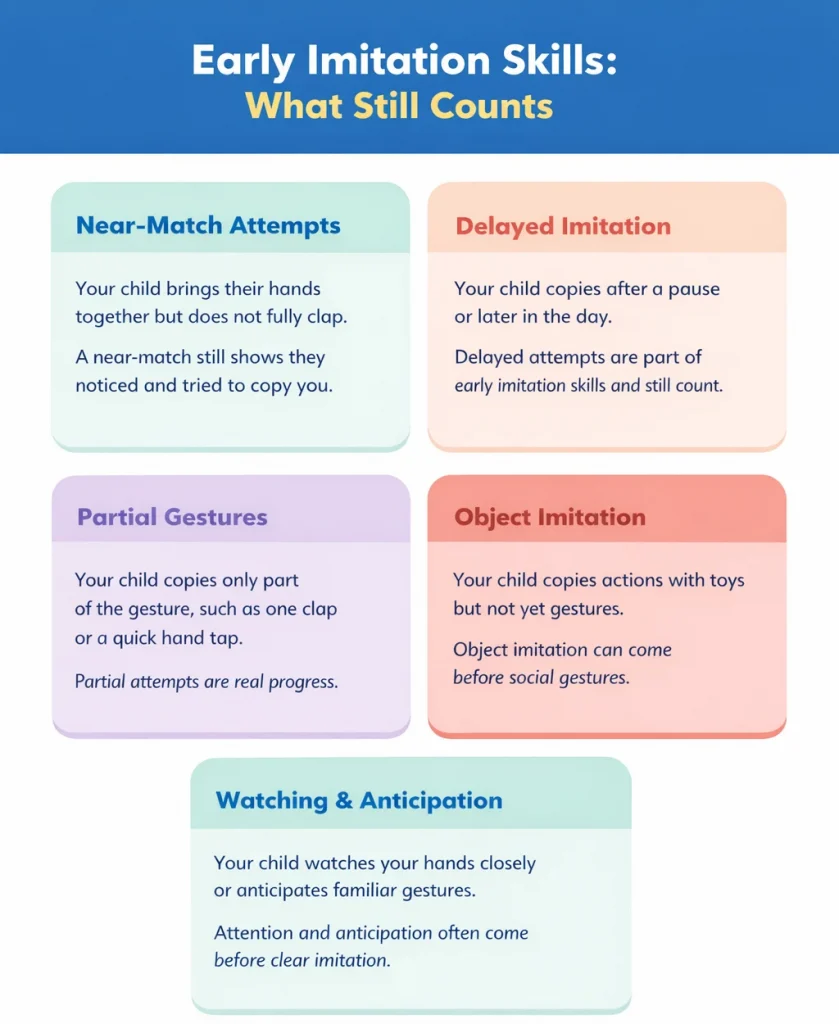
- You clap, and your child brings their hands toward each other but does not quite make contact. That movement is a real attempt. It shows they noticed what you did and tried to match it with their own body.
- You wave with an open hand, and your child wiggles their fingers or lifts their arm slightly. The wave may not look like a wave yet, but the idea—“I’m doing something with my hand because you did”—is there.
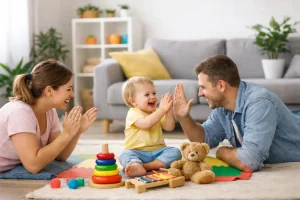
- You hold up your hand for a high-five, and your child touches your wrist, taps your palm with one finger, or bumps your hand with the back of their hand. Many children begin with simple contact before mastering the shape and timing of a true high-five.
Imitation often begins as a rough draft. The goal is not perfection—it is participation.
What if my child copies after a pause?
Delayed imitation is still imitation.
Some children copy right away, while others need more time to take in what they saw. In real life, this can look like you making a gesture during play, moving on, and then noticing your child try it several seconds later—or even later that day.
For example, you wave goodbye at the door and your child does nothing. Then, once you are in the car, they suddenly lift their hand and wave. Or you clap when a block tower stands tall, and your child claps after the tower has already fallen.
These “late copies” can be signs that your child is processing and practicing. The timing may not line up yet, but the connection is forming: they saw it, remembered it, and tried it. If you are watching mainly for immediate responses, delayed imitation can be easy to miss. Yet it is often one of the earliest ways early imitation skills appear.
Also read: Signs Your Child Is Getting Closer to Imitating Sounds (Even If They’re Not Copying Yet)
What counts as imitation if my child only does part of it?
Partial imitation is very common, especially for gestures that require coordination or both hands.
You might see:
- A “one-cheek kiss” instead of a full kiss
- A single clap instead of repeated clapping
- A head tilt instead of a clear head shake for “no”
- A brief touch to your raised hand instead of a firm high-five
Your child may also copy only the beginning of a gesture and then stop, as if testing it out. This still counts. It reflects your child experimenting with how to make their body do what they saw you do.
Over time, these partial attempts often become more complete—especially when they are met with warm attention rather than pressure.
What if my child imitates better with objects than with gestures?
This can be part of the same learning pathway.
Some children find it easier to copy actions with objects first—such as pushing a car, tapping a drum, or stacking blocks—before consistently copying body gestures like waving or clapping. Many parents notice, “They’ll copy what I do with toys, but not when I wave.”
This does not mean gestures will not develop. It may simply mean your child is first learning the idea of “copying” through play and will later apply it to social gestures as those become more familiar. Even within gestures, preferences are common. One child may enjoy high-fives but ignore waving. Another may clap during songs but not for celebration. Progress does not always arrive evenly.
The subtle signs your child is getting ready to imitate
Sometimes the most important changes happen before clear imitation appears. Parents often notice small shifts such as:
Your child watching your hands more closely than before
- Pausing when you make a gesture, as if considering it
- Looking at you, then at your hands, and back at you again
- Smiling or laughing during gesture games even without copying
- Seeming to “wait” for familiar moments, like anticipating a high-five after a task
These moments matter because imitation is not only about movement—it is about attention, anticipation, and shared meaning. A child who is watching closely and staying engaged is often laying the groundwork for early imitation skills.
Why these small attempts matter so much
It can feel discouraging when you repeat the same gestures day after day and see only small or inconsistent responses. But imitation grows through repetition and relationship. Each small attempt is your child practicing how to join you.
When children imitate simple actions and gestures, they are learning the rhythm of interaction: you do something, I respond, we share a moment. This rhythm supports connection and cooperation and builds early foundations for communication in daily life.
Children also become more confident when their efforts are noticed—not in a big, performance-based way, but simply as something meaningful. When a child senses, “That counted,” they are more likely to try again.
A gentle way to think about progress
Instead of asking, “Did they imitate or not?” it can be helpful to ask, “Was there any sign they noticed and tried to join in?”
Progress might look like your child consistently imitating one gesture (such as high-fives) while others are still emerging. It may appear more often in calm moments than busy ones. It might happen only with familiar people, during songs, or when your child feels relaxed.
This does not mean the skill is not developing. It often means it is developing in real life—gradually, unevenly, and within meaningful contexts that support early imitation skills.
Also read: The Best Times of Day to Try Playful Noises (Bath, Meals, Diaper Changes, and More)
When it helps to get extra support
Sometimes parents feel unsure about what “counts” or how to choose gestures that fit naturally into daily routines. If you would like guidance, speech therapy app like BASICS can help you focus on goals such as imitating simple actions and gestures through everyday activities, using short and parent-friendly examples—without turning your home into a practice session.
Support is not about making things intense. It is about making things clearer and calmer for you.
A steady reminder for parents
If your child’s imitation does not look perfect yet, it does not mean they are behind or that something is missing. Many children begin with tiny movements, delayed copies, and partial versions before imitation becomes more obvious as early imitation skills grow stronger.
- A small hand lift can be a wave in progress.
- A near-clap can be a clap in progress.
- A late high-five can still be a real attempt at connection.
When you notice those small wins, you are seeing something important: your child is learning how to connect with you. And that is exactly what this goal is about.
About the Author:
Shravanaveena Gajula
M.Sc ., Speech and Language Pathology (5+ years of experience)
Shravanaveena Gajula is a dedicated Speech-Language Pathologist with a BASLP and an M.Sc in Speech and Language Pathology. With experience spanning multiple settings, including Wellness Hub , Veena specializes in a wide range of disorders from developmental issues in children to speech and language assessments in adults. Her expertise includes parent counseling, managing speech sound and fluency disorders, and creating individualized therapy programs. Veena is also PROMPT certified and an author of several insightful blogs on speech and language pathology, aiming to educate and assist caregivers in supporting their loved ones.
Book your Free Consultation Today
Parent/Caregiver Info:
Client’s Details:
* Error Message