10+ Simple Home Activities to Encourage More Consonant Sounds in Babbling
By Wellness Hub
Last Updated: February 27, 2026
If you’ve been tuning in to your child’s babbling and thinking, “I keep hearing the same few sounds,” you’re definitely not alone. Many parents who worry about speech delay reach a moment where they wonder how to gently invite a little more variety, without turning everyday life into a speech class.
The encouraging part is that exploring new sounds is already part of your child’s natural communication journey. Consonant sounds like b, m, d, g, and p often appear through playful moments, silly noises, and familiar routines. Your job isn’t to make your child produce them on command. It’s to create a warm, responsive space where playing with sounds feels enjoyable, safe, and worth repeating.
Below is a collection of simple, low pressure ideas you can slip into your normal day. Choose what fits your child’s mood and interests, and feel free to rotate them. A little variety keeps things fresh for both of you.
Also read: Is It Normal If My Baby Mostly Makes Vowel Sounds When Babbling?
What you’re listening for and why it matters for speech delay
As children begin to use a wider range of sounds, babbling often becomes more playful and expressive. You might hear new consonants appear more often, or notice your child experimenting with different sound combinations and vocal “tunes,” higher, lower, louder, or softer. These moments are not about getting it right. They’re about curiosity.
Sound exploration also brings more connections. When you answer with a smile, a pause, or a playful echo, your child starts to feel, “My voice matters here.” That feeling can gently spark more vocal experimenting over time, which can be reassuring for families concerned about speech delay.
Simple Everyday activities that invite consonant sounds
Playful consonant modeling during face-to-face moments
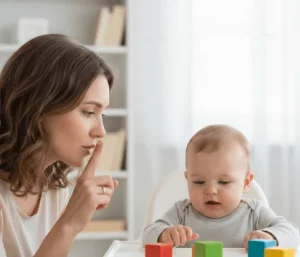
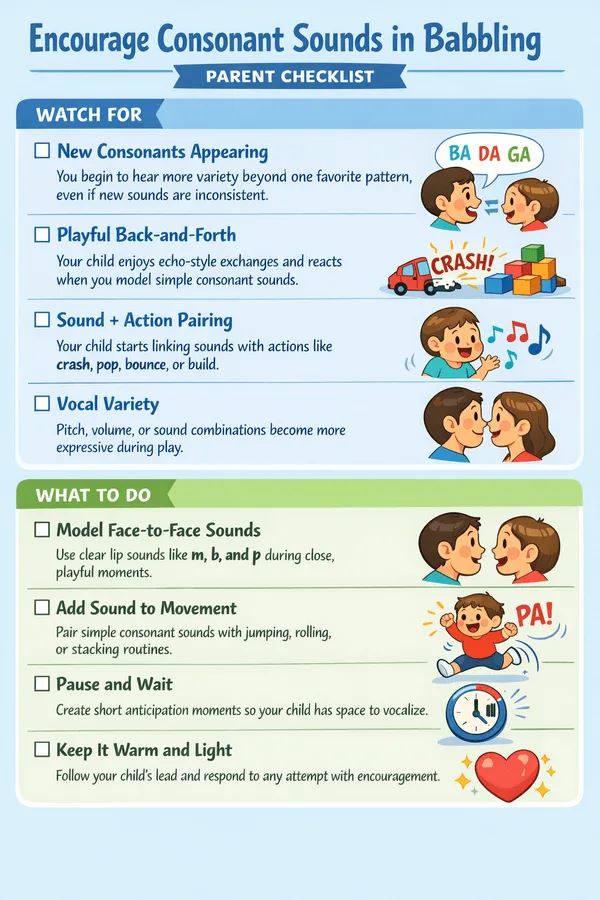
Some of the richest sound play happens when you’re close enough for your child to see your face, during cuddles, diaper changes, or a few quiet minutes on the floor. Parents often notice that casually adding in easy, repeatable sounds, especially m, b, p, d, g, invites their child to try something back. It can feel like a tiny conversation, even if it’s just two sounds traded between you.
Exaggerated mouth movement play
Babies and toddlers are fascinated by faces. Making your mouth movements a little more obvious, opening wide, pressing your lips together, puffing your cheeks, can make consonants more interesting to watch. Sounds like b, p, and m are especially visual because they use the lips. This isn’t about putting on a show. It’s simply leaning into how children naturally learn by looking.
Toy sounds that naturally include consonants
Some toys seem made for consonant sounds: cars, balls, blocks, dolls, animals, trains, and anything that pops, bumps, or drops. The aim isn’t to name everything perfectly. It’s to make playful sounds that happen to include those consonants. Many parents notice that when a sound matches an action, like a bump or a pop, it becomes easier for a child to give it a try.
The “echo” game your voice, their voice
Some children enjoy it when you copy their babble. Others prefer when you offer a new sound and wait. Either way, this back and forth “echo” style of play can slowly expand sound variety. If your child says “ma,” you might mirror it warmly and later introduce a nearby sound like “ba” or “pa,” without any pressure. The back and forth feeling is often what keeps children engaged.
Animal sounds that sneak in consonants
Animal play works so well because it’s repetitive, dramatic, and easy to keep light. Many animal noises naturally include early consonants, and children often enjoy the silliness enough to try them. Even if your child doesn’t copy the exact sound, any attempt counts. Grunts, squeals, and made up animal voices are all part of exploring their voice.
Action plus sound combinations
Movement can wake up the voice. Think about moments your child already loves, jumping, bouncing, pushing, pulling, rolling, or crashing. Pairing a simple sound with an action often makes it more fun and memorable. Over time, your child may start expecting the sound or adding their own version. It becomes less about “say this” and more about “this is our playful routine.”
Varied babble play mixing it up on purpose
Many children settle into one favorite pattern, like “mamama” or “bababa.” That’s completely normal and it can be a great starting point. In your own playful voice, you can gently change the pattern. Speed it up, slow it down, make it higher, make it lower, or swap one sound. This shows that sounds are flexible and fun, not fixed.
Wind-up toys and “ready, set…” moments
Wind-up toys, pop-up toys, or anything with a moment of anticipation can create a natural pause where your child might make a sound. Those waiting moments, before the toy moves, before the ball rolls, before the bubbles appear, often invite spontaneous vocal attempts. Many parents notice that when they pause with an expectant face, their child fills the space with a sound, even if it’s not a clear consonant yet.
Bubble play that invites “p” and “b”
Bubbles feel magical because they mix eye contact, excitement, and quick repetition. They also naturally invite lip sounds like p and b. Some children love watching your mouth as you blow. Others love the popping moment. Either way, bubbles create many short, happy chances for sound play without anyone feeling like they’re practicing.
Build-and-babble towers
Stacking blocks or cups creates a simple rhythm: build, build, build, then crash. That pattern can make it easier for a child to join in with their voice. The crash moment often brings out excited sounds, while the building moments give space for calmer babble. If your child enjoys repetition, tower play can turn into a cozy routine where new sounds appear naturally over time.
High and low voice play
Vocal range is part of sound exploration too. Some children stay in one pitch for a while, and playful high and low voices can add variety without asking for specific consonants. You might notice that when you change your voice, deep and silly, then light and airy, your child experiments with their own voice in response. It’s another way of saying, “Your voice can do many things.”
Silly faces with sound effects
A funny face alone can invite a sound. Adding a simple consonant noise makes it even more interesting. Many children will copy the face first, and the sound may come later. That still counts as progress because they’re learning how faces and sounds go together.
What success can look like without keeping score
Progress is often quiet at first. You might hear a new consonant one day and not again for a week, and may notice your child gets excited when they make a new sound, or starts mixing sounds in new ways. You might simply feel more back and forth during play.
All of that matters. This goal is about expanding variety over time, not producing one perfect sound on request.
Keeping it light when your child isn’t interested
Some days your child will be chatty. Other days they’ll be tired, busy, or just not in the mood to babble. That isn’t a setback, it’s real life. If your child turns away, changes the activity, or grows quiet, it’s okay to follow their lead and try again later. Sound play grows best when it stays linked to enjoyment and a sense of safety.
Also read: What Not to Do When Encouraging First Words: Common Mistakes That Can Shut Talking Down
Optional support if you want more ideas that fit your child
If you like having a bit of structure without turning play into work, tools like BASICS can help you choose communication goals and find simple activity ideas that match your child’s interests. Some parents enjoy having a clear set of options so they’re not always wondering, “What should I try next?”
If concerns about speech delay continue or you notice broader communication differences, some families choose to explore developmental screening to rule out communication delays or autism in a supportive, informed way.
A calm reminder to end on
Your child doesn’t need perfect consonants to be a strong communicator in the making. Babbling is practice, curiosity, and connection all woven together. When you respond warmly, play with sounds naturally, and make space for your child to join in, you’re already supporting the growth you hope to see, one ordinary, playful moment at a time.
Book your Free Consultation Today
Parent/Caregiver Info:
Client’s Details:
* Error Message