Common Mistakes That Can Make Gestures Less Likely Without Realizing It
By Wellness Hub
Last Updated: February 18, 2026
If your child isn’t using many gestures yet like pointing, reaching, giving, waving, nodding “yes,” shaking “no,” or pushing something away to refuse, then you may start to try harder like most parents. You might find yourself asking, “Show me,” “Point to it,” “Do you want this?” over and over. Or you might start anticipating needs faster than ever, just to keep the day moving. And sometimes, without meaning to, communication starts to feel a little tense like everyone is working hard, but nothing is clicking.
This is a gentle reminder: if gestures aren’t showing up much right now, it doesn’t mean you’re doing anything wrong. It often means your child is still learning that their actions can influence what happens next and that the back-and-forth of communication is worth trying.
Gestures grow best when they feel easy, successful, and connected. Below are a few very common patterns that can accidentally make gestures less likely, plus what a more supportive “feel” often looks like instead.
Why gestures matter even before words
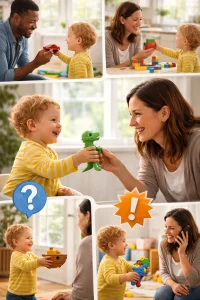
Gestures are one of the earliest ways children learn, “I can share what I want, what I don’t want, and what I notice.” A reach for a snack, a point toward a toy, a hand-off of a book, a wave goodbye, these moments aren’t just cute. They’re powerful.
They help your child express needs and feelings in a natural, low-pressure way. They also create those small, joyful exchanges that build connection: you notice them, they notice you noticing them, and suddenly communication feels like a shared game rather than a demand.
And importantly, gestures don’t have to be perfect to “count.” A small reach, a brief show, a tiny push-away these are real communication.
Also read: Why Your Child Reaches for Things but Doesn’t Give or Show Them
Mistake #1: Turning gestures into a quiz
When you’re worried, it’s easy to slip into “testing mode.” It can sound like: “Where’s the ball? Point to the ball. No, point. Point!” Or you might hold up two items and ask repeatedly, “Which one? Tell me. Show me.”
The problem isn’t the question itself. It’s the feeling that there’s a right answer and your child is being evaluated. Many children respond to that pressure by doing less, not more. They may look away, freeze, fuss, or wait you out because the interaction stopped feeling playful and started feeling like a performance.
A more supportive approach often feels like curiosity instead of testing. It leaves room for your child to respond in their own way, in their own time, and still be “right.” When communication stays light, children are more willing to take small risks like reaching, giving, or pointing because the stakes feel low.
Read more: Signs Your Child Is Starting to Use Gestures Even If It’s Not Consistent Yet
Mistake #2: Asking again and again especially in the same moment
Repetition is a normal parenting reflex. If your child doesn’t gesture, you might try the same prompt several times in a row: “Show me. Show me. Show me.” Or you might rephrase it: “Point. Can you point? Use your finger. Point to it.”
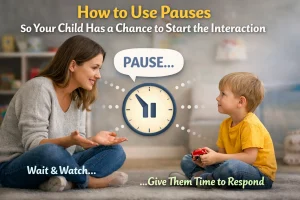
But rapid-fire prompting can accidentally crowd out the very thing you’re hoping to see: your child’s own initiation. Some children need a longer pause to process what’s happening and decide what to do. When the moment fills up with words, there’s no space left for a gesture to appear.
Often, what helps most is not more language but more breathing room. Many parents are surprised by what their child does when the interaction slows down and there’s time to respond without being chased by the next question.
Mistake #3: Anticipating needs too quickly because life is busy
This one is so relatable. You know your child well. You can tell the difference between the “snack whine” and the “tired whine.” You can predict which cup they want, which show they’re asking for, which toy they’re thinking about.
And honestly, this is loving. It’s also how families survive busy mornings and long grocery trips. The tricky part is that when everything is anticipated, your child has fewer natural reasons to gesture. If the crackers appear the moment they glance at the pantry, there’s no need to reach. If the toy is handed over before they have a chance to show you, there’s no reason to give or point. If you automatically remove something they dislike, they don’t get to practice refusing with a push-away or head shake.
A supportive “feel” here isn’t about withholding or making your child struggle. It’s more like allowing tiny, safe opportunities for your child to participate so they can experience, “When I do something, my parents understand me.” That sense of success is what makes gestures more likely next time.
Mistake #4: Only accepting one “correct” gesture
Sometimes parents have a specific gesture in mind usually pointing. And pointing is a wonderful, useful gesture. But it’s not the only doorway into communication.
Your child might reach with an open hand, pull you toward something, lift an item up to show you, place something in your hand, or look back and forth between you and what they want. They might push something away to refuse long before they can shake their head “no.” They might wave with their whole arm or a tiny wrist flick. All of those are meaningful.
When we only respond to one “perfect” gesture, children can learn that their attempts don’t work so they stop trying. When we respond to the attempt, children learn that communication is powerful. A supportive approach often looks like recognizing the message, not grading the form. Over time, gestures tend to become clearer and more purposeful because your child is getting lots of practice feeling understood.
Mistake #5: Saving gestures for “practice time” instead of real life
Some families try to set aside a special time to work on gestures. That can be helpful, until it starts to feel separate from everyday connection. If gestures only come up during a structured “say bye-bye” moment or a “point to the picture” drill, your child may not use them when it actually matters, like during snack, play, dressing, or leaving the house.
Gestures are meant for real communication: requesting, refusing, and sharing. They grow best inside routines and playful moments where your child already has a reason to communicate. A more supportive “feel” is when gestures are simply part of how your family interacts small, natural, and woven into the day.
Mistake #6: Making it feel like high stakes
Sometimes the biggest shift isn’t what you do it’s the emotional tone around it. When a parent is worried (again, very understandable), children can sense that intensity. You might not be saying anything harsh, but the moment can still feel loaded: “We really need you to do this.” For some children, that pressure makes it harder to try something new. They may become silly, avoidant, or upset not because they’re being defiant, but because the interaction feels too big.
A supportive approach feels calm and safe. It communicates, “We’re together. I’m paying attention. Any little attempt counts.” Gestures often show up more when children feel relaxed and connected.
What “good progress” can look like even if it’s subtle
Parents sometimes imagine progress as a clear point, a perfect wave, or a consistent nod. But early progress is often quieter.
You might notice your child starting to reach more often, handing you items, lifting something to show you, looking between you and what they want, or pushing something away instead of melting down. You may see more shared excitement your child notices something interesting and checks whether you’re noticing too. These moments matter. They’re the foundation of communication that feels mutual and joyful.
If you want extra support, you don’t have to figure it out alone
If you’re feeling stuck, like you’re trying everything and gestures still aren’t showing up much, it can help to have a simple, parent-friendly plan that keeps things light.
Speech and Autism therapy apps like BASICS are designed to help parents support goals like using gestures to request, refuse, and share through everyday routines, with short videos and guidance that emphasizes connection over pressure. It’s not about turning your home into a therapy space. It’s about making communication feel easier to notice and respond to.
A gentle closing note
If your child isn’t gesturing much yet, it doesn’t mean they aren’t communicating. It usually means they’re still learning how to make their message clear and how to trust that their message will be received.
The goal isn’t to “get” a point or a wave on command. The goal is to build lots of small, successful moments where your child experiences: “When I reach, show, give, push away, or look at you, you understand me.” And when communication feels successful, gestures become more likely because your child has a reason to try again.
Book your Free Consultation Today
Parent/Caregiver Info:
Client’s Details:
* Error Message