When Should a Toddler Be Able to Stack Blocks Without Knocking Them Over?
By Wellness Hub
Last Updated: April 4, 2026
If you have ever wondered, “when do toddlers stack blocks” without the whole tower crashing down, you are in very good company. Block play can look like constant toppling, big arm movements, and a child who seems excited for one second and furious the next. It is easy to assume something is “wrong” when you see more knocking than stacking.
Most of the time, what you are seeing is a normal part of learning controlled hand and finger movements. Stacking is not just about knowing what to do. It is about being able to slow down, use just enough pressure, and place one block on another without tipping the base.
Also read: Toddler Fine Motor Control Milestones – What to Expect From Ages 1 to 3
Why Stacking Blocks Is Harder Than It Looks
From the outside, stacking seems simple. Pick up a block. Put it on top. Repeat. But for a toddler, each part asks a lot from their body and brain at once.
A steady stack needs the hands to do “gentle and precise” at the same time. That means your child has to:
- Use two hands together, one to hold steady and one to place
- Adjust force so the block does not slam down
- Open and close fingers smoothly instead of grabbing and dropping
- Aim for the middle of the block, not the edge
- Slow their movement even when they feel excited
This is why block play is such a helpful window into toddler fine motor control. When control is still developing, you might see squeezing, crashing, or quick releases that make the tower wobble. None of that means your child is not learning. It often means they are learning right in front of you.
When Do Toddlers Stack Blocks, and What Is Typical Along the Way?
Parents often want a clear age where stacking “should” happen. Real life is messier than that, because toddlers grow in spurts and practice matters. Some kids stack early because they love it, and others avoid it because it feels tricky.
Here is a more helpful way to think about it: stacking usually moves from exploration, to short stacks, to more control, to taller towers. The timeline can overlap, and your child might bounce between stages depending on energy, mood, or the type of blocks.
Around early toddlerhood, many children are still in the “cause and effect” stage. They may place one block on another briefly, then knock it down on purpose. That is not failure. It is learning what happens.
As toddlers get closer to the middle of the toddler years, you often see more intentional stacking. The tower may still fall, but your child starts trying again. You might notice they pause before placing the next block, or they use their other hand to steady the base.
Later in toddlerhood, many children can stack several blocks with fewer crashes, especially with blocks that are easy to line up. Even then, it is normal for towers to fall when a child is excited, rushing, or using unfamiliar blocks.
If you are still asking “when do toddlers stack blocks” because your child seems stuck at knocking everything over, it can help to look for the smaller signs of control that come before a tall tower.
Learn More: 7 Easy Ways to Support Hand Strength Without Making Your Toddler Squeeze Harder
Signs Your Toddler Is Building Control, Even if the Tower Still Falls
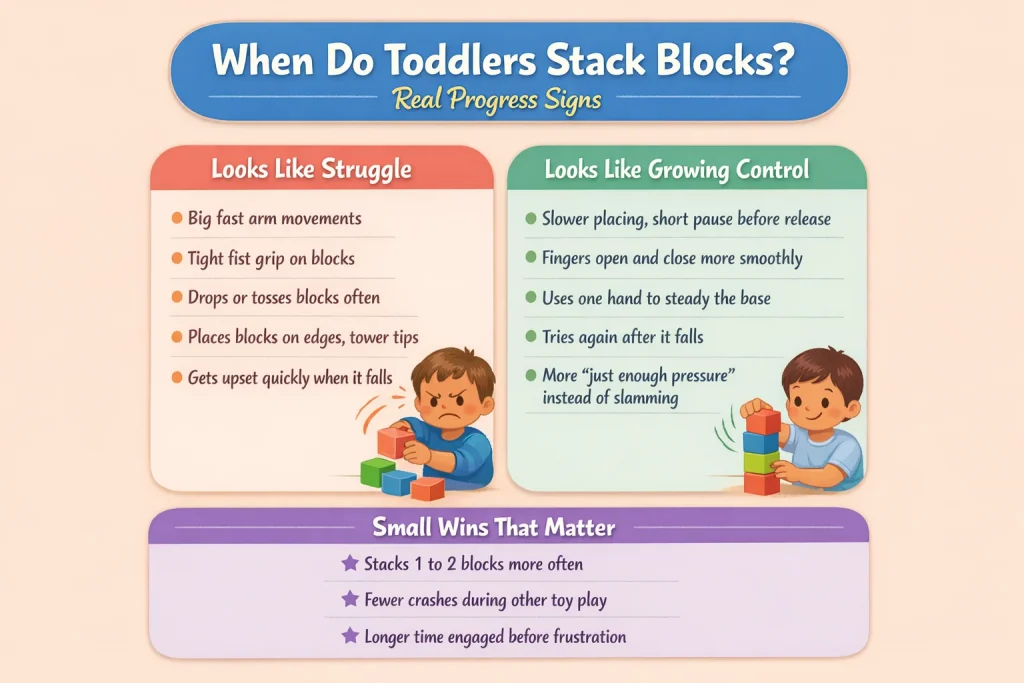
A lot of progress happens before a tower looks “neat.” In therapy, we often watch for the quality of the movement, not just the final result. You can do the same at home, without turning play into a test.
Here are meaningful signs that stacking skills are moving forward:
- Your child places a block more slowly than they used to
- They adjust their grip, instead of holding the block in a tight fist
- They try to line up edges, even if they miss
- They use one hand to hold the stack steady
- They can stack one or two blocks, then add another after a reset
- They show less frustration when it falls, or they recover faster
- They drop blocks less often during play, even outside stacking
You might also notice changes in other daily tasks. A child who is gaining smoother control may turn book pages with less tearing, bring a spoon to their mouth with fewer spills, or handle small toys with less “crashing.” These are all connected. Controlled hand use tends to show up in little moments across the day.
Why Your Toddler Keeps Knocking Blocks Over (and It Is Not Always “Roughness”)
Sometimes the toppling is playful. Toddlers love big results. A crash is loud, satisfying, and predictable. If your child laughs and repeats it, they may be choosing the fun part on purpose.
Other times, the knocking is more about control than choice. A few common reasons:
They are using too much force
Some toddlers press down hard because their body is still learning “just enough.” They may do the same with crayons, doors, or toy buttons.
They are moving too fast
Speed and control rarely develop at the same time. A child who rushes often knocks things over even when they understand stacking.
The blocks are tricky
Lightweight blocks slide. Very small blocks require more precision. Uneven blocks wobble. Even adults find some sets annoying.
Their hands get tired
Fine motor work can be tiring when it is new. You might see more crashing at the end of play, not the beginning.
They are still coordinating both hands
Stacking is a two handed job for a long time. If one hand is not yet steady, the base shifts and everything falls.
If you have also been thinking, “why is my toddler so rough with toys,” block play can be one of the places it shows up first. Not because your child is doing something wrong, but because blocks give immediate feedback.
Learn More: How to Help Your Toddler Use Two Hands Together During Play
Gentle ways to support stacking without turning it into a lesson
Most toddlers build better stacking skills through everyday play, not through repeated correction. The goal is not a perfect tower. The goal is smoother, more purposeful hand movements over time.
A few parent friendly ideas that often help, without needing you to “teach”:
Choose blocks that are easier to succeed with
Bigger, heavier blocks tend to stay put. Blocks with flat sides and a bit of grip are more forgiving than slippery plastic.
Watch for the moment your child naturally slows down
That tiny pause before they place a block is gold. It is a sign their body is starting to plan and control the movement. When you notice it, simple encouragement helps more than fixing the tower.
Keep the stack short on purpose sometimes
Many toddlers do better with “a little tower, many times” than “one tall tower, once.” Short stacks give lots of chances to practice placing without fatigue.
Let your child be the builder, even if it is messy
If you do most of the stacking, your child gets less practice with the hardest part, which is releasing the block gently.
Notice effort, not results
Comments like “You put that on so carefully” or “I saw your slow hands” can support control without pressure.
If you are looking for ideas that fit your day, the BASICS App can be a gentle place to start. It is parent guided and self paced, with simple goal based activities that support hand control through play and routines.
When should you seek extra support for block stacking and hand control?
It is reasonable to want reassurance here. Block play is one of those activities that can make parents second guess everything, especially if other kids the same age seem to build tall towers easily.
Extra support can be helpful if you notice a pattern like:
- Your child almost always uses a very tight grip, even with familiar toys
- They seem to use much more force than they intend, across many activities
- They avoid hand based play because it feels frustrating
- They often drop objects during snacks or play, not just blocks
- Progress feels stalled for a long time, even with lots of low pressure chances to practice
This does not mean something bad is happening. It simply means you might benefit from fresh eyes and a plan that fits your child. Some families like a short burst of coaching to figure out what to adjust, such as block type, setup, or how to support “slow hands” in daily routines.
If you ever want more structured guidance, a pediatric occupational therapist can help you understand what your child is showing you through their play. And if in person support is hard to access, online options can still be practical and personal. (If you are curious, our related read on online occupational therapy for fine motor skills can help you decide what kind of support fits your family.)
Also read: 9 Fine Motor Activities for Toddlers at Home That Build Gentle Hands
A reassuring closing thought about when do toddlers stack blocks
If block time in your house looks like topple, crash, rebuild, you are not alone. Asking “when do toddlers stack blocks” is really another way of asking, “When will this feel easier for my child?” The answer is usually: gradually, with lots of ordinary practice and a little more control showing up week by week.
Try to measure progress in small ways. A gentler placement. One extra block before it falls. Less frustration. More willingness to try again. Those are the building blocks that come first, and they matter.
Book your Free Consultation Today
Parent/Caregiver Info:
Client’s Details:
* Error Message