7 Easy Ways to Support Hand Strength Without Making Your Toddler Squeeze Harder
By Wellness Hub
Last Updated: April 6, 2026
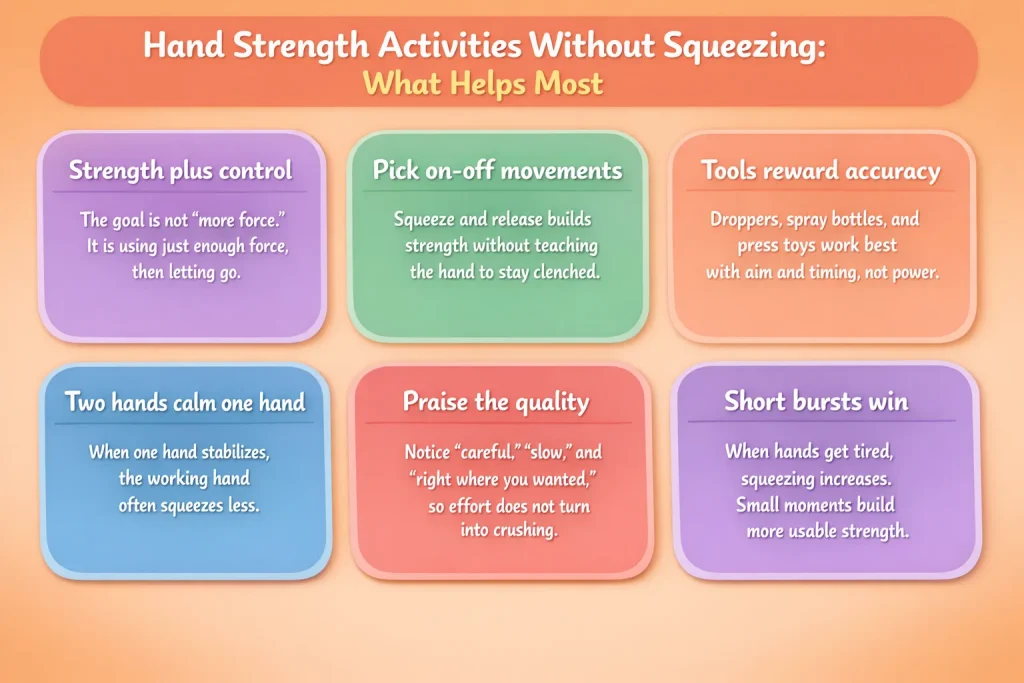
If you have been searching for hand strength activities without squeezing, you are probably in a very specific parenting moment: you want stronger hands, but you also want fewer crushed crackers, snapped crayons, and toys being “loved” a little too intensely. That mix of goals can feel confusing, because so many classic strengthening ideas accidentally reward more force. The good news is that strength and control can grow together, and you do not have to choose one over the other.
Learn More: How to Help Your Toddler Use Two Hands Together During Play
Why Stronger Hands Can Accidentally Lead to More Crushing
A lot of toddlers squeeze hard because their hands are still learning how to use “just enough.” It is not always about being wild or careless. Often it is a smart, early strategy: if I squeeze harder, I can make the thing happen. The lid opens. The toy makes noise. The marker shows up on the page. Big effort gets a clear result.
The tricky part is that many strengthening activities are built around the idea of “more.” More resistance, more squeezing, more repetitions. For a toddler who already uses too much force, that can reinforce the exact pattern you are trying to soften.
There is another piece too: when a child is working hard to stabilize their wrist, coordinate fingers, and keep their grip from slipping, they may default to a tight whole-hand squeeze. It is like turning the volume all the way up because you are not sure which button you need. This is one reason parents sometimes notice: “We tried strengthening and now everything is worse.”
If you have had that experience, it does not mean you did anything wrong. It usually means your child needs strength plus better grading of pressure, and that is a learnable skill.
What To Look For When Strength Is Building in a Healthier Way
When hand strength is growing alongside control, the changes can be subtle at first. You might notice your toddler can hold onto a toy longer without switching hands constantly. Or they can pick something up and place it down with less of a “drop.” Sometimes the biggest sign is emotional: less frustration, fewer redo attempts, and more willingness to try again.
Here are a few everyday “green flags” that often show up as toddler fine motor control improves:
- Your child starts using fingertips a bit more, instead of a full fist for everything.
- They can slow down for a second when something is delicate, like a soft snack or a page in a book.
- They recover from a slip without immediately squeezing harder.
- They can do a short hand task, then move on without their hands looking tired or tense.
Progress does not look like perfect gentleness all day. It usually looks like a few better moments sprinkled into normal toddler intensity. Those moments matter because they are practice your child can actually use.
7 Easy Ways To Support Hand Strength Without Making Squeezing the Goal
Below are seven parent-friendly ways to build strength while still protecting the skill you really want: controlled, purposeful hand use. These are not meant to be a checklist. Think of them as options you can rotate based on your child’s mood, your time, and what is already happening in your day.
1) Choose “squeeze and release,” not “squeeze and hold”
Long, tight squeezing teaches the hand to stay clenched. Activities that naturally include letting go help your child practice turning effort on and off. That on-off pattern is a big part of control.
2) Look for resistance that uses the whole hand, not just a crushing grip
Some resistance activities let the hand work without needing to clamp down hard with the fingers. Pulling, pressing, and pushing can build strength in a way that feels steadier and less “crush-prone.”
3) Use tools that reward accuracy, not force
Droppers, spray bottles, hole punchers, and simple press toys can be great because they work best when the movement is lined up and intentional. The “win” comes from aim and timing, not from squeezing harder.
4) Offer “firm but not fragile” materials
If everything is either too flimsy or too hard, toddlers tend to overdo it. Materials with a little give can help them feel success without needing maximum force. Many families notice calmer hands when the item is easier to control.
5) Build strength through two-hand jobs
When one hand holds and the other hand works, your child gets stability. Stability often reduces the need to squeeze. Think of tasks like holding a container while opening it, or steadying paper while tearing. Two-hand coordination supports smoother fine motor control without you having to talk about “gentle” constantly.
6) Praise the quality of the movement, not the power
This is a big one. If a child gets the biggest reaction when they squeeze the hardest, they will keep doing it. Try noticing things like “You held that carefully,” “You slowed down,” or “You put it right where you wanted.” You are teaching what success looks like.
7) Keep strength practice short and sprinkled
Toddlers do best with little bursts. When hands get tired, control often drops and squeezing increases. Short, playful moments tend to build more usable strength than long sessions that end in frustration.
If you are reading this and thinking, “Okay, but my toddler is still so rough with toys,” you are not alone. Many parents wonder that exact thing, especially during busy, energetic phases.
How To Tell if an Activity Is Secretly Encouraging Harder Squeezing
Parents often ask, “How do I know if this is helping or making it worse?” A simple way to think about it is to watch what your child has to do to succeed.
An activity may be pushing squeezing harder if:
- Your child only “wins” when they clamp down as hard as they can.
- They start holding their breath or tensing their shoulders while using their hands.
- You see more white knuckles, more bent wrists, or a tight fist pattern.
- They get stuck in a loop of squeeze harder, slip, squeeze harder again.
- Afterward, they are more crashy with toys or more likely to crumble snacks.
On the other hand, activities tend to support control when success comes from lining things up, using two hands, or repeating a smooth movement. You might still see effort, but it looks more organized.
If you are also noticing frequent dropping, that can fit into this same picture. Some toddlers squeeze too hard to prevent dropping, and others drop because they are still coordinating grip and release. If that is your child, you might also like our related read: “Toddler Drops Things a Lot: What It Can Mean and What Helps.”
Small Tweaks That Build Just Enough Pressure During Real Routines
You do not need special equipment to support this goal. Daily routines are full of natural hand practice, and small changes can shift the focus from force to control.
During snacks, notice whether your child does better with slightly sturdier foods that do not crumble instantly. If a snack falls apart every time, your toddler may squeeze harder out of frustration. You can also model slower hands without turning it into a lesson. Many toddlers copy what they see when the moment is calm.
In play, it helps to offer objects that are easier to grasp without a death grip. Chunkier crayons, larger blocks, and toys with a clear “job” often reduce random squeezing because the hands have a purpose. Purpose is calming.
During dressing, give your child time to try the pull, press, or peel parts of clothing fasteners. When adults rush in quickly, toddlers sometimes respond by using more force the next time, because they are trying to “beat” the help. A few extra seconds can change the whole tone.
If your child tends to crash toys when excited, it can help to start hand tasks when they are already regulated, like after a snack or a cuddle, rather than at the end of a long day. This is not about perfect timing. It is about noticing patterns and choosing easier moments when you can.
A gentle closing note: strength is not the same as squeezing
If your toddler squeezes hard, you are not failing at fine motor support. You are seeing a common stage where effort is bigger than precision. Over time, with playful practice and lots of real-life chances to use their hands, many toddlers learn to adjust pressure in a way that feels calmer and more confident.
If you want a simple guiding idea, it is this: choose hand strength activities without squeezing as the main “theme,” and let control be the measure of success. Strong hands that can slow down, hold steady, and let go on purpose are the hands that make daily life easier.
Book your Free Consultation Today
Parent/Caregiver Info:
Client’s Details:
* Error Message