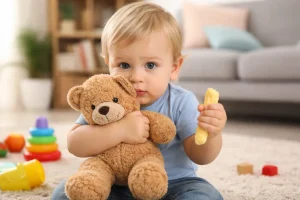
How Children Learn To Look Back and Forth Between a Toy and Your Face
Last Updated: March 30, 2026
If you have been watching your child play and thinking, “They love the toy, but do they even notice me?” you are not alone. Many parents expect eye contact to look like a steady gaze, when early connection often looks more like a quick flicker. The skill of being able to look between toy and face is one of those small, easy to miss building blocks that can quietly grow over time, especially during familiar play and daily routines.
This article is here to put words to what you might be seeing, and to help you notice progress that does not always look like “eye contact” in the way adults imagine it.
Also read: Why Does My Child Look at My Mouth but Not My Eyes?
What does looking back and forth actually mean in real play?
When adults talk about a child “looking back and forth,” it can sound like a very clear pattern. Toy, face, toy, face. In real life, it is usually messier and much more subtle.
For young children, this skill often starts as a brief check in. It might be a glance toward your eyes, your mouth, or even just the general area of your face. Sometimes it is a look that happens right after something exciting, like a toy making a sound, a block tower falling, or a bubble popping. Other times it shows up as a pause in their body, like they freeze for a second and then continue playing.
Here are a few everyday examples of what “back and forth” can look like before it looks obvious:
- Your child holds up a toy near their chest and briefly looks up, almost like they are making sure you are still there.
- They push a car, then look toward you right before they push it again, as if they are waiting for your reaction.
- They smile at the toy, then their eyes drift to your face for a moment, and they smile again.
- They look at your hands when you are about to do something fun, like winding up a toy or turning a page, then their eyes pop up to your face.
None of these moments need to be long. In fact, short is often exactly right at the beginning. The goal is not “staring.” The goal is shared attention, that feeling of “we are doing this together.”
Why do some kids stay locked onto objects and skip the “check in”?
Some children naturally focus deeply on objects. They might be careful observers, persistent problem-solvers, or kids who get a lot of satisfaction from figuring out how something works. That kind of focus can be a real strength.
There are also very normal, very human reasons a child might not look up much during play:
- A toy can be easier than a face. Toys are predictable. Faces change quickly. Expressions shift, voices change, and social moments can feel fast.
- Your child might be busy. When a child is concentrating, their attention can narrow. You might notice more looking up when the play is simple and familiar, and less when they are trying something new.
- Some kids are slow to warm. A child may look more at a parent or sibling than at visitors. They may also look more during routines like meals or bath time than during open-ended play.
- The environment can pull attention away. Bright lights, background noise, screens, or lots of toys out at once can make it harder for a child to notice a face.
- Temperament matters. Some children are naturally more independent in play. They enjoy being near you, but they do not feel the need to “share” every moment yet.
If you are wondering about eye contact during play, it can help to remember that connection is not always shown through looking. Some children connect through movement, closeness, touch, or bringing you an object without looking up. Those are still meaningful social signals, and they can be a starting point.
Learn More: When Should a Child Respond to Their Name With Eye Contact
The tiny early signs your child is starting to look between toy and face
Parents often tell me, “I think they never look at me.” Then, when we slow things down and watch closely, we find small moments that were happening all along. They were just quick, and they did not match the parent’s picture of what “eye contact” should be.
Early signs often include:
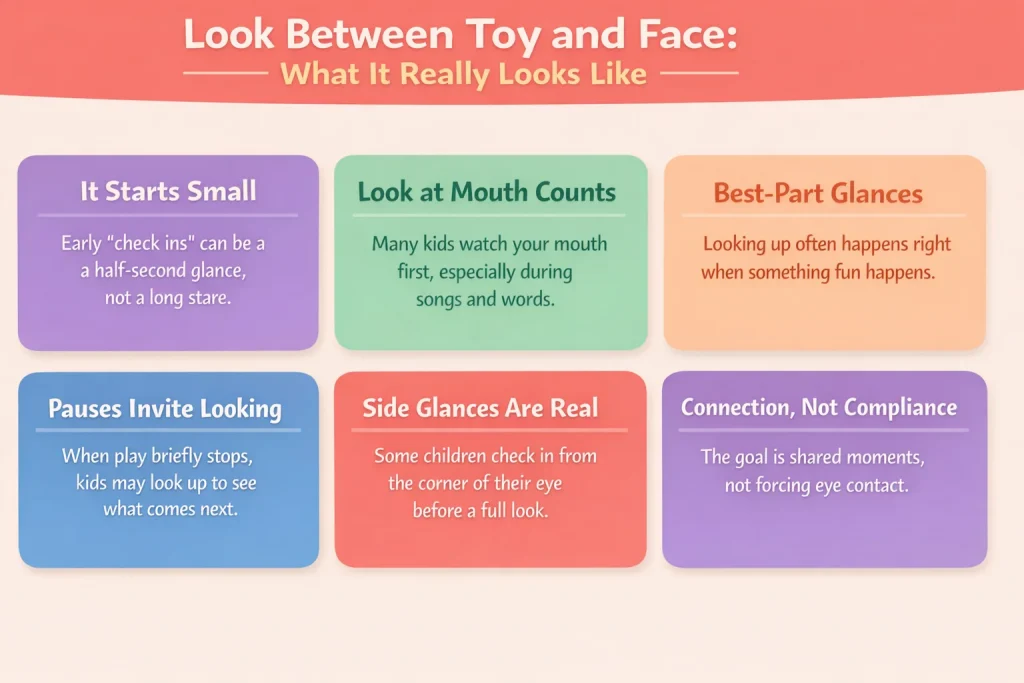
- A glance that happens at the best part. Your child looks up right when something fun happens, like you make a silly sound, the ball rolls, or the toy lights up.
- A look that happens during a pause. When the action stops for a second, your child checks your face, almost like they are asking, “More?”
- More looking at your mouth than your eyes. This is common, especially when children are learning sounds, words, or songs. Looking at your mouth still counts as noticing your face.
- A “side glance.” Some kids look out of the corner of their eye first. It can be their way of checking in without fully shifting attention.
- A body check in. They lean into you, sit closer, or turn their shoulders toward you for a moment. Often, the eyes follow later.
- If you are seeing any of these, you are already seeing the beginning of shared attention. It is not all or nothing. It grows in small steps.
What helps this skill grow, without turning it into a test
Most children learn to shift their gaze because it becomes useful and enjoyable. They look up when it helps them predict what will happen next, or when it gets them more of what they want. That is why playful routines and warm reactions matter so much.
A few gentle principles make a big difference:
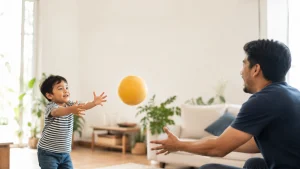
- Motivation beats prompting. If a child is excited about what you are doing, they are more likely to look up naturally. This is why simple social games like peekaboo, bubbles, rolling a ball, funny faces, and songs often bring more “check ins” than a toy that plays by itself.
- Predictable moments create anticipation. When your child learns that a pause means something fun is coming, their eyes often start to search your face. Not because they are being trained, but because they are curious.
- Your face needs to be easy to find. Being at eye level helps. So does being close enough that your child does not have to work hard to locate you in the room.
- Your response teaches the meaning of the look. When a child glances up and you respond right away with a smile, a comment, or continuing the fun, they learn that looking at you is part of the interaction.
- If you have ever felt unsure about how to encourage eye contact without making it awkward, think of it as building a “back and forth feeling,” not collecting seconds of looking.
Learn More: Eye Contact Milestones by Age, What’s Typical in Toddlers and Preschoolers
Common misunderstandings that can accidentally reduce looking
Parents are incredibly intuitive, and most are already doing many helpful things. The tricky part is that some well-meant strategies can add pressure, and pressure often makes looking less likely.
A few patterns I gently steer families away from:
- “Look at me” as a repeated demand. Many children respond by looking away more, not because they are being defiant, but because the moment stops feeling playful.
- Moving a child’s face toward yours. Even when done softly, it can feel intrusive. It also takes away the child’s choice, which is a big part of real social connection.
- Big, excited praise that interrupts the moment. If every glance gets a loud celebration, some children stop looking because it changes the mood too suddenly. Warm and simple is usually best.
- Treating it like a performance. If a child senses they are being watched for “doing it right,” they may focus even harder on the toy, because the toy feels safer and more predictable.
Expecting the same pattern in every setting. A child might look up often at home, then barely at all at the park. That does not erase progress. It usually means the environment is busy, and their attention is working hard.
If you have tried any of these, it does not mean you did anything wrong. It means you care, and you are experimenting. A small shift back toward comfort and connection often helps quickly.
When to get extra support, and what that support can look like
Sometimes parents feel stuck because they are offering warm play and predictable routines, but the “check ins” still feel rare. Or connection feels harder across most parts of the day, not just during play. In those cases, it can be comforting to have another set of eyes.
Extra support can be helpful if:
- You are not seeing more shared moments over time, even small ones.
- Play often feels one-sided, and you are working hard to get your child’s attention.
- Daily routines feel stressful, and you want them to feel calmer and more connected.
- You would like coaching on how to build more eye contact during routines like meals, dressing, and bath time.
Some families also consider developmental screening to better understand communication delays or possible autism-related differences, especially if concerns persist across settings. This is not about jumping to conclusions. It is about getting clearer information and practical support.
If you want something self-paced, the BASICS App can be a gentle place to explore ideas and see what “pressure-free practice” can look like in real life. If you prefer a more structured plan or personal guidance, therapist support can help you tailor strategies to your child’s style.
Read More: What games help with eye contact during play when my child keeps moving?
A reassuring closing: noticing the look between toy and face is already progress
It is easy to miss the early versions of this skill, especially when you are tired or comparing your child to someone else. A quick glance can feel like “nothing,” but it is actually your child practicing shared attention in their own way.
The next time you play, see if you can spot even one moment where your child shifts their gaze, softens their face, or checks that you are still part of the moment. That is the beginning of learning to look between toy and face, and it often grows best when it stays warm, playful, and pressure-free.
About the Author:
Shravanaveena Gajula
M.Sc ., Speech and Language Pathology (5+ years of experience)
Shravanaveena Gajula is a dedicated Speech-Language Pathologist with a BASLP and an M.Sc in Speech and Language Pathology. With experience spanning multiple settings, including Wellness Hub , Veena specializes in a wide range of disorders from developmental issues in children to speech and language assessments in adults. Her expertise includes parent counseling, managing speech sound and fluency disorders, and creating individualized therapy programs. Veena is also PROMPT certified and an author of several insightful blogs on speech and language pathology, aiming to educate and assist caregivers in supporting their loved ones.
Book your Free Consultation Today
Parent/Caregiver Info:
Client’s Details:
* Error Message