How To Encourage Eye Contact During Play Using Turn Taking, Not Prompts
Last Updated: March 26, 2026
If you have been trying to figure out how to encourage eye contact and it feels like you are repeating “look at me” all day, you are not alone. Many parents tell me it starts to feel awkward, or even a little discouraging, because the more you prompt, the less natural the moment feels. The good news is that eye contact often grows best when it is invited, not requested. One of the simplest ways to invite it is through turn taking.
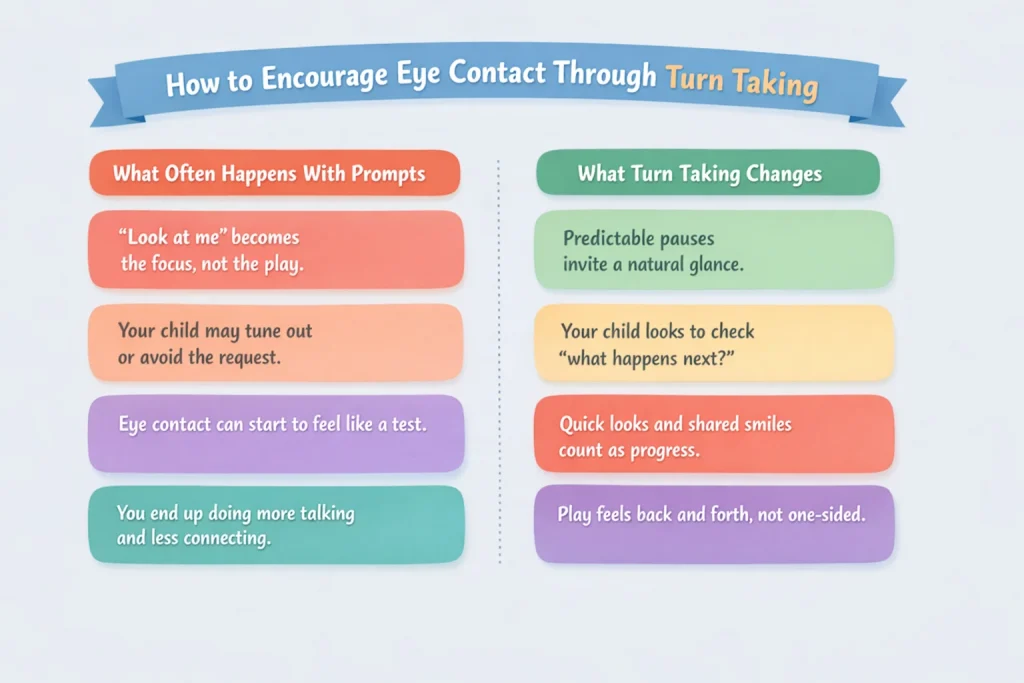
Turn taking creates a tiny, predictable pause in the fun. And in that pause, many kids glance up, not because they were told to, but because their brain is checking, “Is it your turn? What happens next?”
Also read: 6 Eye Contact Activities for Toddlers That Fit Into Short Play Bursts
Why Prompts Often Backfire, Even When You Are Being Gentle
Most parents prompt because they care. You want connection. You want to know your child is with you. So you try a reminder, then another, then maybe you move closer and repeat it again.
Here is the tricky part. When a child is busy playing, their attention is already working hard. Adding a verbal prompt can feel like extra noise layered on top of the play. Some kids tune it out. Some kids get stuck on the words and miss the moment. Some kids start to avoid looking because they can sense the expectation, even if you are smiling and keeping it light.
Prompts can also accidentally turn eye contact into a task. Instead of “We are sharing this,” it becomes “I need to do this right.” That is a lot for a small child, especially in the middle of play.
A more comfortable goal is a quick “check in.” A glance. A shared smile. Looking from the toy to your face and back again. This is the kind of eye contact during play that builds connection without making anyone feel pressured.
How turn taking naturally invites eye contact during play
Turn taking works because it is predictable and social at the same time.
When you take turns, you create a pattern your child can learn. My turn, your turn. Something happens, then a pause, then something happens again. That pause is where eye contact often shows up.
Kids look up for a few common reasons in those moments:
- Anticipation: “Are you going to do the fun part again?”
- Confirmation: “Is it my turn now?”
- Sharing: “Did you see what I did?”
- Connection: “Are we doing this together?”
This is why turn taking can feel so different from prompting. You are not asking for a look. You are building a little social rhythm that makes looking useful.
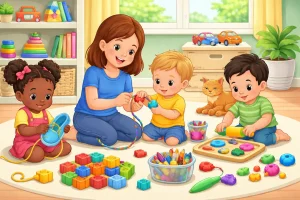
You will often see this with simple back and forth play like rolling a ball, bubbles, peekaboo, or a silly sound you repeat. The toy or action is still the focus, which is fine. Your face becomes part of the pattern, not the center of a demand.
Read More: It’s Okay if Your Toddler Only Gives Quick Glances During Play
What good eye contact can look like in real life (it is usually brief)
Many parents picture eye contact as steady looking, almost like a child is listening in a classroom. That image can make everyday play feel like it is falling short.
In real homes, “good” eye contact is often quick and casual. It might look like:
- A half second glance right before you blow bubbles
- A look up after your child knocks down a block tower
- A grin that comes with a quick look toward your face
- Looking at the snack, then at you, then back to the snack
- A tiny check in during dressing, like “Are you still there?”
These moments count because they are meaningful. They show your child is noticing you as part of the interaction.
If your child looks more when something is exciting, funny, or familiar, that is also normal. Many kids look less when they are concentrating, tired, or in a busy environment. Eye contact during play is not a performance. It is a relationship skill that grows with comfort and repetition.
Where Turn Taking Shows Up Easily, Even if Your Child Is Always on the Move
Some kids love sitting for face to face games. Others want to move, climb, spin, and explore. Turn taking can work for both, because it is not limited to sitting still.
You might notice natural “my turn, your turn” moments in:
- Rolling something back and forth, even for one roll at a time
- Bubbles where you hold the wand, then pause
- A wind-up or light-up toy that you control briefly
- A silly sound you do, then wait for your child’s reaction
- A familiar song where you pause before the favorite part
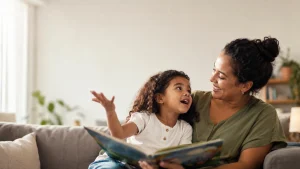
- Page turning in a book, especially if there is a repeated line
- Snack routines where you offer, then wait a beat
You do not need to announce “my turn” and “your turn” out loud for it to work. The rhythm can be mostly nonverbal. Your child learns the pattern through repetition.
If you are looking for “eye contact activities for toddlers,” it can help to think less about activities and more about moments. Turn taking is a moment you can create inside almost any game your child already likes.
Know More: Why won’t my child make eye contact during play with me?
How To Encourage Eye Contact Without Nagging: Small Shifts That Change the Whole Feel
If you want to keep things comfortable and natural, focus on your role in the moment, not on getting your child to perform.
A few parent-friendly shifts that often help:
- Get on the same level when you can. Eye level makes glances easier.
- Use a playful pause instead of a question. A quiet pause gives space for a look.
- Let your face do the talking. A warm smile or curious expression can be more inviting than words.
- Comment more, quiz less. “Uh oh, it fell!” often lands better than “Look at me!”
- Respond quickly when a glance happens. Continue the fun, smile back, or mirror their excitement.
- Keep praise simple. Big celebrations can pull kids out of the moment. A gentle “I see you” tone is often enough.
If your child does not look up in the pause, it does not mean it is not working. Sometimes the first sign of progress is that your child stays near you longer, brings you a toy, or waits for your turn. Those are early building blocks for eye contact during play.
When it feels stuck: common reasons and kind next steps
Some days, eye contact is harder. That is true for adults too. If it feels like turn taking is not getting traction yet, a few common reasons may be in the mix:
- Your child is in a deep focus stage and loves problem solving with objects
- The environment is busy, loud, or visually distracting
- The play is moving too fast, so there is no natural pause to “check in”
- Your child is unsure what will happen next, so they stay focused on the toy for predictability
- Your child is more comfortable with connection side by side than face to face
Often, the kindest next step is simply making the pattern more predictable and the pause more obvious, without adding pressure. Many families also find that routines are easier than toys at first. Meals, bath, dressing, and greetings have built-in repetition, which can support eye contact during routines in a very natural way.
If you are noticing broader communication differences and you feel unsure what you are seeing, some families consider a developmental screening to better understand communication delays or possible autism-related differences. It is not about jumping to conclusions. It is about getting clear, supportive guidance that fits your child.
A therapist can also help you troubleshoot tiny adjustments that make a big difference, like how long to pause, where to position yourself, and how to keep the interaction playful when your child is on the move.
A gentle closing: how to encourage eye contact by protecting connection first
If you take one thing from this, let it be this: you do not have to remind your child to look at you all day for eye contact to grow. When you focus on turn taking, you are building a shared rhythm that makes looking up feel useful and safe.
Those quick glances are real communication. A half second look before you blow bubbles, a grin after a silly sound, a check in during a snack pause. It all adds up.
If you are still wondering how to encourage eye contact, start by noticing where your child already pauses, waits, or anticipates. That is your opening. Connection first, always.
About the Author:
Shravanaveena Gajula
M.Sc ., Speech and Language Pathology (5+ years of experience)
Shravanaveena Gajula is a dedicated Speech-Language Pathologist with a BASLP and an M.Sc in Speech and Language Pathology. With experience spanning multiple settings, including Wellness Hub , Veena specializes in a wide range of disorders from developmental issues in children to speech and language assessments in adults. Her expertise includes parent counseling, managing speech sound and fluency disorders, and creating individualized therapy programs. Veena is also PROMPT certified and an author of several insightful blogs on speech and language pathology, aiming to educate and assist caregivers in supporting their loved ones.
Book your Free Consultation Today
Parent/Caregiver Info:
Client’s Details:
* Error Message