Joint Attention Myths: Make Them Look at Me and Other Advice That Backfires
Last Updated: March 13, 2026
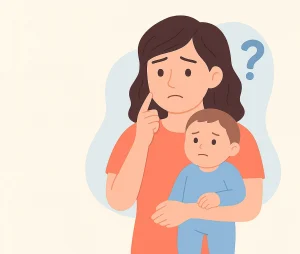
If you’ve ever been told, “Just make them look at you,” you’re not alone. A lot of joint attention advice is shared with good intentions by relatives, friends, even strangers at the park. But it can leave parents feeling like they’re supposed to test their child all day long: “Did they look when I pointed? Did they look when I said their name? Did they look at my face long enough?” For many parents, that worry sounds like: “toddler not looking at you.”
That pressure can turn everyday moments into a scoreboard. And it can make you feel like you’re doing something wrong if your child doesn’t respond the way someone expects.
Here’s the reassuring truth: joint attention isn’t about compliance, perfect eye contact, or performing on cue. It’s about shared interest; those small, meaningful moments when you and your child are tuned into the same thing, together.
Also read: Am I Over-Talking During Play? How Too Many Words Can Make It Harder to Share Attention
What toddler not looking at you can really mean
Joint attention is your child learning to share focus with you around something in the world, an object, an event, a sound, a silly moment. It can look like following your gaze, noticing where you point, shifting attention between you and a toy, or showing you something they find interesting.
In real life, it’s the feeling of, “We’re in this moment together.”
That shared focus helps children connect with caregivers and make sense of what’s happening around them. Over time, it also supports communication, because it’s much easier to share ideas, feelings, and words when two people are paying attention to the same thing. And most importantly, joint attention often shows up in quiet, easy-to-miss ways. A quick glance. A pause. A small shift of the eyes toward what you’re looking at. A smile that says, “I see it too.”
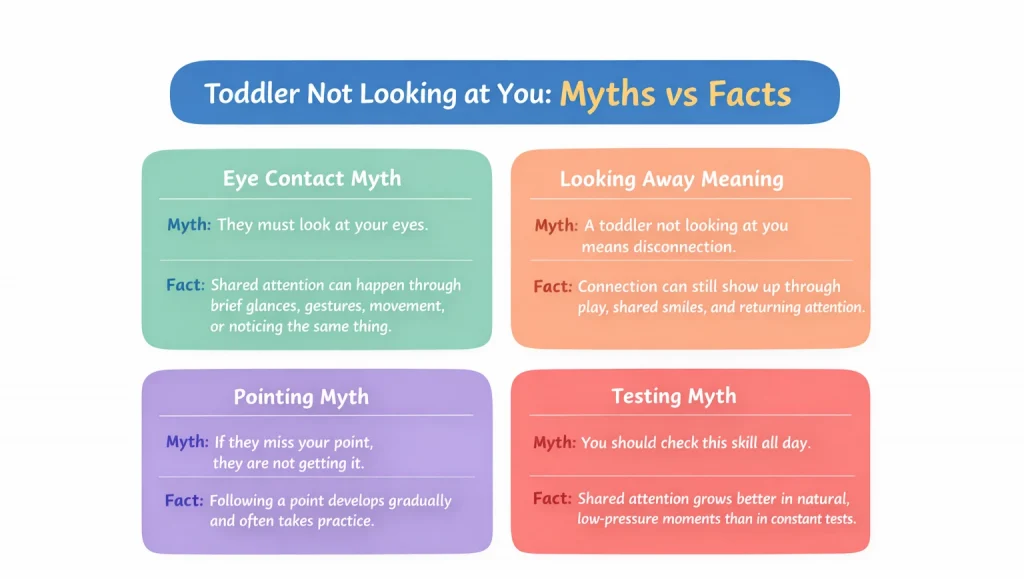
Myth #1: Joint attention means they have to look at my eyes
This is one of the most common misunderstandings. Many parents get told to “work on eye contact” as if that’s the whole goal.
But joint attention is not a staring contest. It’s not about holding eye contact for a certain number of seconds. It’s about sharing attention, sometimes through eye gaze, sometimes through body movement, sometimes through bringing you an object, leaning in, or looking where you’re pointing.
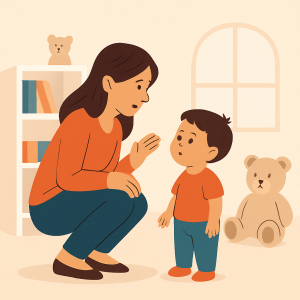
Some children naturally use brief glances. Others prefer to look at what’s interesting rather than at a person’s face. That doesn’t mean they aren’t connecting. It often means they’re connecting in a way that fits their temperament and comfort. When adults focus too hard on “Look at me,” children can start to feel interrupted or pressured, especially if they are happily engaged in play. Connection tends to grow more easily when your child feels safe to look when they’re ready, not when they’re being directed.
Myth #2: If I point and they don’t look, they’re not getting it
Pointing feels like it should be simple: you point, they look. But for many children, following a point is a skill that develops gradually. It can take time to understand that your finger isn’t the interesting part, the thing you’re pointing to is.
Sometimes children will look at your hand, they’ll look in the general direction but not land on the exact object. Sometimes they’ll keep playing and check in later. All of that can be part of learning. Joint attention isn’t an instant response. It’s a growing awareness that your attention has meaning, and that sharing it can be enjoyable.
Myth #3: You need to test it throughout the day
When parents feel worried, it’s completely understandable to start checking, especially when the fear is “toddler not looking at you”: “If I point at the dog, will they look? If I look at the airplane, will they follow my gaze?” The problem is that testing can quietly steal the joy from the moment.
Children are more likely to share attention when it feels natural and emotionally safe. When it feels like a quiz, many kids do what kids do best: resist, ignore, or get silly. A more helpful mindset is noticing rather than testing. Instead of “Did they do it?” the question becomes, “When do they naturally tune in with me?” and “What kinds of moments bring us together?”
Also read: How to Build Joint Attention During Everyday Routines (Meals, Bath, Getting Dressed)
Myth #4: If they don’t follow my lead, they’re not connecting
Joint attention is often described as your child following your gaze or your point. That’s part of it, but it’s not the whole story.
Children also build joint attention by inviting you into their world. When your child brings you a toy, makes a sound and looks to see your reaction, pulls you toward something, or lights up when you notice what they’re doing, that’s shared attention too. Sometimes the strongest connection happens when you follow their lead first. When a child feels understood and seen, they’re often more open to noticing what you notice as well.
Myth #5: The best way is to physically guide them
Parents sometimes hear advice like, “Turn their face toward you,” or “Hold their chin so they look.” Even when meant kindly, this approach can backfire.
Most children don’t enjoy having their body directed that way, and it can make them less likely to look or engage next time. Joint attention grows through trust and comfort. If a child learns that looking at you leads to being physically controlled, they may start avoiding those moments altogether. Connection is much more likely when your child feels they have choice, when they can look, shift away, and return again without pressure.
What tends to work better: connection over control
If forcing eye contact and constant testing don’t help, what does?
In everyday life, joint attention tends to grow in moments that are already meaningful: a shared laugh, a surprise sound, something interesting outside the window, a favorite page in a book, a snack you both enjoy. When you notice something and genuinely react, “Oh wow!”, you’re offering your child a chance to join you, not demanding that they do.
It also helps to remember that “success” often looks subtle at first. You might notice your child looking where you gaze more often, shifting attention between you and an object, or sharing excitement in small ways. You may see more shared smiles during play, or a growing curiosity about what you’re talking about.
These are real signs of connection building. They count.
Also read: What Joint Attention Looks Like at Home (Small Signs You Might Be Missing)
If advice has made you feel anxious, you’re not doing anything wrong
Many parents carry a quiet fear that “toddler not looking at you” means they’re supposed to fix joint attention by trying harder. But joint attention isn’t something you can force into place with the right trick. It’s a relationship skill, built through repeated, low-pressure experiences of shared focus.
- If your child doesn’t look when you point, it doesn’t mean you’re failing.
- If your child doesn’t look at your face much, it doesn’t mean you’re not bonded.
- If your child seems to connect differently than other kids, it doesn’t mean those connections aren’t real.
It simply means this skill is still developing, and development is rarely linear.
When you might want extra support without panic
Sometimes it helps to have another set of eyes, not because something is “wrong,” but because parenting is easier when you feel supported and confident, especially if the worry “toddler not looking at you” keeps coming up.
If you find yourself stuck in worry, unsure how to create more shared moments, or wanting ideas that fit your child’s personality, structured support can be comforting. Some families like having a simple plan and examples they can use during real routines: play, reading, snacks, or being outside, without turning the day into therapy.
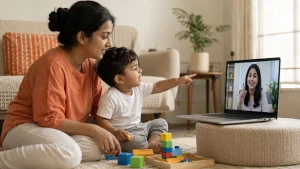
Speech therapy like BASICS can be a helpful option here. It’s designed to help parents understand goals like joint attention and support them through everyday moments, with short videos and guidance that keeps things calm and doable. It’s not about pushing a child to perform, it’s about making connections easier to notice and nurture.
If you still have concerns about your child’s communication or social connection, speaking with a paediatrician or speech-language pathologist can be a helpful next step.
A gentle takeaway to hold onto
Joint attention is shared interest, not perfect behavior.
It’s your child learning, little by little, that your attention is worth noticing, and that being “together” around something can feel good. The goal isn’t to make your child look at you on command. The goal is to build more moments where you and your child are connected to the same experience, in a way that feels safe and natural. So if you’ve been told to “make them look at you,” you can let that go. Look for the tiny invitations. The quick glances. The shared smiles. The moments when your child’s excitement meets yours, even briefly.
Those moments are joint attention.
And they’re already a beautiful place to begin.
About the Author:
Anuradha Karanam
Speech-language pathologist (7+ years of experience)
Anuradha Karanam is a skilled speech-language pathologist with over 6 years of experience. Fluent in Tamil, Telugu, Hindi, and English, she specializes in parent counseling, speech sound disorders, fluency assessment, and speech-language evaluations. Anuradha excels at working with children with developmental disorders, offering creative and effective therapy programs. Currently, at Wellness Hub, she holds a BASLP degree and is registered with the RCI (CRR No A85500). Her patience, ambition, and dedication make her a trusted expert in her field.
Book your Free Consultation Today
Parent/Caregiver Info:
Client’s Details:
* Error Message