Joint Attention Routines for Children: Meals, Bath and Dressing
Last Updated: March 23, 2026
Joint attention routines help a child share focus with an adult during everyday moments like eating, bathing, or getting dressed. This matters because shared attention supports early language, gestures, imitation, and social communication. For example, when your child looks at bubbles, looks back at you, and smiles, that is joint attention.
What you will learn in this article
- What joint attention looks like
- Why it supports communication
- Age-wise red flags to watch
- Simple routines parents can use
- When professional help is needed
Your child is sitting for breakfast. A banana slice slips from the spoon and lands on the table. You smile, look at the banana, and say, “Oops, it fell.” Your child briefly looks at the banana, then looks at your face.
In our clinic, we tell parents not to dismiss that tiny look. That small shift from object to parent is one of the early signs that your child is learning, “We are noticing this together.” It may last only one second, but it is clinically meaningful.
For many toddlers, joint attention grows best inside ordinary routines. You do not need a therapy room at home. You need short, repeated moments where your child can look, notice, respond, and share interest without pressure.
Also read: What Joint Attention Looks Like at Home Small Signs You Might Be Missing
What joint attention looks like in children
Joint attention looks like your child sharing focus with you around an object, person, sound, or event. It is not just eye contact; it is the back-and-forth shift between you and something interesting.
In real life, I look for small behaviours. A 10-month-old may follow your gaze when you look at a toy. A 14-month-old may point to a dog outside and look back at you. A 2-year-old may bring a broken crayon, show it to you, and wait for your reaction.
Parents often ask us, “Does it count if my child only looks for one second?” Yes, it can count. In early development, brief moments matter because children build communication through repeated micro-connections.
| What you may see | Example at home | Why it matters clinically |
|---|---|---|
| Follows your gaze | You look at the fan; child looks up too | Shows response to another person’s attention |
| Looks where you point | You point to a dog; child turns | Supports understanding of gestures |
| Shows an object | Child brings a toy car to you | Shows desire to share, not only request |
| Looks back and forth | Child looks at bubbles, then your face | Shows coordinated shared attention |
| Reacts with you | You laugh at a splash; child smiles at you | Builds social-emotional connection |
A key point: joint attention is different from requesting. If your child points to a biscuit because they want to eat it, that is communication, but it is mainly requesting. If your child points to a butterfly just to show you, that is joint attention.
The NIH/NICHD defines joint attention as sharing focus on an object or area with another person and gives examples such as following another person’s gaze or pointed finger. It also notes that joint attention is important for communication and language learning.
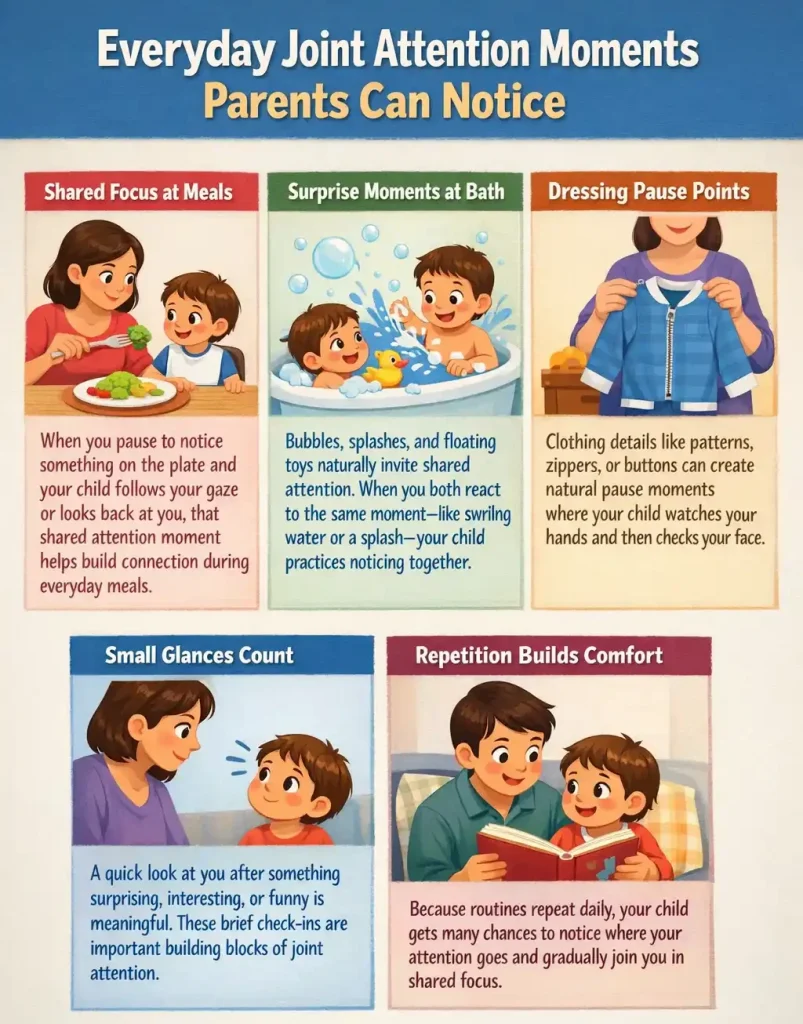
Why joint attention matters for speech and communication
Joint attention matters because children learn language more easily when they connect words, people, and shared experiences. When your child notices what you notice, your words become easier to understand.
In our clinic, we often see toddlers who can label letters, numbers, or colours but struggle to share attention with another person. They may know “A, B, C,” yet not look when a parent says, “Look, the dog is running.” That gap can affect social communication.
Joint attention supports several pre-language skills:
- Following gestures
- Understanding pointing
- Sharing interest
- Imitating actions
- Taking turns
- Linking words to real objects
- Starting early back-and-forth interaction
ASHA lists pointing, waving, showing, and giving objects as expected communication behaviours around 10–12 months, and points to requesting, commenting, or getting information as expected around 13–18 months. That is why delayed gestures should not be ignored.
Here is a simple clinical example. During bath time, you say, “Bubble!” while looking at the bubbles. If your child also looks at the bubbles and then checks your face, your word has a shared meaning. Your child is not just hearing sound; they are linking your word to a shared event.
Another example: while dressing, you hold up two socks and say, “Where is the red sock?” If your child looks at the sock, points, or hands it to you, they are using attention, understanding, and communication together.
At what age does joint attention develop
Joint attention usually begins in the first year and becomes more visible during the second year. By 12–18 months, parents should expect more pointing, showing, gaze-following, and shared reactions during daily routines.
Age ranges are not strict exam marks, but they help us decide when to watch closely. A child may be quiet and still developing well, but missing gestures, poor response to name, and lack of shared interest together need attention.
| Age Range | What to expect | Red flag if missing |
|---|---|---|
| 6–9 months | Looks toward voices, responds to faces, enjoys back-and-forth sounds | Rarely looks at faces or voices |
| 9–12 months | Responds to name, follows simple social games, points/waves/shows emerging | No response to name or no gestures |
| 12–18 months | Points to request/comment, shows objects, follows simple directions | No pointing, showing, or shared interest |
| 18–24 months | Shifts attention between parent and object, imitates actions, uses words with gestures | No back-and-forth attention or very limited gestures |
| 2–3 years | Uses words, gestures, and shared play to communicate | Plays only alone and rarely shares interest |
| Any age | Skills steadily increase | Loss of words, gestures, eye contact, or social interest |
The CDC states that all children should be screened for autism at 18 and 24 months, and developmental screening is recommended at 9, 18, and 30 months. Parents should not wait if joint attention concerns appear before those checkups.
What I tell families is simple: do not panic over one missed behaviour. But do not ignore a pattern. If your child does not respond to name, does not point, does not show objects, and does not share enjoyment by 18 months, book a developmental consultation.
During meals: use food moments to build shared attention
Meals work well because food naturally creates sights, smells, sounds, choices, and surprises. The goal is not to make the meal longer; the goal is to pause for small shared moments.
In our clinic, we use meals because parents already repeat them every day. A child may look at a crunchy papad, a rolling pea, a dripping spoon, or steam from rice. Each of these moments can become a small joint attention opportunity.
Use this simple routine:
| Step | What parent does | Example |
|---|---|---|
| Pause | Wait before giving the next bite | Hold the spoon near the bowl |
| Notice | Look at something interesting | Look at the rolling grape |
| Comment | Use short natural language | “It rolled!” |
| Wait | Give 3–5 seconds | Let your child look or react |
| Respond | Copy or expand their reaction | “Yes, grape rolled away!” |
Do not ask too many questions. “What is this? What colour? Say banana.” can turn a shared moment into a test. Instead, make comments your child can connect with: “Hot dosa,” “Crunchy carrot,” “Big bite,” “Oops, it fell.”
Micro-example one: Your child drops a spoon. Instead of quickly picking it up, look at the spoon, widen your eyes, and say, “Spoon fell.” If your child looks at the spoon and then at you, respond with a smile: “You saw it.”
Micro-example two: Your child likes curd rice. Before serving, hold the bowl where your child can see it, look at the bowl, and say, “Curd rice.” Wait. If your child reaches, looks, points, or vocalises, treat that as communication and respond.
For children who avoid sitting, keep the routine shorter. A 12-month-old may manage 10 seconds. A 2-year-old may manage 30 seconds. Your target is not perfect sitting; it is shared attention without pressure.
During bath time: use bubbles, water, and surprise
Bath time is powerful because water creates natural “wow” moments. Pouring, splashing, bubbles, floating toys, and disappearing water all invite shared attention.
Many children who resist table activities respond better in the bath. The routine is sensory-rich, predictable, and playful. In occupational therapy, we also watch whether water, sound, temperature, or touch overwhelms the child, because sensory discomfort can reduce social engagement.
Try this bath-time pattern:
- Pour water slowly and say, “Pour.”
- Pause before the next pour.
- Look at the falling water.
- Wait for your child to look.
- Smile or copy their sound.
- Repeat the same action three times.
Micro-example one: You squeeze a sponge and water drips out. Look at the sponge, then your child, and say, “Drip, drip.” If your child watches the sponge and then checks your face, that is shared attention.
Micro-example two: A toy duck floats away. Instead of grabbing it immediately, point gently and say, “Duck is going.” If your child follows your point, you can add, “Bye duck,” and wave.
Do not force eye contact in the bath. Some children look less when they are managing water on the face, sound echo, or slippery movement. If the child is sensory-sensitive, keep language calm, reduce splashing, and use one predictable toy.
A DIR/Floortime-informed style works well here because it follows the child’s interest and builds interaction from what already catches the child’s attention. If the child is fascinated by pouring, you join pouring. If the child likes bubbles, you join bubbles.
During getting dressed: turn pause points into communication
Dressing can support joint attention because it naturally includes objects, body parts, choices, and playful pauses. The routine may feel rushed, but even 20 seconds can help.
In our clinic, we often coach parents to stop treating dressing only as a task. A sleeve, sock, zipper, button, or printed T-shirt can become a communication moment. The child does not need to speak for the routine to work.
Use these dressing opportunities:
| Moment | Parent action | Child response to watch for |
|---|---|---|
| Shirt before wearing | Hold shirt near your face | Looks at shirt, then you |
| Sock choice | Show two socks | Reaches, points, or looks |
| Stuck zipper | Pause and look surprised | Checks your face |
| Mirror moment | Point to child’s reflection | Looks at mirror and smiles |
| Shoes | Hold one shoe and wait | Gives foot, looks, or vocalises |
Micro-example one: The shirt gets stuck over your child’s head for one playful second. You say, “Where are you?” and wait. If your child smiles, looks, or pulls the shirt down, you respond with, “There you are.”
Micro-example two: You hold up two T-shirts and say, “Car shirt or blue shirt?” If your child looks at one, touches one, or points, honour that choice. Joint attention often grows when the child sees that their attention changes what happens next.
For children aged 18–36 months, dressing is also a chance to pair words with body parts: “arm in,” “foot out,” “zip up,” “hat on.” Keep language short and useful. Too much talking can overload the child.
If dressing causes meltdowns, step back and check sensory triggers. Tags, tight collars, socks, seams, cold lotion, or rushed handling can make joint attention harder. Occupational therapy can help when sensory discomfort blocks daily routines.
What progress looks like
Progress in joint attention is usually small before it becomes obvious. Parents should look for more frequent shared looks, pointing, showing, imitation, and back-and-forth reactions across routines.
Do not measure progress only by speech. A child may first improve through gaze, gesture, facial expression, body movement, or sound. In our sessions, we document how often the child shares attention and how naturally they do it.
| Sign of progress | What it means clinically |
|---|---|
| Looks where you point more often | Responding joint attention is improving |
| Looks from object to parent | Coordinated attention is emerging |
| Brings objects to show | Initiating joint attention is growing |
| Smiles during shared routines | Social engagement feels rewarding |
| Copies your action | Imitation and attention are linking |
| Uses gesture with sound or word | Communication is becoming more intentional |
| Stays in routine longer | Regulation and engagement are improving |
| Shares attention in more than one routine | Skill is generalising across daily life |
Micro-example one: Last month your child never looked when you pointed to the window. Now they look two out of five times when you say, “Bird.” That is progress.
Micro-example two: Your child used to grab snacks without looking. Now they glance at you before taking the snack. That small check-in can be the beginning of stronger social communication.
Frameworks like JASPER focus on joint attention, symbolic play, engagement, and regulation. A review of JASPER studies found improvements in outcomes related to joint attention, joint engagement, play skills, and language skills in many studies.
What not to do
The biggest mistake is turning joint attention into a performance test. Children share attention more easily when they feel safe, interested, and unpressured.
Avoid saying “look at me” repeatedly. Eye contact is not the same as joint attention. A child can stare at your face without sharing meaning, and a child can share attention through pointing, smiling, showing, or shifting gaze without long eye contact.
Avoid these common traps:
| What not to do | Better option |
|---|---|
| “Look at me” repeated 10 times | Hold an interesting object near your face |
| Testing colours during every meal | Comment naturally on what happens |
| Taking the child’s hand to force pointing | Model pointing and wait |
| Asking too many questions | Use short comments |
| Ignoring sensory distress | Adjust sound, touch, clothing, or pace |
| Expecting instant speech | Accept gaze, gesture, sound, or movement |
Do not compare siblings. One child may point early, another may show objects later. The clinical concern is not personality; it is a pattern of missing social communication behaviours across settings.
Do not wait for preschool if your 18–24-month-old has no pointing, showing, response to name, imitation, or shared enjoyment. Early support is not a label. It is a way to understand what your child needs.
When to seek professional help
Seek professional help when your child rarely shares attention, does not point or show objects, does not respond to name, loses communication skills, or struggles with daily routines because of sensory or social communication difficulties. Early assessment gives parents clarity and helps therapy start before frustration grows.
In our clinic, we recommend help when concerns appear across more than one routine. For example, if your child does not look when called during meals, does not follow pointing during play, and does not show objects during the day, that pattern deserves assessment.
| Warning sign | Recommended action |
|---|---|
| No response to name by 9–12 months | Speak with paediatrician; check hearing and development |
| No pointing, waving, showing, or giving by 12 months | Book speech-language assessment |
| No pointing to share interest by 15–18 months | Request developmental screening |
| No back-and-forth gaze between object and parent by 18–24 months | Consult SLP or developmental paediatrician |
| Loss of words, gestures, eye contact, or social interest | Seek urgent developmental review |
| Strong sensory distress during bath, dressing, or feeding | Consult occupational therapist |
| Uses words but rarely shares interest | Assess social communication |
| Parent feels unsure despite trying routines | Book a consultation for guided coaching |
The CDC notes that autism can sometimes be detected at 18 months or younger, and by age 2 a diagnosis by an experienced professional can be considered reliable.
If you are worried, do not wait for relatives to say, “Boys talk late” or “She will grow out of it.” Some children do catch up, but a professional can help you know whether your child needs monitoring, parent coaching, speech therapy, occupational therapy, or a full developmental evaluation.
How speech therapy or occupational therapy works on joint attention routines
Speech therapy works on joint attention by helping the child share focus, use gestures, imitate actions, understand words, and communicate with intention. Occupational therapy helps when sensory processing, regulation, posture, feeding, dressing, or play participation affects attention and interaction.
In our speech therapy sessions, we do not start by forcing words. We first build connection. We may use bubbles, snack routines, pretend play, cause-and-effect toys, songs, books, and parent coaching. The goal is to help the child notice, respond, and communicate.
In occupational therapy, we look at the body and sensory side. A child who hates water on the face may not share attention in the bath because they are distressed. A child who dislikes tags may resist dressing so strongly that communication disappears. Regulation comes before learning.
Read more: Speech Delay Red Flags in Toddlers: 18–24 Month Warning Signs for Parents
Therapy may include:
- Parent coaching during real routines
- Modelling gestures and pointing
- Building imitation through play
- Creating predictable pause-and-wait moments
- Supporting sensory regulation
- Using AAC or pictures if speech is limited
- Expanding from requesting to sharing
- Tracking progress across home routines
A Naturalistic Developmental Behavioral Intervention, or NDBI, blends developmental interaction with behavioural teaching inside natural play and routines. ESDM is one example used with young autistic children, while JASPER directly targets joint attention, play, engagement, and regulation.
PECS or other AAC systems may help children who have limited speech, but they should not be used only for requesting. A good therapist also builds commenting, showing, choosing, rejecting, and sharing interest.
Comparing therapy approaches
Different therapy approaches can support joint attention, but the right choice depends on the child’s age, regulation, communication level, sensory needs, and family routine. No single approach fits every child.
| Approach | What it focuses on | Best for |
|---|---|---|
| JASPER | Joint attention, symbolic play, engagement, regulation | Children with autism or social communication delays |
| Hanen More Than Words | Parent coaching in everyday routines | Families needing practical home strategies |
| ESDM | Developmental play, social engagement, communication | Toddlers with autism or early signs |
| DIR/Floortime | Emotional connection, child-led interaction, regulation | Children who need relational engagement first |
| NDBI | Natural routines plus structured teaching | Young children who learn through play and repetition |
| PECS/AAC | Functional communication through pictures or devices | Children with limited speech or high frustration |
| Occupational Therapy | Sensory regulation, dressing, feeding, play participation | Children whose sensory needs block interaction |
| Speech-Language Therapy | Gestures, understanding, words, social communication | Children with speech/language delay |
In our clinic, we often combine approaches. A 20-month-old may need Hanen-style parent coaching, JASPER-informed play, and OT support for sensory regulation. A 3-year-old may need speech therapy plus AAC if frustration is high.
The NIH/NICHD notes that joint attention therapy focuses on skills such as pointing, showing, and coordinating looks between a person and an object.
Questions parents ask
1. My child looks at me but does not follow my pointing. Is that joint attention?
Looking at you is social attention, but following your pointing shows responding joint attention. If your child looks at your face but does not turn toward what you point to by 12–18 months, watch the pattern closely. Try pointing during exciting moments, such as a dog running or bubbles popping. If your child still does not follow points across daily routines, book a speech-language evaluation.
2. My toddler points only when they want something. Should I worry?
Pointing to request is useful communication, but it is not the same as pointing to share interest. We also want to see your child point to show you a bird, a toy, a sound, or something funny. If your toddler only points to get things and rarely shares enjoyment, they may need support with social communication. A therapist can help expand pointing from requesting into commenting and sharing.
3. Can I build joint attention if my child does not talk yet?
Yes. Joint attention often develops before clear speech and can be built through looks, gestures, sounds, smiles, showing, and imitation. During meals, bath, and dressing, focus on shared moments rather than asking for words. If your child starts looking, pointing, or showing more often, that is meaningful progress. Speech can grow more easily when these pre-language foundations improve.
4. Should I force my child to look into my eyes?
No. Forcing eye contact can increase stress and does not automatically build communication. Instead, place interesting objects near your face, use warm expressions, pause, and let your child look voluntarily. Joint attention is about shared meaning, not staring. If eye contact feels uncomfortable for your child, a neuroaffirming therapist can help build connection through gestures, play, AAC, and shared routines.
5. What if my child shares attention during play but not during dressing or bath?
That tells us the skill may not have generalised yet, or the routine may be harder because of sensory or time pressure. A child may share attention with toys but shut down when water, clothing, noise, or transitions feel uncomfortable. Start with the easiest routine and add one small pause. If bath or dressing always causes distress, occupational therapy can help identify sensory triggers.
6. When should I stop home routines and get therapy?
Do not stop home routines; combine them with professional guidance if red flags are present. Seek help if your child has no pointing, showing, response to name, imitation, or shared interest by 18–24 months, or if skills have regressed at any age. A therapist can show you how to use the routines correctly instead of guessing. Early guidance often reduces parent stress and child frustration.
Citations used in the article
- Eunice Kennedy Shriver National Institute of Child Health and Human Development. “Joint Attention Therapy for Autism.” NICHD, 2017. URL: https://www.nichd.nih.gov/health/topics/autism/conditioninfo/treatments/joint-attention
- American Speech-Language-Hearing Association. “Communication Milestones: Birth to 1 Year.” ASHA. URL: https://www.asha.org/public/developmental-milestones/communication-milestones-birth-to-1-year/
- American Speech-Language-Hearing Association. “Communication Milestones: 13 to 18 Months.” ASHA. URL: https://www.asha.org/public/developmental-milestones/communication-milestones-13-to-18-months/
- Centers for Disease Control and Prevention. “Clinical Screening for Autism Spectrum Disorder.” CDC, 2025. URL: https://www.cdc.gov/autism/hcp/diagnosis/screening.html
- Waddington H, et al. “The effects of JASPER intervention for children with autism spectrum disorder: A systematic review.” PubMed, 2021. URL: https://pubmed.ncbi.nlm.nih.gov/34348479/
- Kasari C, Gulsrud AC, Wong C, Kwon S, Locke J. “Randomized controlled caregiver mediated joint engagement intervention for toddlers with autism.” Journal of Autism and Developmental Disorders, 2010. URL: https://ncaep.fpg.unc.edu/resource/randomized-controlled-caregiver-mediated-joint-engagement-intervention-for-toddlers-with-autism/
Book your Free Consultation Today
Parent/Caregiver Info:
Client’s Details:
* Error Message