When Turn-Taking Feels Impossible: Gentle Signs It’s Time for Extra Support
Last Updated: March 5, 2026
Turn-taking is one of those skills that sounds simple until you’re living it, especially when turn-taking difficulties keep interrupting play.
You try “my turn, your turn,” and it lasts for one exchange, maybe two, before someone grabs, melts down, or walks away. You set up a fun little back-and-forth game, and it turns into tears or a power struggle. Or you feel like you’ve been “working on it” for weeks, and nothing is sticking.
If this is your home right now, it doesn’t mean you’re doing anything wrong. Turn-taking asks a lot of young children: waiting briefly, handling disappointment, shifting attention, and staying connected long enough to keep the exchange going. Many kids need time to grow into that rhythm.
And sometimes, families reach a point where it’s helpful to pause and ask a different question: not “How do I make this work?” but “Would extra support make this easier for all of us?”
Why turn-taking difficulties can feel so hard even when your child wants to play
Turn-taking during play and simple routines includes things like rolling a ball back and forth, taking toy turns, doing “vocal ping-pong” with sounds, or sharing small roles in everyday moments, like taking turns turning book pages or choosing a snack item. Over time, many children build toward a comfortable back-and-forth with 3–5 or more exchanges.
But early on, the “turn” part can feel like a loss. Your child may understand the fun of the activity, but the pause, the waiting, and the uncertainty of “Will I get it back?” can be genuinely hard. Some children also get so excited that their body moves faster than their patience can keep up.
It’s also common for turn-taking to look different depending on the day. When your child is tired, hungry, overstimulated, or adjusting to a new routine, turns can fall apart quickly. That doesn’t erase progress—it just means real life is part of the learning.
What progress usually looks like and why it can be easy to miss
Parents often imagine turn-taking progress as a clean, steady climb: one turn becomes two, two becomes five, and suddenly you’re playing nicely.
In reality, progress is often quieter and more uneven. It might look like your child tolerating a tiny pause before grabbing. Or handing something to you once and then snatching it back. Or staying near you during a back-and-forth game even if they’re not ready to wait yet. Sometimes it shows up as more connection—more eye contact, more smiles, more “again!” even if the turns are still messy.
These moments count. Turn-taking is as much about shared joy as it is about sharing objects.
Also read: Turn-Taking During Snack, Books, and Getting Ready: Easy Routines That Count
When home efforts feel stuck: gentle signs it may be time for extra support
Needing extra support isn’t a sign of failure. It’s often a sign that your child’s needs are a little bigger than what “try this at home” can comfortably hold right now or that you deserve more guidance so it doesn’t feel so heavy.
Here are a few patterns that can be worth paying attention to.
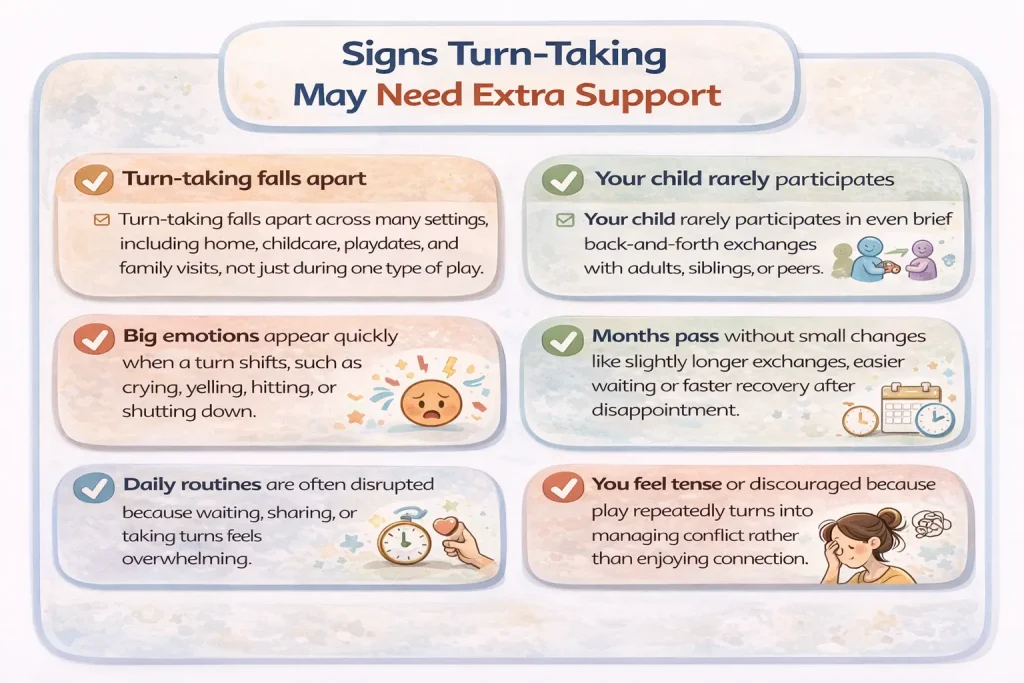
Turn-taking falls apart across settings, not just at home
Many children do best in familiar places with familiar people. So if turn-taking is hard at the park or with cousins, but you can sometimes get a few exchanges at home, that may simply be “new environment energy.”
But if turn-taking feels impossible everywhere home, childcare, grandparents’ house, playdates and it consistently leads to big feelings, extra support can help you sort out what’s getting in the way and what kind of expectations are realistic right now.
It’s hard with everyone, not just one adult or sibling
Sometimes turn-taking is hardest with siblings (because siblings are fast, unpredictable, and very motivating). Other times it’s hardest with a particular parent because that parent is the “safe place” where feelings come out.
If your child struggles to take turns with anyone adults, peers, siblings and you rarely see even brief back-and-forth moments, it can be helpful to have another set of eyes to notice what your child is doing and how to build from there when turn-taking difficulties persist.
Big emotions show up quickly and often
It’s normal for young children to protest when a turn ends. What parents often find draining is when turn-taking regularly becomes a flashpoint: crying, yelling, hitting, throwing, or a full shutdown the moment a turn shifts.
When the emotional cost is high, it can be hard to practice at all because you’re not just “working on turns,” you’re managing distress. Support can help you protect your relationship and your child’s sense of safety while still moving the skill forward gently.
You’re not seeing change over time, even in tiny ways
A single rough week doesn’t mean much. But if months go by and you’re not seeing small shifts like slightly longer exchanges, slightly easier waiting, or slightly quicker recovery after disappointment—it’s reasonable to ask for guidance about possible turn-taking difficulties.
Sometimes families are doing all the “right” things, but the approach doesn’t match the child’s current stage. Sometimes expectations are accidentally too big. Sometimes the child needs more structure or a different kind of support. Getting help can make the path clearer.
Read more: How to Teach Turn-Taking Without Power Struggles or Forced Sharing
Turn-taking is affecting daily life, not just play
Turn-taking isn’t only a “toy skill.” It shows up in simple routines: waiting while you pour a drink, taking turns choosing a song, passing a spoon, letting someone else open the door, or turning book pages.
If everyday routines are frequently derailed because waiting and sharing feel impossible, support can help daily life feel calmer not perfect, just more doable when turn-taking difficulties affect routines.
You feel tense, discouraged, or like you’re constantly “managing”
This one matters. If turn-taking has become a daily stress point and you find yourself bracing for the next struggle, it’s okay to want help.
Sometimes the best reason to seek support is simply that you’re carrying too much of it alone. Parenting is already full. You deserve tools that fit your family, and reassurance that you’re not missing something obvious.
What “extra support” can look like without blame or panic
Support doesn’t have to mean something is wrong. Think of it more like getting a coach when the game feels confusing.
Extra support might look like a professional watching how your child engages in back-and-forth play and noticing small strengths to build on like moments of connection, curiosity, or willingness to re-engage. It might look like help choosing goals that match your child’s current abilities, especially when turn-taking difficulties make practice feel overwhelming.
It can also be practical support for you: ways to keep play light, reduce power struggles, and create more moments where turn-taking feels like shared joy instead of a test.
Some families prefer in-person support; others like a structured, home-based approach. Speech and Autism therapy apps like BASICS can also be an option if you want simple guidance around goals such as taking turns during play and routines, with ideas that fit into everyday life without adding pressure.
How to seek help in a calm, parent-friendly way
If you’re considering support, you don’t need a perfect summary or a dramatic story. A few simple observations are enough.
It can help to reflect on patterns like: When does turn-taking go best? When does it fall apart? Is it easier with an adult than with a peer? Does your child manage one exchange but not several? Are there certain toys or routines that trigger conflict?
You can also share what you’ve already noticed works maybe playful language helps, maybe a brief pause helps, maybe your child does better when the activity is predictable. This isn’t about proving you tried hard enough. It’s about giving someone a clear picture so they can meet your child where they are.
A steadying reminder for parents
Turn-taking is a big skill made of many small skills: connection, waiting, flexibility, and trust that the fun will continue. When it’s hard, it’s not a reflection of your parenting or your child’s character. It’s simply a sign that this part of development needs more time or more support.
If you’re feeling stuck, you’re allowed to reach for help early and gently. The goal isn’t to force sharing or create perfect play. The goal is to make back-and-forth moments feel more possible, more peaceful, and more connected, one small exchange at a time even when turn-taking difficulties are part of the journey.
About the Author:
Rajini Darugupally
M.Sc., Speech-Language Pathologist (9+ years of experience)
Rajini is a passionate and dedicated Speech-Language Pathologist with over 9+ years of experience, specializing in both developmental speech and language disorders in children and rehabilitation in adults. Driven by a desire to empower each individual to find their voice, Rajini brings a wealth of experience and a warm, genuine approach to therapy. Currently, at Wellness Hub, she thrives in a team environment that values innovation, compassion, and achieving results for their clients. Connect with Rajini to learn more about how she can help you or your loved one find their voice.
Book your Free Consultation Today
Parent/Caregiver Info:
Client’s Details:
* Error Message