Common Turn-Taking Mistakes Like Saying ‘Share!’ Too Much and What Helps Instead
By Wellness Hub
Last Updated: March 3, 2026
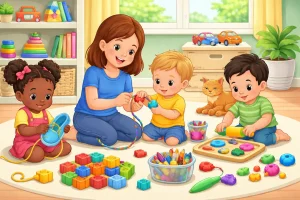
If turn-taking feels like the hardest part of playtime in your home, you’re in good company. These turn-taking mistakes are incredibly common. Many parents go into play with the best intentions, hoping siblings will get along, wanting to teach kindness, trying to prevent a meltdown before it starts, and still end up thinking, “Why does this always blow up?”
Turn-taking is a real skill. It’s not just “being nice.” It includes waiting briefly, handing something over, accepting “not yet,” and staying in the interaction for a few back-and-forth exchanges, whether that’s rolling a ball, taking turns with a favorite toy, or doing a simple “my turn/your turn” routine during snack or books. That’s a lot for a young child’s brain and body to manage, especially when they’re excited, tired, or deeply invested in what they’re holding.
This article isn’t about doing more. It’s about noticing a few common habits that can accidentally make turn-taking harder, and what tends to help instead, in a calmer, more cooperative way.
Why turn-taking gets so intense so fast
Turn-taking often involves the exact things that are hardest for young children: pausing, waiting, giving up control, and trusting that something will come back to them. When a child is playing, the toy isn’t just an object, it’s part of their plan, their focus, and sometimes their sense of safety in the moment.
So when turn-taking is introduced abruptly, or when it feels like a demand, it can trigger big feelings quickly. That doesn’t mean your child is “bad at sharing.” It usually means they’re still learning the rhythm of back-and-forth play and the emotional patience that goes with it.
Turn-Taking Mistakes 1: Saying “Share!” over and over especially mid-conflict
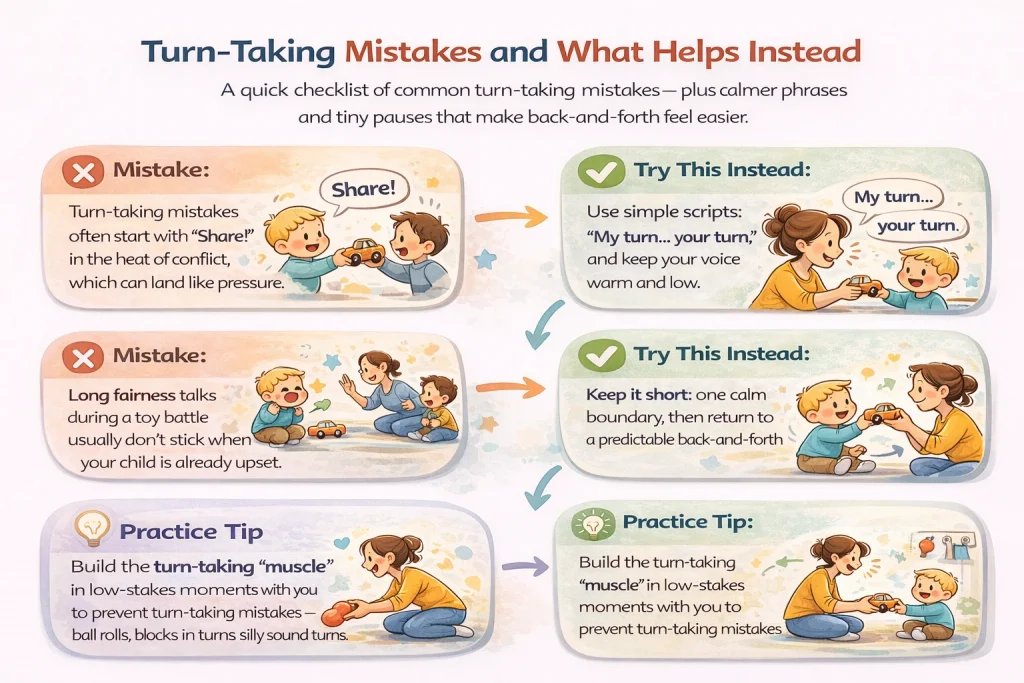
“Share!” is one of the most common phrases parents reach for, because it’s short, familiar, and we’ve all heard it used as the go-to solution. The problem is that in the heat of the moment, “Share!” often lands like pressure.
When a child is already upset or protective of a toy, repeated prompting can feel like a spotlight: You’re doing it wrong. Fix it right now. Instead of helping them settle into cooperation, it can turn turn-taking into a test they’re failing in real time.
What often helps instead is shifting from a command to a simple, warm narration of the turn-taking idea. Language like “my turn… your turn” tends to feel more playful and less moralizing than “share.” It also matches what turn-taking actually is: a back-and-forth exchange, not a one-way giveaway.
Mistake 2: Treating turn-taking like a fairness lecture
It’s completely understandable to want to teach fairness. Many parents find themselves explaining, “It’s not nice to grab,” or “You have to share with your sister,” right when emotions are high. But long explanations during conflict rarely work the way we hope. When children are upset, their brains are busy managing feelings, not absorbing lessons. A fairness lecture can also unintentionally raise the stakes, making the moment feel heavy and loaded.
What tends to help more is keeping the message small and steady, and letting the experience teach the concept over time. Turn-taking grows through repeated, low-pressure moments of “back and forth” that feel safe and predictable, not through one big talk during a toy battle.
Mistake 3: Taking the toy away abruptly to “teach a lesson”
When things get tense, many parents step in and remove the toy: “If you can’t share, nobody gets it.” Sometimes this is done to stop hitting or grabbing, sometimes to be fair, sometimes because everyone is overwhelmed.
And yes there are moments when you need to end an interaction for safety or sanity. But as a regular strategy, abruptly taking the toy can backfire. It can make children more protective next time, because the lesson they absorb is, If I let go, it disappears. That can make waiting and exchanging feel even riskier.
What often helps instead is protecting the relationship and the play. A calmer approach is to aim for a predictable exchange: the toy comes back, the interaction continues, and the child learns, little by little, that turns are temporary and safe. Even a brief pause before passing something can support that sense of predictability.
Mistake 4: Expecting a perfect “trade” when your child is still learning
Many parents try to make turn-taking logical: “Give him the truck and you can have the dinosaur.” That can work sometimes, but it can also create a bargaining mindset where every turn must be negotiated, equal, and immediate.
Early turn-taking is often messier than that. Some children can handle a quick swap. Others need a beat of time to process. Some can do a few vocal back-and-forths (“ba!” “ba!”) more easily than toy turns. Some can roll a ball back and forth happily but struggle with a highly preferred toy.
What helps instead is adjusting expectations to what “turn-taking practice” really looks like: brief waiting, small exchanges, and building toward 3–5+ back-and-forth moments over time. Progress might look like a half-second pause, a quick handover with support, or returning to the game after a protest. Those are meaningful steps.
Also read: 10+ Simple Home Activities That Build Turn-Taking (No Prep, No Pressure)
Mistake 5: Jumping in too fast not leaving room for the pause
When parents can sense a conflict coming, it’s natural to rush in with words: “Okay, your turn, now her turn, now say sorry, now give it back…” We’re trying to prevent tears, and we’re trying to keep things moving.
But turn-taking needs a little space. A small pause is often where the learning happens. That pause gives your child time to notice, to anticipate, to decide, and to participate—rather than simply comply.
What helps instead is allowing a beat of quiet, paired with warm connection. Eye contact, a smile, and a calm “your turn” can be more effective than a stream of prompts. The goal isn’t to make your child hand something over instantly. It’s to help them feel the rhythm of the exchange.
Mistake 6: Only practicing turn-taking when siblings are involved
Sibling dynamics add intensity: competition, big feelings, and a strong sense of “mine.” If the only time your child hears about turns is when a sibling wants what they have, turn-taking can start to feel like losing.
What often helps instead is building the turn-taking “muscle” in easier, lower-stakes moments—especially with you. Simple back-and-forth play (like rolling a ball, stacking blocks in turns, or taking turns making silly sounds) can create the feeling of cooperation without the same pressure. Even daily routines can hold tiny turns, like choosing a snack item, turning a book page, or doing a quick “my turn/your turn” moment that ends with shared laughter.
Over time, those experiences make sibling turn-taking more possible because the idea is familiar and the emotional load is lower.
What success actually looks like (and why it’s often quieter than you expect)
Many parents imagine success as cheerful sharing on demand. In real life, success is usually smaller and more gradual.
You might notice your child waiting for a second longer than yesterday. You might see them tolerate “not yet” without falling apart. You might get three back-and-forth exchanges with a toy before someone protests. You might hear them start to use the language of turns—“my turn!”—even if they’re not fully flexible yet.
Those moments count. Turn-taking is built from many small experiences of “we’re doing this together,” not one perfect interaction.
If turn-taking feels like a daily struggle, you’re not failing
If you’ve been saying “Share!” a hundred times a day, it doesn’t mean you’re doing it wrong. It means you’re trying. Most of these “mistakes” are really just normal parent reflexes, especially when you’re managing multiple kids, limited time, and big emotions. If you feel stuck in the same turn-taking mistakes loop, you’re not alone.
Sometimes it helps to have a little outside structure so you’re not guessing at the moment. Speech and Autism therapy like BASICS can support parents with simple, everyday ways to encourage goals like taking turns during play and routines, using short videos and gentle guidance that keeps the focus on connection rather than pressure. It’s not about doing playtime “perfectly.” It’s about making it feel more doable.
Turn-taking grows best when it feels safe, playful, and shared. And even when it’s messy, every small pause, every brief exchange, and every return to play is your child learning something important: relationships can hold both “me” and “you.”
About the Author:
Rajini Darugupally
M.Sc., Speech-Language Pathologist (9+ years of experience)
Rajini is a passionate and dedicated Speech-Language Pathologist with over 9+ years of experience, specializing in both developmental speech and language disorders in children and rehabilitation in adults. Driven by a desire to empower each individual to find their voice, Rajini brings a wealth of experience and a warm, genuine approach to therapy. Currently, at Wellness Hub, she thrives in a team environment that values innovation, compassion, and achieving results for their clients. Connect with Rajini to learn more about how she can help you or your loved one find their voice.
Book your Free Consultation Today
Parent/Caregiver Info:
Client’s Details:
* Error Message