What Counts as Turn-Taking? Small Signs Your Child Is Learning (Even If It’s Messy)
By Wellness Hub
Last Updated: March 3, 2026
Turn-taking sounds simple until you’re watching real life happen on your living room floor.
When parents start noticing the early signs of turn-taking, they often realise progress looks smaller and messier than expected.
You roll the ball. Your child grabs it and runs off. You offer a toy. They hold it… then pull it back. You say, “My turn,” and they look at you for half a second before going back to what they were doing. And you would wonder: Is this actually turn-taking? Are we getting anywhere?
Turn-taking is one of those skills that often develops in tiny, uneven steps. Early “turns” can be brief, inconsistent, and honestly a little chaotic. That doesn’t mean your child isn’t learning. It often means they’re learning exactly the way children do, through many small moments that add up over time.
This article will help you spot the early signs of turn-taking—those “almost-turns” that are easy to miss and feel more confident about what’s worth celebrating.
What turn-taking really means (especially at the beginning)
When adults think of turn-taking, we picture a neat back-and-forth: you roll the ball, they roll it back, you roll it again, three to five exchanges or more, with some waiting in between.
That can absolutely be a long-term goal. But early turn-taking is usually less polished. It’s not just about sharing a toy or waiting patiently. It’s about your child starting to understand a simple rhythm: you, me, you, me in play, in sounds, and in everyday routines.
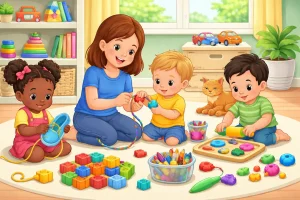
Turn-taking can show up in different ways, including vocal turn-taking (like a little “conversation” of sounds), toy turn-taking (passing or trading), and simple routines (like taking turns turning book pages or choosing a snack). And in the early stages, it often looks like your child is hovering near the idea of a turn rather than completing it.
That “hovering” still counts.
Why turn-taking often looks messy before it looks smooth
Many children don’t jump straight into cooperative back-and-forth play. They’re balancing a lot at once: excitement, curiosity, big feelings about control, and the simple fact that waiting is hard when you’re little.
Sometimes a child understands the idea of a turn but gets overwhelmed in the moment. Sometimes they want the interaction but aren’t sure what to do next. Sometimes they’re willing to take a turn only when it’s their favorite toy, or only when they’re in the right mood, or only with one specific person.
This is why progress can be easy to miss. If you’re looking for consistent, clean exchanges, you might overlook the quieter signs that your child is building the foundation.
Also read: My Child Won’t Take Turns During Play — Is That Normal?
Small signs that count as turn-taking even if they don’t look perfect
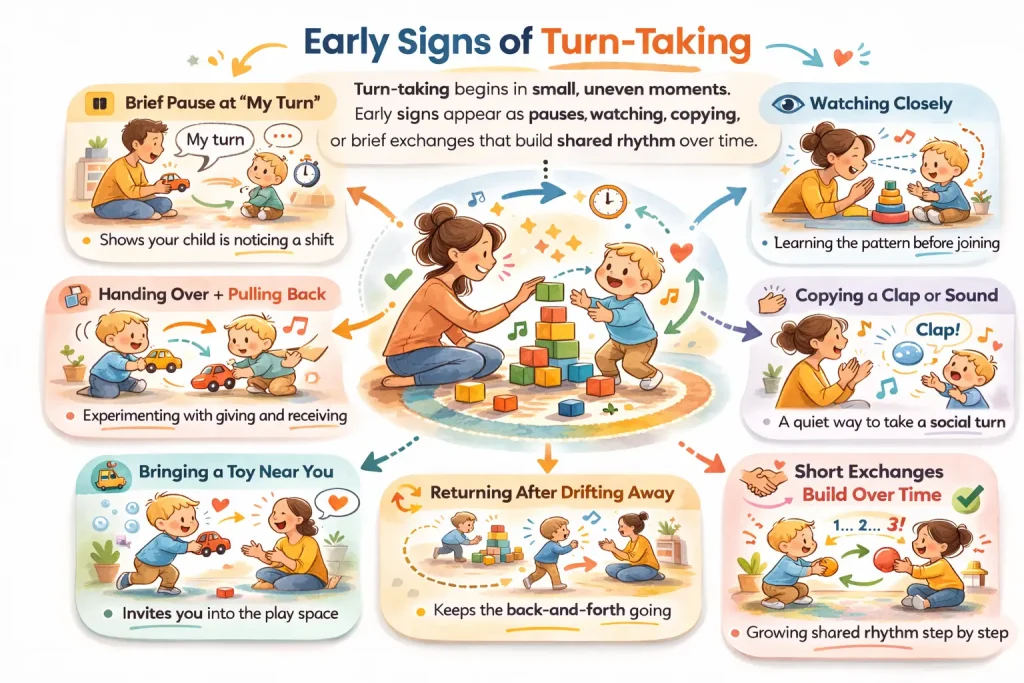
Here are some early “almost-turns” that are worth noticing. These are the kinds of moments that often come before longer back-and-forth exchanges and reflect the early signs of turn-taking.
Your child pauses, even briefly
A tiny pause can be a big deal. If your child stops for a moment when you say “my turn” or when you hold out your hand, they’re practicing the beginning of waiting. It might be one second. It might be a half-second. That still shows they noticed a shift in the interaction.
Your child watches you closely
Sometimes turn-taking starts with watching. If your child looks at your hands while you stack a block, watches you roll the ball, or studies your face when you say “your turn,” they’re gathering information. They’re learning the pattern, even if they aren’t ready to jump in consistently.
Your child hands something over… and then changes their mind
This one is incredibly common. Your child reaches toward you with the toy, then pulls it back. Or they place it in your hand and immediately grab it again.
It can feel like “that didn’t count,” but it often means your child is experimenting with the idea of giving and taking. They’re testing how it feels, what happens next, and whether the toy is safe. That back-and-forth tug is often part of learning.
Your child copies your action
Imitation is a quiet form of participation. If you clap and your child claps back, if you tap a block and they tap theirs, if you make a silly sound and they repeat it, that can be a form of turn-taking, especially when it becomes a little rhythm between you.
It may not look like “sharing,” but it is shared interaction.
Your child brings you something (even if they don’t let go)
If your child walks over with a toy and holds it near you, that can be an invitation. Some children “offer” by bringing an item close, placing it on your lap, or hovering it near your hands. They may not release it yet, but they’re including you in their play space, which is an important step toward exchanging turns.
Your child returns to you after taking a turn their own way
Maybe you roll the ball and they pick it up instead of rolling it back. But then they come back toward you with it. Or they drop it near you. Or they look at you as if to say, “Now what?”
That return, coming back into the shared moment, can be part of the turn-taking cycle, even if the “turn” didn’t look like you expected.
Your child tolerates a tiny “my turn” moment
Sometimes progress looks like acceptance. Your child might allow you to hold the toy for a second, add one block to the tower, or turn one page before they take over again. That willingness to share control, even briefly, is meaningful and part of the early signs of turn-taking.
Read more: How to Teach Turn-Taking Without Power Struggles or Forced Sharing
What to celebrate (so your child feels successful)
Turn-taking grows best when children feel safe and capable, not corrected or tested. That’s why it helps to celebrate the attempt, not the perfection.
You can quietly count it as a win when your child notices you, stays near you, pauses, watches, imitates, or re-engages after drifting away. These moments build confidence and connection, which is the real engine behind cooperation.
And it’s okay if your child can do this one day and not the next. In early development, inconsistency is often part of the process, not a sign that things aren’t working.
The comparison trap: why your child’s “turns” may look different
It’s hard not to compare. You might see another child calmly passing toys back and forth and wonder why your child’s version involves grabbing, running, or refusing.
But turn-taking isn’t a personality test or a reflection of your parenting. Children vary widely in how they approach shared play. Some are naturally cautious and watch for a long time before joining. Some are energetic and need movement built into the interaction. Some are very attached to certain toys and more flexible with others.
What matters most is your child’s trajectory over time: Are there more moments of shared attention? More willingness to pause? More little exchanges sprinkled into the day? Those patterns often reveal the early signs of turn-taking becoming more consistent.
How to support turn-taking without turning it into a lesson
The most helpful support usually looks like a simple, everyday connection small pauses, warm cues, and a relaxed back-and-forth that doesn’t demand perfection.
Many parents find that naming the rhythm in a cheerful way (“my turn… your turn”) helps everyone stay oriented, especially during simple routines like snack time or reading. And often, the most powerful part is the pause: giving your child a beat to notice, process, and decide to join in.
It also helps to remember that turn-taking doesn’t have to be long to be real. A few quick exchanges, a shared laugh, or a short “vocal ping-pong” moment can be just as valuable as a longer game, especially in the beginning.
If you’d like extra support spotting these small wins and knowing what to look for next, Speech and Autism therapy apps like BASICS can help parents focus on goals like taking turns during play and routines using short, everyday moments, without pressure and without needing special materials.
A calm reminder to take with you
Turn-taking is built from hundreds of tiny interactions: a glance, a pause, a hand reaching out, a copied clap, a quick exchange that lasts two seconds before falling apart.
That doesn’t mean it isn’t working. It means your child is practicing.
So if turn-taking feels messy in your house right now, you’re not behind. You’re in the real, normal middle of learning. And when you start noticing the early signs of turn-taking, you’ll often realise your child is making more progress than it seemed at first.
About the Author:
Rajini Darugupally
M.Sc., Speech-Language Pathologist (9+ years of experience)
Rajini is a passionate and dedicated Speech-Language Pathologist with over 9+ years of experience, specializing in both developmental speech and language disorders in children and rehabilitation in adults. Driven by a desire to empower each individual to find their voice, Rajini brings a wealth of experience and a warm, genuine approach to therapy. Currently, at Wellness Hub, she thrives in a team environment that values innovation, compassion, and achieving results for their clients. Connect with Rajini to learn more about how she can help you or your loved one find their voice.
Book your Free Consultation Today
Parent/Caregiver Info:
Client’s Details:
* Error Message