When to Get Extra Help With Early Communication: If Gestures and Sounds Aren’t Connecting Yet
Last Updated: February 24, 2026
Early communication delays happen when a child is not using gestures, sounds, eye contact, pointing, showing, or simple words to share needs and interests as expected for their age. This matters because gestures and sounds build the foundation for speech. For example, pointing to a toy while vocalizing shows intentional communication.
What you will learn in this article
- What early communication delays look like
- Age-wise red flags to watch
- When to contact a professional
- How therapy supports communication
- What parents should avoid
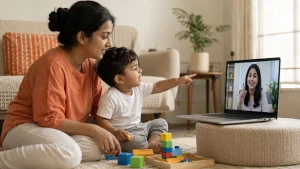
Your toddler reaches toward the snack box. You can see they want something, but they do not point, look back, make a sound, or show you clearly. You guess once. Then twice. Finally, they cry because you opened the wrong thing.
In our clinic, parents often describe this moment as confusing. Their child clearly has intention, but the message is not clear yet. They may reach, pull, cry, or look at an object, but the gesture and sound do not connect into communication.
The clinical question is not, “Is my child lazy?” The real question is, “Does my child have a reliable way to share wants, needs, interest, refusal, help, and attention?”
What early communication delays look like in children
Early communication delays look like missing, unclear, or inconsistent use of gestures, sounds, eye gaze, pointing, showing, imitation, or words for the child’s age. The concern is stronger when the child wants things but cannot clearly show another person what they mean.
In our clinic, we look beyond spoken words. A child may not say “ball,” but they may point to the ball, look at the parent, and make a sound. That is communication. Another child may make many sounds but never point, show, or look back to share meaning. That pattern needs closer attention.
Micro-example one: a 15-month-old reaches toward bubbles but does not look at the parent or make a sound. The desire is there, but the communication link is weak. Micro-example two: a 20-month-old pulls the parent’s hand to the fridge but does not point, vocalize, or choose between options. That may mean the child needs help building clearer communication.
| What parents notice | What it may mean clinically |
|---|---|
| Reaches but does not vocalize | Gesture and sound are not connecting yet |
| Makes sounds but does not point | Sounds may not be intentional communication yet |
| Pulls adult’s hand | Uses adult as a tool instead of sharing a message |
| Cries when not understood | Communication breakdown is causing frustration |
| Rarely shows objects | Joint attention may need support |
| Does not look back after reaching | Shared attention may be weak |
| No babbling or few sounds | Speech-sound development needs review |
| No gestures by toddler age | Early communication delay risk |
| Lost words or gestures | Needs prompt developmental review |
ASHA lists pointing to request, comment, or get information, along with head shaking for “no” and nodding for “yes,” as expected communication behaviours in the 13–18 month range.
What I tell families is direct: do not wait for perfect words before taking communication seriously. Gestures, sounds, and shared attention are the bridge to speech.
Why early communication delays matter for speech and communication
Early communication delays matter because speech grows from repeated social messages, not words alone. A child first learns that sounds, gestures, looks, and actions can make people respond.
When gestures and sounds do not connect, everyday routines become guesswork. Parents may over-anticipate needs, the child may cry faster, and true back-and-forth communication may stay limited. Over time, this can affect speech, play, social interaction, and behaviour.
Micro-example one: a child who cannot point and vocalize for “more” may scream during snack. Micro-example two: a child who cannot show a toy may play beside the parent without inviting them into the experience.
Early communication supports:
- Requesting
- Refusing
- Asking for help
- Showing interest
- Pointing
- Imitation
- Joint attention
- Turn-taking
- First words
- Play-based language
- Social connection
- Reduced frustration
NIDCD explains that children follow a natural progression in speech and language development, and milestone checklists help professionals decide whether a child is on track or may need extra help.
In speech therapy, we often work on gestures and sounds before expecting clear words. A child may first learn “reach + sound,” then “point + sound,” then “point + word,” then short phrases.
This is why “wait and see” can become risky when several early communication signs are missing together. A quiet child is not always delayed, but a child with few gestures, few sounds, poor response to name, limited imitation, and frustration needs assessment.
Also read: Baby Not Pointing or Imitating? Milestones, Red Flags & What to Do
At what age does early communication develop
Early communication begins in infancy and becomes more intentional across the first two years. By 12–18 months, most children should be using gestures, sounds, pointing, showing, and early words to communicate more clearly.
Age ranges are not strict deadlines, but they help parents decide when to monitor and when to act. The concern grows when a child misses several milestones together or loses skills they previously had.
| Age Range | What to expect | Red flag if missing |
|---|---|---|
| 6–9 months | Turns to sounds, smiles, vocalizes, enjoys back-and-forth play | Rarely makes sounds or responds socially |
| 9–12 months | Babbles, responds to name, reaches, waves, shows interest | No babbling, no response to name, no gestures |
| 12–15 months | Gives, shows, reaches, points emerging, uses sounds intentionally | No gestures, no meaningful sounds, little shared attention |
| 13–18 months | Points to request/comment, shakes head “no,” uses early words | No pointing, no head shake, no clear communication |
| 18–24 months | Combines gestures, sounds, words, and simple choices | No functional words or communication mainly through crying |
| 24–30 months | Uses short phrases, follows simple directions, names familiar things | No two-word combinations or poor understanding |
| 30–36 months | Uses phrases for needs, play, questions, and routines | Speech is very limited or hard to use functionally |
| Any age | Skills steadily increase | Loss of words, gestures, eye contact, or social interest |
CDC states that developmental screening is recommended at 9, 18, and 30 months, autism screening at 18 and 24 months, and additional screening whenever concerns appear. AAP gives the same screening schedule and adds that screening should happen whenever parents, clinicians, or early childhood professionals have concerns.
Micro-example one: a 14-month-old who uses a few sounds, reaches, points sometimes, and looks back at a parent may need monitoring and modelling. Micro-example two: an 18-month-old with no pointing, no words, limited response to name, and frequent frustration needs professional review.
During meals: watch how your child requests, refuses, and asks for help
Meals reveal early communication clearly because children need to request, reject, choose, ask for help, and show preferences. A child who cannot communicate during meals may cry, throw, push, or wait passively.
In our clinic, we often ask parents to observe one snack routine. Does the child point to what they want? Do they look at you after reaching? Do they make a sound? Can they show “more,” “all done,” or “help”?
Micro-example one: your child wants banana but only cries near the table. You hold banana and water, wait, and watch whether they look, reach, point, or vocalize. Micro-example two: your child pushes the spoon away but does not have a clear “no” gesture. You model “no” or “all done” with a word and gesture.
| Mealtime moment | Communication to watch | Parent response |
|---|---|---|
| Wants more food | Reach, point, look, sound | Model “more” and wait |
| Rejects food | Head turn, push away, “no” gesture | Label “no” or “all done” |
| Needs help opening | Gives item, looks, vocalizes | Model “help open” |
| Wants different food | Looks between choices | Offer two choices |
| Finished eating | Pushes away, signs, says sound | Model “all done” |
| Frustrated | Crying without clear signal | Reduce choices and model one message |
A Hanen-style responsive approach works well here: observe, wait, listen, and respond. The parent does not force speech. The parent creates small chances for the child to connect a gesture, sound, or word with a real message.
Do not make meals a quiz. “Say banana. What colour? What is this?” can increase pressure. Instead, model short useful words: “more,” “open,” “help,” “all done,” “no,” and “water.”
During play: build gestures and sounds through shared routines
Play is one of the strongest settings for early communication because children naturally reach, request, show, copy, and react. The best play routines are short, repeatable, and easy for the child to join.
In our clinic, we do not start by demanding words. We build predictable loops: roll ball, pause; blow bubbles, pause; push car, pause; open box, pause. The pause gives the child a reason to look, point, reach, vocalize, sign, or ask.
Micro-example one: your child reaches for bubbles. Blow once, close the lid, and wait. If they look, reach, or make a sound, treat that as communication. Micro-example two: your child watches a car ramp. Hold the car, say “ready,” pause, and wait for a look, gesture, or sound before sending it down.
| Play routine | Skill it builds |
|---|---|
| Bubbles | Requesting, eye gaze, “more,” sounds |
| Ball rolling | Turn-taking and shared attention |
| Car ramp | Anticipation and vocalizing |
| Blocks | Imitation and joint play |
| Books | Pointing and naming |
| Animal toys | Sound imitation |
| Puzzle box | Asking for help |
| Songs with pauses | Fill-in sounds and gestures |
JASPER targets Joint Attention, Symbolic Play, Engagement, and Regulation. NDBI approaches teach developmental skills inside natural play and routines. These frameworks are useful because early communication grows best inside meaningful interaction, not isolated drilling.
If your child plays mostly alone, rarely shows objects, or does not copy simple actions, do not only buy more toys. The issue may be social communication, imitation, or joint attention.
Read more: How Long Does It Take for a Child to Respond to Their Name Consistently?
During daily routines: track communication without turning life into a test
Daily routines help parents see whether communication is growing across real life. Bath, dressing, going outside, bedtime, and clean-up all show whether a child can request, refuse, choose, transition, and ask for help.
In our clinic, we ask parents to track patterns, not every tiny behaviour. You do not need a spreadsheet. You need three real examples that show how your child communicates.
Micro-example one: during dressing, your child cries when the shirt appears but does not push away, point, sign, or say “no.” That may mean refusal communication needs support. Micro-example two: before going outside, your child brings shoes but does not look at you or vocalize. That may be an early routine cue that can be shaped into communication.
| Routine | What to observe |
|---|---|
| Snack | How does the child ask for more or refuse? |
| Bath | How does the child say stop, wait, or again? |
| Dressing | Does the child choose, help, refuse, or protest clearly? |
| Play | Does the child show, give, point, or imitate? |
| Books | Does the child point to pictures or share attention? |
| Outdoor time | Does the child point to interesting things? |
| Bedtime | Does the child request comfort or routine items? |
Functional Communication Training, or FCT, can help when crying, throwing, grabbing, or running away serves a communication purpose. The goal is to teach a safer message with the same function: “help,” “stop,” “more,” “break,” or “all done.”
AAC can also help early communication. ASHA describes AAC as multimodal and includes gestures, signs, pictures, symbols, and speech-generating systems. A child does not need to “fail speech” before AAC is considered.
What progress looks like
Progress means your child’s communication becomes clearer, more intentional, more frequent, and easier for others to understand. It does not always begin with spoken words.
In our clinic, we often see progress first as a stronger look, a better reach, a clearer point, a sound added to a gesture, or a calmer way to ask for help. These are not tiny wins. They are the building blocks of speech and social communication.
| Sign of progress | What it means clinically |
|---|---|
| Looks at parent after reaching | Shared attention is emerging |
| Adds sound to gesture | Intentional communication is growing |
| Points to request | Gesture use is becoming clearer |
| Points to show interest | Joint attention is improving |
| Gives item for help | Problem-solving communication is emerging |
| Uses “more,” sign, or picture | Functional requesting is improving |
| Cries less during routines | Message is becoming easier to understand |
| Copies sounds or actions | Imitation skills are improving |
| Uses one skill across routines | Generalisation is beginning |
| Uses word with gesture | Speech and gesture are linking |
Micro-example one: last month your child cried near the shelf. This week they reach, look at you, and make “uh.” That is progress. Micro-example two: your child still does not say “open,” but now gives you the box and looks at your face. That is functional communication.
Track progress over two to four weeks. One quiet day after poor sleep does not erase growth. But no change across several weeks, despite responsive modelling, should push you toward professional support.
What not to do
Do not wait for speech while ignoring missing gestures. Gestures are not optional extras; they are part of early communication development.
The biggest mistake is turning every interaction into a demand for words. If the child reaches, points, or makes a sound and the adult says, “Say it properly,” the child may stop trying. Communication should feel successful before it becomes perfect.
Avoid these mistakes:
| What not to do | Better option |
|---|---|
| Force “say this” repeatedly | Model the word and accept gesture/sound |
| Ignore pointing or reaching | Treat it as communication |
| Anticipate every need instantly | Pause and create a chance to communicate |
| Ask too many questions | Use short comments and wait |
| Compare siblings | Compare your child to their own baseline |
| Wait despite multiple red flags | Seek screening or SLP review |
| Blame yourself | Focus on next steps |
| Use only apps/videos | Build real interaction with people |
Micro-example one: instead of “Say water,” say “water,” hold the cup, and wait for a look, reach, sound, or word. Micro-example two: instead of guessing five things, offer two choices and let the child point, reach, look, or vocalize.
Do not panic over one missing skill. But do not minimise a pattern. No babbling, no pointing, no response to name, no gestures, no shared attention, or skill loss needs action.
when-to-seek-professional-help
Seek professional help when your child is not using gestures, sounds, pointing, showing, words, response to name, or shared attention as expected for their age, or when communication mostly happens through crying, pulling, grabbing, or meltdowns. Early assessment gives parents a clear plan instead of weeks of guessing.
In our clinic, we recommend help when parents notice a repeated pattern across routines, not just one difficult day. Support is especially important when missing gestures and missing sounds appear together.
| Warning sign | Recommended action |
|---|---|
| No babbling or very few sounds by 9–12 months | Discuss with paediatrician or SLP |
| Does not respond to name by 9–12 months | Hearing check and developmental review |
| No gestures like waving, showing, giving by 12 months | Speech-language assessment |
| No pointing to request or show by 15–18 months | Developmental screening and SLP review |
| No meaningful words by 16–18 months | Speech-language evaluation |
| No two-word phrases by 24 months | Speech-language and developmental evaluation |
| Pulls adults by the hand but does not point/look/vocalize | Assess functional communication |
| Communication mainly through crying or meltdowns | SLP/behavioural communication support |
| Loss of words, gestures, eye contact, or social interest | Prompt medical/developmental review |
| Parent feels unsure despite trying strategies | Book professional consultation |
CDC advises parents to act when a child is missing milestones, has lost skills, or when parents have developmental concerns; developmental screening can help clarify whether more support is needed. CDC also states that early intervention helps children and families get support as early as possible.
Here is the blunt clinical truth: if gestures and sounds are not connecting, and your daily life is mostly guessing, you need guidance. Not fear. Not guilt. Guidance.
How speech therapy or occupational therapy works on early communication delays
Speech therapy works on early communication by helping the child use gestures, sounds, words, signs, AAC, imitation, pointing, showing, and functional messages during real routines. Occupational therapy helps when sensory processing, regulation, feeding, motor skills, or daily routines block communication.
In speech therapy, we may target “more,” “help,” “open,” “stop,” “all done,” pointing, showing, imitation, sound play, joint attention, and parent-child interaction. The goal is not to force words. The goal is to build a communication system that works.
Micro-example one: if a child reaches silently for bubbles, the SLP may model “more,” wait, and accept a look, sound, sign, or point. Micro-example two: if a child cries when a toy is stuck, the therapist may teach “help” using a gesture, picture, sound, or word.
Occupational therapy may help when the child cannot stay regulated enough to communicate. For example, a child who covers ears during play may need sensory support before they can join sound imitation. A child who struggles with feeding textures may need OT and feeding support alongside communication work.
Named approaches that may be used include:
- Hanen-style parent coaching
- NDBI
- JASPER
- ESDM
- AAC
- PECS
- Functional Communication Training
- DIR/Floortime
A strong therapy plan should train parents, not just the child. The child needs communication to work at home, during meals, in play, at preschool, and with caregivers.
Comparing therapy approaches
Different therapy approaches support different reasons gestures and sounds may not be connecting. The right choice depends on the child’s age, communication level, play skills, sensory profile, frustration, and family routines.
| Approach | What it focuses on | Best for |
|---|---|---|
| Speech-Language Therapy | Gestures, sounds, words, understanding, functional communication | Toddlers with speech/language delay |
| Hanen-style Parent Coaching | Responsive interaction in daily routines | Parents needing home strategies |
| NDBI | Natural play, developmental learning, communication | Young children with developmental delays |
| JASPER | Joint attention, symbolic play, engagement, regulation | Children with weak showing, pointing, or shared play |
| ESDM | Social engagement, imitation, communication, play | Toddlers/preschoolers with autism signs |
| AAC | Gestures, signs, pictures, devices, communication boards | Children with limited or unreliable speech |
| PECS | Picture exchange for functional communication | Children who need structured picture-based communication |
| Functional Communication Training | Replacing crying/grabbing with clear messages | Children using behaviour to communicate |
| Occupational Therapy | Sensory regulation, feeding, motor participation | Children whose body regulation blocks communication |
| Developmental Paediatric Review | Broader developmental assessment | Multiple red flags, regression, or autism concerns |
In our clinic, we rarely use one approach alone. A toddler may need speech therapy for gestures and sounds, Hanen-style parent coaching for home routines, AAC for frustration, and OT for sensory regulation.
The wrong question is, “Will my child talk if we wait?” The better question is, “What communication tools does my child have today, and what is the next safest step?”
Questions Parents Ask
1. My toddler makes sounds but does not point. Should I worry?
Sounds are useful, but pointing is an important early communication gesture. If your toddler makes sounds without pointing, showing, giving, or looking back to share meaning, the sounds may not yet be connected to intentional communication. Watch whether your child uses sounds to request, comment, or get your attention. If pointing and showing are missing by 15–18 months, book a speech-language assessment.
2. My child points but does not make sounds with it. Is that okay?
Pointing is a strong communication sign, even without sound. But over time, we want gestures and sounds to begin connecting because this supports speech development. You can model a short sound or word when your child points, such as “ball,” “more,” or “open,” without forcing repetition. If your child stays mostly silent across routines, ask an SLP for guidance.
3. When should I get help for early communication delay?
Get help when your child has no babbling, no pointing, no showing, no meaningful gestures, poor response to name, no words by 16–18 months, or no two-word phrases by 24 months. You should also seek help immediately if your child loses words, gestures, or social interest. A speech-language pathologist can assess communication before frustration increases. Waiting is not necessary when several red flags appear together.
4. Is pulling my hand to things communication?
Yes, pulling your hand can be communication, but it is usually an early or less clear form. We want to help your child add pointing, looking, sounds, words, signs, or pictures so the message becomes easier for others to understand. If your child uses your hand as a tool but rarely looks at you or vocalizes, this needs support. Therapy can shape pulling into clearer functional communication.
5. Can speech therapy help before my child talks?
Yes. Speech therapy can help before clear words appear. Early therapy often works on gestures, sounds, imitation, pointing, showing, turn-taking, play, understanding, AAC, and parent routines. The goal is to help your child communicate more clearly now, not wait for perfect speech. This can reduce frustration and prepare the child for spoken words when they are ready.
6. Are gestures and sounds linked to autism signs?
They can be, but missing gestures and sounds do not automatically mean autism. We look at the wider pattern: response to name, pointing, showing, shared attention, imitation, play, sensory behaviours, and regression. CDC and AAP recommend autism screening at 18 and 24 months, and earlier discussion is appropriate when concerns appear. If your child has several social communication red flags, seek developmental screening.
Early communication delays are not a parenting failure. They are a signal to look closer and support your child more clearly. Start today by watching one routine: snack, play, bath, or dressing. Notice whether your child uses a gesture, sound, look, or word to send a message. If the pattern is still unclear or concerning, book a speech-language consultation instead of waiting in uncertainty.
Citations used in the article
- American Speech-Language-Hearing Association. “Communication Milestones: 13 to 18 Months.” ASHA. Year: 2026 page access. URL: https://www.asha.org/public/developmental-milestones/communication-milestones-13-to-18-months/
- Centers for Disease Control and Prevention. “Developmental Monitoring and Screening.” CDC, 2026. URL: https://www.cdc.gov/act-early/about/developmental-monitoring-and-screening.html
- American Academy of Pediatrics. “Developmental Surveillance and Screening Patient Care.” AAP, 2026. URL: https://www.aap.org/en/patient-care/developmental-surveillance-and-screening-patient-care/
- National Institute on Deafness and Other Communication Disorders. “Speech and Language Developmental Milestones.” NIDCD, 2022. URL: https://www.nidcd.nih.gov/health/speech-and-language
- American Speech-Language-Hearing Association. “Augmentative and Alternative Communication.” ASHA Practice Portal. URL: https://www.asha.org/practice-portal/professional-issues/augmentative-and-alternative-communication/
About the Author:
Rajini Darugupally
M.Sc., Speech-Language Pathologist (9+ years of experience)
Rajini is a passionate and dedicated Speech-Language Pathologist with over 9+ years of experience, specializing in both developmental speech and language disorders in children and rehabilitation in adults. Driven by a desire to empower each individual to find their voice, Rajini brings a wealth of experience and a warm, genuine approach to therapy.
Currently, at Wellness Hub, she thrives in a team environment that values innovation, compassion, and achieving results for their clients.
Book your Free Consultation Today
Parent/Caregiver Info:
Client’s Details:
* Error Message