


Transitioning Between Activities at School – Social Story PDF
₹80
₹160
50% off
0 (0 ratings)
Grade Levels
Kindergarten - Grade 3 (Ages 5-9)
Content Overview
Format: Printable PDF, Total Pages: 11, Features: 16 segments with real images, vocabulary, spelling, comprehension, role-play activities
Categories
Share


About the Product
Introduction
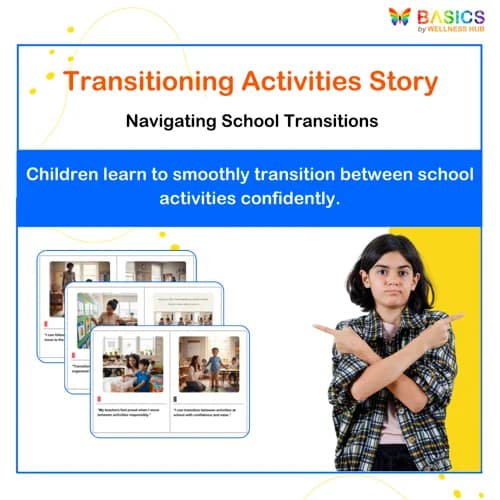
Navigating transitions between activities at school can be challenging for many children. This Social Story PDF on Transitioning Between Activities at School is designed to ease these transitions by providing a relatable and structured narrative. Using real-life images and first-person storytelling, this resource helps children visualize and understand the process of moving from one activity to another in a school setting. Ideal for use in classrooms, special education, and therapy sessions, this social story supports children in developing smoother transitions, reducing anxiety, and fostering independence.
Product Details
- Format: Printable PDF
- Total Pages: 11
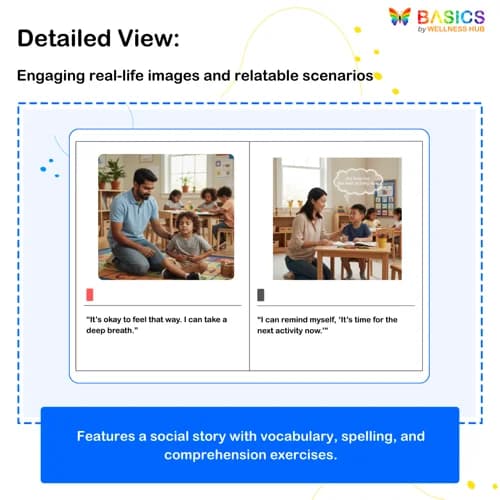
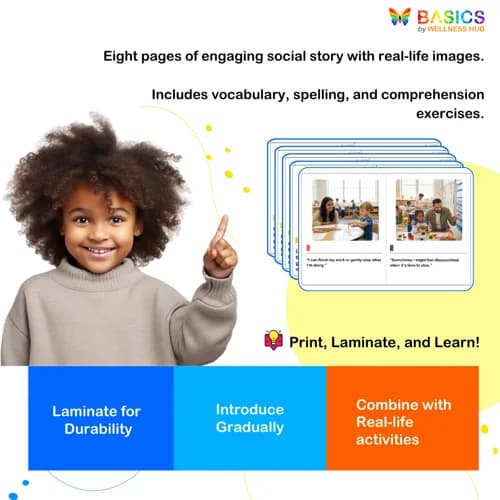
- Social Story: 8 pages, divided into 16 segments with real images and first-person sentences
- Vocabulary and Spelling: Page 9 includes 5 vocabulary words with multiple-choice meanings and 5 spelling words with correct and incorrect options
- Comprehension: Page 10 features comprehension and open-ended questions based on the social story
- Role-Play Activities: Page 11 includes role-play scenarios to practice transitioning skills
- Designed For: Early learners, special education students, and children in need of sensory support or speech therapy
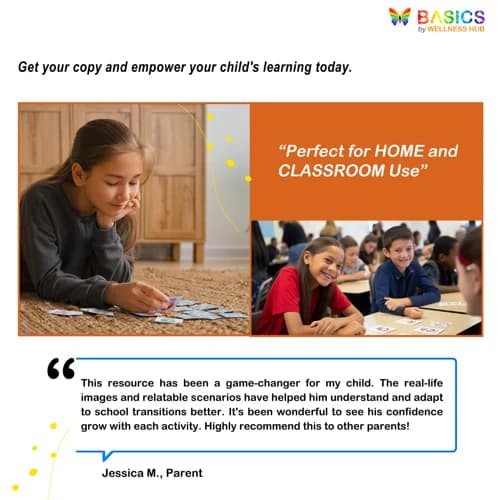
- Usability: Suitable for classroom use, therapy sessions, and home practice
Educational Benefits
1. Supports Smooth Transitions
- Helps children understand and anticipate changes in their school routine, reducing anxiety and stress.
- Encourages flexibility and adaptability by preparing kids for moving between different activities.
2. Enhances Vocabulary and Spelling Skills
- Introduces key vocabulary related to school transitions, reinforcing language development.
- Improves spelling skills through targeted practice with words from the story.
3. Boosts Comprehension and Critical Thinking
- Encourages children to think critically about the story through comprehension questions.
- Promotes discussion and deeper understanding with open-ended questions.
4. Develops Social and Emotional Skills
- Teaches children how to manage emotions and behaviors during transitions.
- Promotes independence and self-regulation by modeling appropriate actions and responses.
5. Engages Through Visual Learning
- Utilizes real images to help children connect with the story and visualize scenarios.
- Supports children with special needs by providing clear, relatable visuals and first-person narratives.
Instructions for Use
Step 1: Read the Social Story Together
- Sit with the child and read through the social story, discussing each segment.
- Use the real images to help the child visualize and relate to the scenarios.
- Encourage the child to express their thoughts and feelings about transitions.
Step 2: Vocabulary and Spelling Practice
- Review the vocabulary words on page 9, discussing each word's meaning.
- Have the child choose the correct meaning from the options provided.
- Practice spelling by selecting the correct spelling for each word.
Step 3: Comprehension and Open-Ended Questions
- Go through the comprehension questions on page 10 to assess understanding.
- Encourage the child to answer open-ended questions, promoting discussion and critical thinking.
Step 4: Role-Play Activities
- Use the role-play scenarios on page 11 to practice transitioning skills.
- Act out different transition situations, using props if available, to make learning interactive.
- Encourage the child to use language and behaviors learned from the story during role-play.
Step 5: Reinforce Learning in Real-Life Situations
- Apply the skills learned from the social story in actual school transitions.
- Provide gentle reminders and support as the child practices transitioning between activities.
- Praise and encourage the child for successfully managing transitions and using appropriate behaviors.
Activities Using the Resource
1. Picture and Sentence Match-Up
Objective: Reinforce comprehension and visual connection.
How to Play:
- Print and cut out the segments from the social story.
- Mix up the images and sentences, then ask the child to match each image with the correct sentence.
- Discuss each match to reinforce understanding of the transition process.
Skill Development:
- Visual literacy
- Comprehension
- Attention to detail
2. Vocabulary Bingo
Objective: Enhance vocabulary retention through interactive play.
How to Play:
- Create bingo cards with vocabulary words from the story.
- Call out definitions, and the child marks the corresponding word.
- Use small tokens or stickers to cover words; the first to complete a line wins.
Skill Development:
- Vocabulary recognition
- Listening skills
- Word-meaning association
3. Transition Role-Play
Objective: Practice real-life application of transition skills.
How to Play:
- Set up different "stations" representing school activities (e.g., reading, art, snack time).
- Use the role-play scenarios to guide transitions between stations.
- Encourage the child to verbalize their actions and feelings during each transition.
Skill Development:
- Social interaction
- Emotional regulation
- Practical application
4. Comprehension Charades
Objective: Strengthen understanding through active engagement.
How to Play:
- Write comprehension questions on slips of paper.
- The child draws a slip and acts out the answer without speaking.
- Others guess the answer based on the charade.
Skill Development:
- Non-verbal communication
- Critical thinking
- Interpretation skills
5. Spelling Relay Race
Objective: Make spelling practice dynamic and fun.
How to Play:
- Write spelling words on cards and place them at one end of a space.
- The child runs to pick a card, returns to spell the word aloud, then tags the next player.
- Continue until all words are correctly spelled.
Skill Development:
- Spelling accuracy
- Physical coordination
- Teamwork
6. Real-Life Transition Practice
Objective: Apply learned skills in everyday settings.
How to Play:
- Identify daily transitions (e.g., from playtime to dinner).
- Use language and strategies from the social story to guide these transitions.
- Provide positive feedback and support as the child uses learned skills.
Skill Development:
- Generalization of skills
- Independence
- Routine management
Frequently Asked Questions
Q1: How can I access the social story PDF after purchase?
A1: Once you complete your purchase, you will receive an email with a download link for the PDF. You can also access it anytime through your Wellness Hub account under the "My Resources" section.
Q2: Are there any licensing restrictions for using the social story in a classroom?
A2: Yes, the PDF is licensed for personal and educational use only. You may use it in your classroom or therapy sessions but cannot redistribute or sell it. For broader usage rights, please contact Wellness Hub for licensing options.
Q3: What is the refund policy if I'm not satisfied with the resource?
A3: Wellness Hub offers a 30-day satisfaction guarantee. If you are not satisfied with the resource, contact our support team within 30 days of purchase for a refund or exchange.
Q4: How can I get support if I have questions about using the resource?
A4: Our support team is available to assist you with any questions or issues. You can reach us via email or through the contact form on our website. We are committed to ensuring you have a positive experience with our resources.
Q5: How does this social story help children with transitions?
A5: The social story uses real images and first-person narratives to help children visualize and understand the process of transitioning between activities. It reduces anxiety by providing a structured and relatable narrative that prepares children for changes in their school routine.
Q6: Can this resource be used for children with special needs?
A6: Yes, it is designed to support children with special needs, including those in special education and therapy sessions. The real images and simple language make it accessible and engaging for children who need extra support with transitions.
Q7: What activities can I do with the vocabulary and spelling section?
A7: You can review the vocabulary words by discussing their meanings and practicing spelling with the provided options. This section enhances language development and spelling skills through targeted practice.
Q8: How can role-play activities be integrated into learning?
A8: Use the role-play scenarios to practice transitioning skills in a fun and interactive way. Set up different activity stations and guide children through transitions, encouraging them to verbalize their actions and feelings.
Q9: What are the educational benefits of using this social story?
A9: The social story supports smooth transitions, enhances vocabulary and spelling skills, boosts comprehension and critical thinking, develops social and emotional skills, and engages children through visual learning.
Q10: How can I reinforce the skills learned from the social story in real-life situations?
A10: Apply the skills during actual school transitions by providing gentle reminders and support. Praise and encourage the child for successfully managing transitions and using appropriate behaviors, reinforcing learning through real-life practice.
Usage Rights and Restrictions
Allowed Usage:
- Personal use by parents, teachers, and therapists.
- Printable for classroom, home, or therapy settings.
- Can be used in group or one-on-one learning sessions.
Not Allowed:
- Reselling, redistributing, or modifying the resource for commercial use.
- Sharing publicly (e.g., on blogs, social media, or websites) without permission.
- Uploading the file to public sharing platforms.
If you need a bulk license for schools or therapy centers, please contact us.
Conclusion
The Social Story PDF on Transitioning Between Activities at School is a comprehensive resource designed to support children in navigating school routines with confidence. By combining real-life images, first-person narratives, and interactive activities, this tool effectively reduces anxiety and fosters independence in children, particularly those with special needs. Ideal for educators, therapists, and parents, this resource not only aids in smoother transitions but also enhances vocabulary, spelling, comprehension, and social skills. Embrace this engaging approach to learning and help children thrive in their daily school activities.