


HOT & COLD – Learn Comparison Words Through Pictures
₹80
₹160
50% off
0 (0 ratings)
Grade Levels
Pre-K - Grade 2 (Ages 3-7)
Content Overview
Format: Printable PDF | Pages: 20 | Features: 60 illustrated images demonstrating hot and cold comparisons.
Categories
Share


About the Product
Introduction
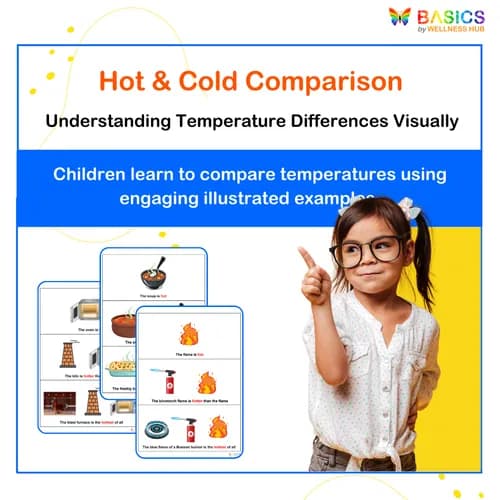
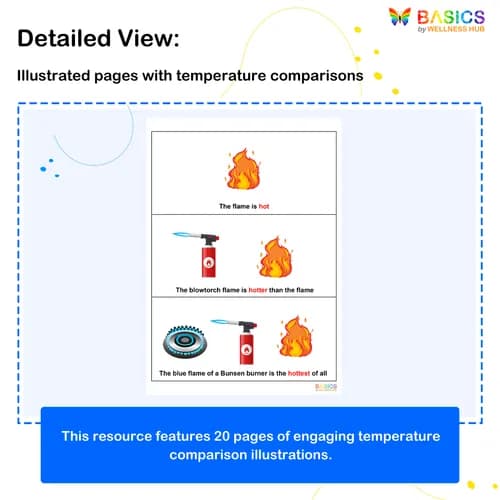
Understanding comparison words is a fundamental skill that enhances children's language development and critical thinking. The HOT & COLD – Learn Comparison Words (Hot, Hotter, Hottest / Cold, Colder, Coldest) Through Pictures resource is designed to help children ages 4-8 grasp the concept of degrees of comparison in a fun and engaging way. This printable PDF features 20 pages, each containing three illustrated images that depict varying temperatures, making it easy for young learners to visualize and comprehend the differences between hot and cold.
Each page presents a sequence that begins with a base adjective, progresses to a comparative form, and culminates in the superlative. For example, children will learn phrases like "The snowball is cold," "The ice-cube is colder than the snowball," and "The frozen snowball is the coldest of all." By incorporating relatable everyday scenarios, such as food and weather, this resource not only builds vocabulary but also strengthens grammar awareness and encourages active participation in learning. Ideal for use at home, in classrooms, or during therapy sessions, this resource makes learning about comparisons both accessible and enjoyable.
Product Details
- Format: Printable PDF
- Total Pages: 20
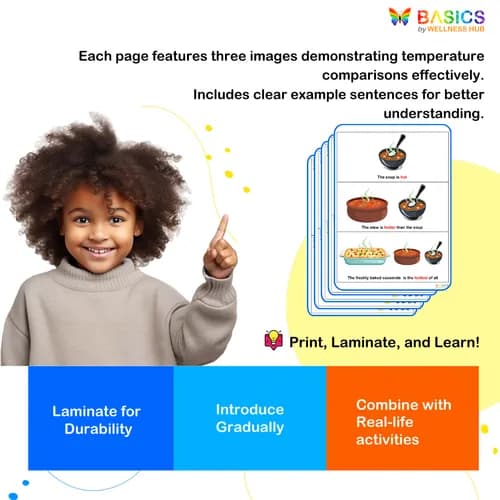
- Illustrated Images: 60 total (3 images per page)
- Content Structure: Each page demonstrates one sequence of comparison (hot → hotter → hottest or cold → colder → coldest)
- Example Sentences: Includes clear, descriptive sentences for each image to reinforce understanding of comparative and superlative adjectives.
- Visuals: Engaging illustrations depicting everyday objects and scenes related to temperature differences (e.g., food, drinks, weather).
- Designed For: Early childhood education, language development, and vocabulary building.
- Best Suited For: Ages 4-8, suitable for home, classroom, and therapy use.
Educational Benefits
1. Enhances Vocabulary and Language Skills
- Introduces children to new adjectives and their comparative forms, expanding their language repertoire.
- Encourages the use of descriptive language in everyday conversations, improving communication skills.
2. Develops Critical Thinking and Comprehension
- Promotes analytical thinking as children compare different items based on temperature.
- Encourages children to make connections between concepts, enhancing their overall understanding of comparisons.
3. Strengthens Grammar Awareness
- Teaches the structure of comparative and superlative adjectives through relatable examples.
- Helps children recognize and use correct grammar in their speech and writing.
4. Engages Visual Learners
- Utilizes colorful illustrations to make learning more interactive and enjoyable.
- Supports visual learners by providing concrete examples of abstract concepts, making it easier to grasp comparisons.
5. Fosters Active Participation
- Encourages children to actively engage with the material through discussions and comparisons.
- Provides opportunities for hands-on learning, making the educational experience more memorable.
Instructions for Use
Step 1: Print the PDF
- Download and print the 20-page PDF resource on standard A4 or Letter-sized paper.
- Consider laminating the pages for durability and repeated use in various settings.
Step 2: Introduce Comparison Words
- Begin by explaining the concept of hot and cold using everyday examples.
- Use simple language to describe the differences, such as "This is hot, and this is cold."
Step 3: Explore Each Page
- Go through each page one by one, discussing the three illustrated images.
- Read the descriptive sentences aloud, emphasizing the adjectives and their comparative forms.
Step 4: Encourage Interaction
- Ask the child to identify which item is the hottest or coldest on each page.
- Encourage them to use the comparison words in their responses (e.g., "The soup is hot, but the stove is the hottest!").
Step 5: Create Real-Life Comparisons
- Incorporate real-life examples by comparing items around the house or outdoors.
- Ask questions like, "Which drink is colder, the iced tea or the soda?" to reinforce learning.
Step 6: Reinforce Learning Through Games
- Turn the activity into a game by having children match items based on temperature.
- Use flashcards or physical objects to create a fun and engaging learning environment.
Step 7: Review and Repeat
- Regularly revisit the pages to reinforce understanding and retention of comparison words.
- Encourage children to create their own sentences using the vocabulary learned, enhancing their language skills further.
Activities Using the Resource
1. Temperature Sorting Game
Objective: Help children categorize items based on temperature.
How to Play:
- Gather various household items (e.g., ice, soup, coffee).
- Have the child sort them into "hot" and "cold" groups.
- Discuss why each item belongs in its category, using comparison words.
Skill Development:
- Categorization skills
- Vocabulary enhancement
- Critical thinking
2. Comparative Sentence Creation
Objective: Encourage sentence formation using comparative adjectives.
How to Play:
- Choose a page from the resource and read the sentences.
- Ask the child to create their own comparative sentences using different items (e.g., "The chocolate is hotter than the ice cream.").
- Write or illustrate their sentences for a visual reference.
Skill Development:
- Grammar awareness
- Expressive language
- Creativity
3. Hot and Cold Charades
Objective: Reinforce understanding of hot and cold through movement.
How to Play:
- Write down various hot and cold items on slips of paper (e.g., "hot soup," "cold ice cream").
- Take turns drawing a slip and acting out the item without speaking.
- Others guess the item and describe it using comparison words.
Skill Development:
- Non-verbal communication
- Vocabulary recall
- Teamwork
4. Real-Life Temperature Hunt
Objective: Apply comparison words to real-life situations.
How to Play:
- Go on a walk or explore the kitchen.
- Ask the child to find items that are hot or cold and describe them (e.g., "The sun is hot," "The fridge is cold.").
- Encourage them to compare items they find (e.g., "The coffee is hotter than the tea.").
Skill Development:
- Observation skills
- Application of vocabulary
- Environmental awareness
5. Illustrated Comparison Book
Objective: Create a personalized comparison book for reinforcement.
How to Play:
- Use the resource to create a mini-book with the child.
- Each page features a hot or cold item, with the child drawing or pasting pictures and writing sentences.
- Share the book with family or friends to practice reading.
Skill Development:
- Writing and illustration skills
- Understanding of comparisons
- Confidence in sharing work
6. Temperature Flashcard Match
Objective: Enhance memory and understanding of temperature comparisons.
How to Play:
- Create flashcards with images and sentences from the resource.
- Mix them up and place them face down.
- Take turns flipping two cards to find matching items with correct comparative forms.
Skill Development:
- Memory retention
- Visual recognition
- Language skills
Frequently Asked Questions
Q1: What age group is this resource designed for?
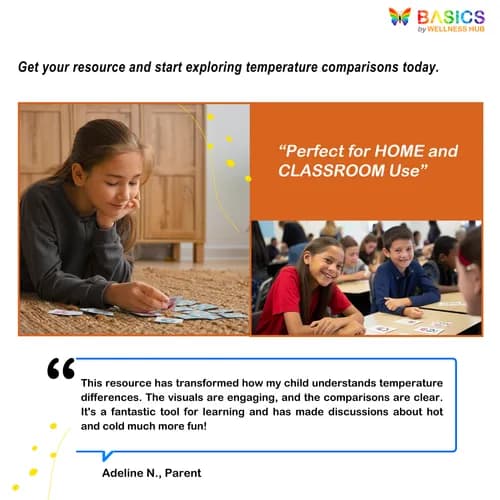
A1: This resource is specifically designed for children ages 4-8. It caters to early learners who are beginning to explore language concepts, making it suitable for preschool and early elementary education. The engaging visuals and simple sentence structures help young children grasp the idea of comparative adjectives effectively.
Q2: How can I use this resource in a classroom setting?
A2: The resource can be utilized in various ways, such as during direct instruction, small group activities, or individual practice. Teachers can lead discussions about hot and cold items, use the illustrations for interactive games, or incorporate the material into literacy centers. This flexibility allows for integration into different lesson plans and learning styles.
Q3: Can this resource be used for children with special needs?
A3: Absolutely! This resource is designed to be inclusive and can be adapted for children with various learning needs. The visual elements and clear examples make it easier for all learners to understand comparative adjectives. Additionally, educators can modify the activities to suit individual learning styles and provide additional support as needed.
Q4: Is the resource suitable for home use?
A4: Yes, this resource is perfect for home use as well. Parents can use it to reinforce language skills with their children in a fun and interactive way. The illustrations and engaging content make learning enjoyable, allowing parents to facilitate discussions and activities that enhance their child's understanding of comparative adjectives.
Q5: What is the licensing policy for this resource?
A5: The resource is intended for personal and educational use only. You may print and use it in your home, classroom, or therapy sessions, but redistribution or commercial use is prohibited. If you are interested in bulk licensing for schools or organizations, please contact us for more information.
Q6: How do I access the resource after purchase?
A6: Once you complete your purchase, you will receive a download link via email. You can access the PDF file immediately, allowing you to print or use it digitally right away. If you encounter any issues with downloading, please reach out to our support team for assistance.
Q7: What kind of support does Wellness Hub offer if I have questions about the resource?
A7: Wellness Hub provides customer support for any inquiries related to our resources. You can reach out via our website's contact form or email for assistance. Our team is dedicated to ensuring you have a positive experience and can effectively utilize our materials for your child's learning.
Q8: What is Wellness Hub's refund policy?
A8: At Wellness Hub, we want you to be satisfied with your purchase. If you experience any issues with the resource or find it does not meet your needs, please contact us within 14 days of purchase for a refund or exchange. We value your feedback and strive to improve our offerings.
Q9: Does Wellness Hub offer bulk purchasing options for schools?
A9: Yes, we do offer bulk purchasing options for schools and organizations. If you are interested in acquiring multiple copies of our resources, please contact us directly to discuss pricing and licensing options that best suit your needs.
Q10: How can I stay updated on new resources and offerings from Wellness Hub?
A10: To stay informed about new resources, promotions, and updates from Wellness Hub, we recommend subscribing to our newsletter on our website. You can also follow us on social media platforms, where we regularly share valuable information and tips for parents and educators.
Usage Rights and Restrictions
Allowed Usage:
- Personal use by parents, teachers, and therapists.
- Printable for classroom, home, or therapy settings.
- Can be used in group or one-on-one learning sessions.
Not Allowed:
- Reselling, redistributing, or modifying the resource for commercial use.
- Sharing publicly (e.g., on blogs, social media, or websites) without permission.
- Uploading the file to public sharing platforms.
If you need a bulk license for schools or therapy centers, please contact us.
Conclusion
The HOT & COLD – Learn Comparison Words resource is an essential educational tool designed to help children ages 4-8 understand and use comparative and superlative adjectives in a fun and engaging way. With 20 pages of vibrant illustrations and clear sentences, this printable PDF not only enhances vocabulary but also strengthens grammar skills and critical thinking through relatable everyday examples.
Ideal for use at home, in classrooms, or during therapy sessions, this resource encourages active participation and interaction, making learning about comparisons enjoyable. Equip your child with the language skills they need to express themselves confidently by incorporating this engaging resource into their learning routine today!