


BIG & SMALL – Learn Comparison Words Through Pictures
₹80
₹160
50% off
0 (0 ratings)
Grade Levels
Pre-K - Grade 2 (Ages 3-7)
Content Overview
Format: Printable PDF, Total Pages: 20, Features: 60 illustrated images demonstrating big, bigger, and biggest.
Categories
Share


About the Product
Introduction
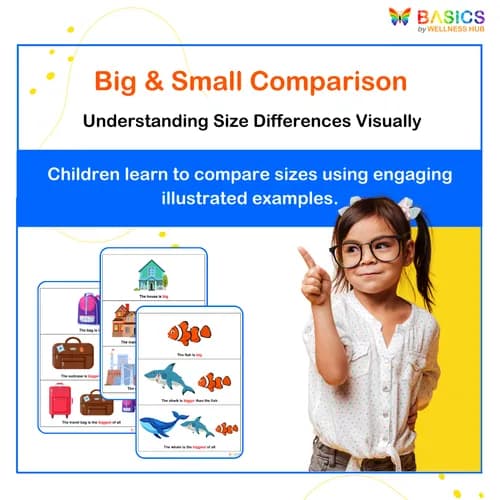
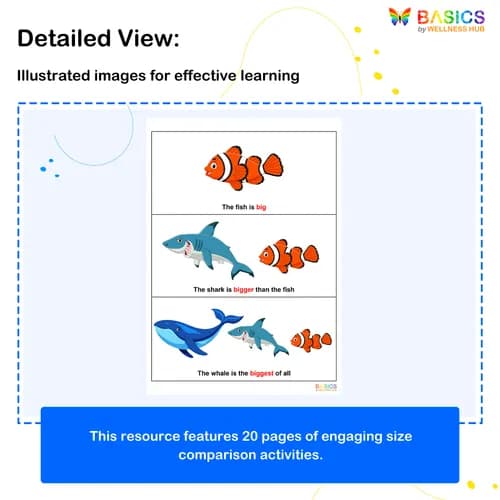
Understanding the concepts of size and comparison is fundamental for young learners as they develop their vocabulary and descriptive language skills. The BIG & SMALL – Learn Comparison Words (Big, Bigger, Biggest) Through Pictures printable PDF is designed to help children aged 3-7 grasp the differences between these degrees of comparison in a fun and engaging way. Each of the 20 pages features three illustrated images that depict everyday objects in varying sizes, making it easier for children to visualize and comprehend the concepts of big, bigger, and biggest.
This resource not only introduces comparative and superlative adjectives but also enhances children's observation skills and vocabulary expansion. By providing clear examples and engaging visuals, parents, teachers, and therapists can effectively support language development in home, classroom, and therapy settings. This interactive approach encourages children to explore language in a meaningful context, fostering a deeper understanding of how to describe the world around them.
Product Details
- Product Name: BIG & SMALL – Learn Comparison Words (Big, Bigger, Biggest) Through Pictures
- Format: Printable PDF
- Total Pages: 20
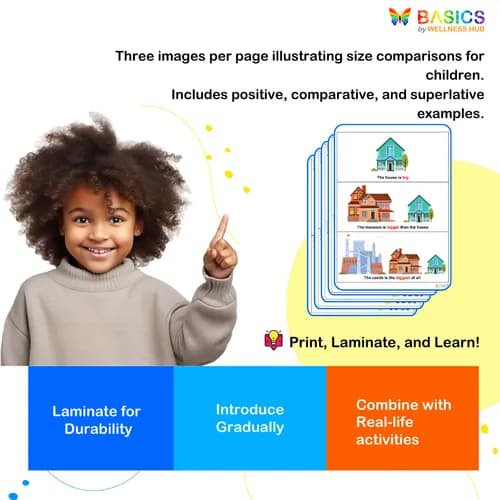
- Illustrated Images: 60 total (3 images per page)
- Content Structure: Each page includes one positive, one comparative, and one superlative example
- Example Sentences: Simple, clear sentences accompanying each image to illustrate size comparisons
- Designed For: Early childhood education, language development, and vocabulary building
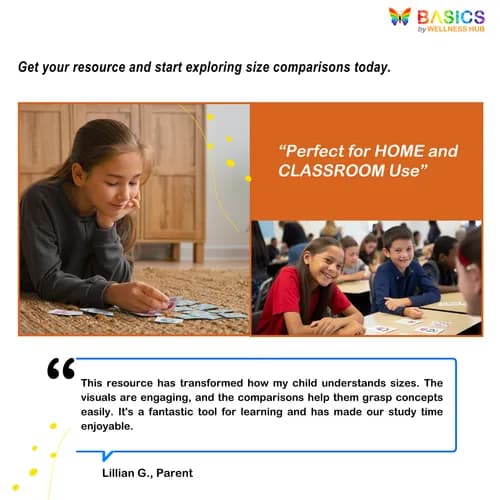
- Best Suited For: Ages 3-7, suitable for home use, classrooms, and speech therapy sessions
- Visuals: Colorful illustrations of everyday items to engage young learners and aid comprehension
Educational Benefits
1. Enhances Vocabulary Development
- Introduces children to key adjectives: big, bigger, and biggest.
- Expands descriptive language skills, enabling children to articulate size comparisons effectively.
2. Improves Observation and Comparison Skills
- Encourages children to visually analyze differences in size among everyday objects.
- Fosters critical thinking as they learn to categorize and compare items based on size.
3. Supports Early Literacy and Language Skills
- Provides clear, simple sentences that help children understand sentence structure and context.
- Encourages reading practice through engaging, illustrated content that holds their interest.
4. Engages Visual Learners
- Utilizes colorful illustrations to capture attention and aid comprehension.
- Helps children grasp abstract concepts through concrete visual examples, making learning more relatable.
5. Promotes Interactive Learning
- Encourages discussion and interaction as children describe the images and compare sizes.
- Supports collaborative learning opportunities in group settings, enhancing social skills.
Instructions for Use
Step 1: Print the PDF
- Download the BIG & SMALL resource and print the 20 pages on standard A4 or Letter-sized paper.
- Consider laminating the pages for durability if using in a classroom or therapy setting.
Step 2: Review the Images Together
- Go through each page with the child, pointing out the three images and reading the accompanying sentences.
- Encourage them to repeat the sentences to reinforce language skills.
Step 3: Discuss Size Comparisons
- Ask the child to identify which object is big, bigger, and biggest on each page.
- Encourage them to use the vocabulary words in their responses (e.g., "The chair is big. The table is bigger. The sofa is the biggest.").
Step 4: Engage in Interactive Activities
- Create games where the child has to find objects around the house or classroom that match the sizes shown in the images.
- Use prompts like "Can you find something bigger than this cup?" to reinforce learning.
Step 5: Reinforce Learning Through Repetition
- Revisit the pages regularly to solidify understanding of the concepts.
- Encourage the child to create their own comparisons using objects they see in their environment.
Step 6: Incorporate into Daily Conversations
- Use the vocabulary in everyday discussions to reinforce learning naturally.
- For example, when out shopping, ask questions like "Which is bigger, this bag or that one?" to apply concepts in real-life situations.
Step 7: Adapt for Different Learning Styles
- For children who may need additional support, use tactile objects to demonstrate size comparisons physically.
- Encourage them to touch and compare items to enhance understanding through hands-on learning.
Activities Using the Resource
1. Size Sorting Game
Objective: Help children categorize objects based on size.
How to Play:
- Gather a variety of objects from around the house or classroom.
- Ask the child to sort them into three groups: big, bigger, and biggest.
- Discuss their choices using the vocabulary words.
Skill Development:
- Categorization skills
- Vocabulary reinforcement
- Critical thinking
2. Picture Storytelling
Objective: Encourage creative expression and narrative skills.
How to Play:
- Choose a page from the resource and cover the sentences.
- Ask the child to create a story using the three images, describing the objects and their sizes.
- Share the story aloud, focusing on using the words big, bigger, and biggest.
Skill Development:
- Narrative skills
- Descriptive language
- Imagination and creativity
3. Size Comparison Walk
Objective: Apply size comparison concepts in real-life settings.
How to Play:
- Go on a walk and ask the child to identify objects they see.
- Prompt them with questions like, "Which is bigger, this tree or that car?"
- Encourage them to use the vocabulary words in their responses.
Skill Development:
- Real-world application
- Observation skills
- Conversational skills
4. Drawing and Labeling
Objective: Foster artistic expression while reinforcing vocabulary.
How to Play:
- Provide paper and colored pencils.
- Ask the child to draw three objects of different sizes (e.g., a small ball, a bigger ball, and the biggest ball).
- Have them label each drawing using the terms big, bigger, and biggest.
Skill Development:
- Fine motor skills
- Vocabulary application
- Creativity
5. Size Comparison Chart
Objective: Create a visual reference for size comparisons.
How to Play:
- Use a large sheet of paper to create a chart.
- Have the child draw or paste pictures of objects in order from big to biggest.
- Label each object with the appropriate size term.
Skill Development:
- Visual organization
- Understanding of comparative terms
- Collaborative learning
6. Interactive Size Quiz
Objective: Test understanding of size comparisons through a fun quiz.
How to Play:
- Create a simple quiz using images from the resource.
- Show an image and ask the child to choose the correct size term (big, bigger, biggest) from options.
- Discuss their answers and correct any misunderstandings.
Skill Development:
- Critical thinking
- Recall and recognition
- Confidence in knowledge
Frequently Asked Questions
Q1: What age group is this resource intended for?
A1: The BIG & SMALL resource is designed for children aged 3-7 years. This age range is crucial for developing vocabulary and understanding comparative language. The engaging illustrations and simple sentences make it accessible for early learners, helping them to grasp the concepts of big, bigger, and biggest in a fun and interactive way.
Q2: How can I use this resource in a classroom setting?
A2: This resource is perfect for small group activities, whole-class discussions, or individual learning. You can print the pages and use them during language lessons, encouraging students to describe the images and practice using the terms big, bigger, and biggest in their sentences. Additionally, it can be integrated into thematic units about sizes or comparisons, making it a versatile tool for educators.
Q3: Can this resource be used for children with special needs?
A3: Absolutely! The BIG & SMALL resource is designed to be visually engaging and straightforward, making it suitable for children with varying learning needs. The clear illustrations and repetitive sentence structures can help reinforce understanding for children who may benefit from visual supports or differentiated instruction.
Q4: How do I access support if I have questions about the resource?
A4: If you have any questions or need assistance, you can reach out to our support team through the contact form on our website. We are here to help with any inquiries related to your purchase or how to best use our resources for your child's learning. Our team is committed to providing timely and helpful responses.
Q5: What is your refund policy if I am not satisfied with the resource?
A5: Wellness Hub offers a satisfaction guarantee. If you are not satisfied with your purchase, you can contact our support team within 30 days for a refund or exchange. We want to ensure that our resources meet your needs and expectations, and we are dedicated to your satisfaction.
Q6: Is this resource available for digital use, or do I need to print it?
A6: The BIG & SMALL resource is provided as a digital PDF, which means you can choose to print it out for hands-on activities or use it on a tablet or computer. This flexibility allows you to adapt the resource to your teaching style and the preferences of your students, making it a convenient option for various learning environments.
Q7: What are the licensing terms for using this resource in a school setting?
A7: The BIG & SMALL resource comes with a standard individual license, which allows you to use it for personal or classroom purposes. If you are interested in using it for a larger group or school-wide implementation, we offer bulk licensing options that provide additional usage rights. Please contact us for more details on bulk purchases.
Q8: How quickly will I receive the resource after purchase?
A8: Once you complete your purchase, you will receive an email with a download link to access the BIG & SMALL resource immediately. This allows you to start using the resource right away without any delays. If you do not receive the email, please check your spam folder or contact our support team for assistance.
Q9: Can I share this resource with other teachers or parents?
A9: The BIG & SMALL resource is intended for individual use only, meaning it should not be shared with others outside of your personal or classroom use. If other teachers or parents are interested in using the resource, we encourage them to purchase their own copy to support our work and ensure continued development of high-quality materials.
Q10: What types of support does Wellness Hub provide beyond this resource?
A10: Wellness Hub offers a wide range of expert-led therapy and developmental support services for children and families. These include speech and language therapy, occupational therapy, and behavioral therapy, among others. We also provide a library of home therapy resources, ensuring that caregivers have the tools they need to support their child's growth and learning at home.
Usage Rights and Restrictions
Allowed Usage:
- Personal use by parents, teachers, and therapists.
- Printable for classroom, home, or therapy settings.
- Can be used in group or one-on-one learning sessions.
Not Allowed:
- Reselling, redistributing, or modifying the resource for commercial use.
- Sharing publicly (e.g., on blogs, social media, or websites) without permission.
- Uploading the file to public sharing platforms.
If you need a bulk license for schools or therapy centers, please contact us.
Conclusion
The BIG & SMALL – Learn Comparison Words (Big, Bigger, Biggest) Through Pictures resource is an essential tool for young learners to master the concepts of size and comparison in a fun and engaging way. With 20 pages of vibrant illustrations and clear examples, children aged 3-7 will not only learn to differentiate between big, bigger, and biggest but also enhance their vocabulary and descriptive language skills. This resource is perfect for parents, teachers, and therapists looking to support language development in various settings, including homes, classrooms, and therapy sessions.
By utilizing this printable PDF, you can foster critical thinking and observation skills while making learning interactive and enjoyable. Encourage children to explore their environment and apply their newfound knowledge of comparisons in real-life situations. Download this resource today and empower your child to express themselves with confidence and clarity!