


FAST & SLOW – Learn Comparison Words Through Pictures
₹80
₹160
50% off
0 (0 ratings)
Grade Levels
Pre-K - Grade 2 (Ages 3-7)
Content Overview
Format: Printable PDF, Total Pages: 20, Features: 60 illustrated images demonstrating fast and slow comparisons.
Categories
Share


About the Product
Introduction
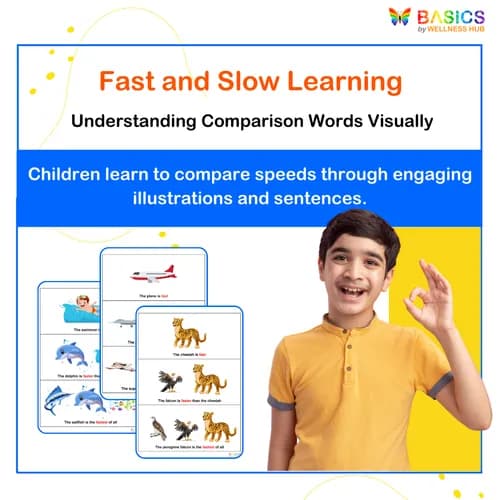
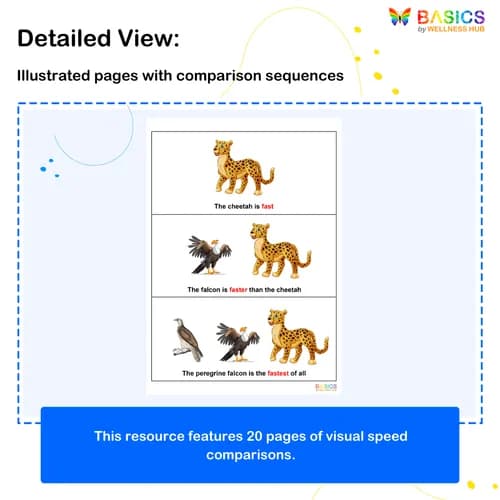
Understanding comparison words is a crucial part of language development for young learners. The FAST & SLOW – Learn Comparison Words (Fast, Faster, Fastest / Slow, Slower, Slowest) Through Pictures resource is designed to help children ages 4-8 grasp the concept of speed through engaging visuals and simple sentences. This printable PDF features 20 pages, each containing three illustrated images that depict various vehicles, animals, and people in motion, allowing children to see firsthand how speed can be compared.
Each page introduces a clear sequence of comparison, such as "The truck is slow," followed by "The tractor is slower than the truck," and concluding with "The bulldozer is the slowest of all." This structured approach not only reinforces vocabulary related to speed but also enhances children's understanding of comparative and superlative forms in a fun, interactive way. Ideal for parents, teachers, and therapists, this resource can be used in classrooms, at home, or during therapy sessions to support language development and comprehension skills.
Product Details
- Product Name: FAST & SLOW – Learn Comparison Words (Fast, Faster, Fastest / Slow, Slower, Slowest) Through Pictures
- Format: Printable PDF
- Total Pages: 20
- Illustrated Images: 60 total (3 images per page)
- Content: Each page demonstrates one comparison sequence (fast → faster → fastest or slow → slower → slowest)
- Example Sentences: Includes clear, descriptive sentences accompanying each image to illustrate comparison.
- Designed For: Early childhood education, language development, and speech therapy.
- Best Suited For: Ages 4-8, Pre-K, Kindergarten, Grade 1.
- Visuals: Engaging illustrations of vehicles, animals, and people in motion to aid comprehension and retention.
Educational Benefits
1. Enhances Vocabulary Development
- Introduces children to comparative and superlative forms of adjectives in a fun and engaging way.
- Helps expand their vocabulary related to speed, allowing for more expressive language use.
2. Improves Comprehension Skills
- Visual aids support understanding by showing real-life examples of speed differences.
- Encourages children to make connections between words and their meanings through illustrated comparisons.
3. Supports Language Development
- Reinforces sentence structure and grammar by providing clear, simple examples.
- Encourages children to practice speaking and writing using comparison words in context.
4. Promotes Critical Thinking
- Encourages children to analyze and compare different speeds, fostering critical thinking skills.
- Helps them understand the concept of degrees of comparison in a practical, relatable manner.
5. Engages Visual Learners
- Utilizes colorful illustrations to capture attention and enhance memory retention.
- Makes learning interactive and enjoyable, catering to various learning styles.
Instructions for Use
Step 1: Print the PDF
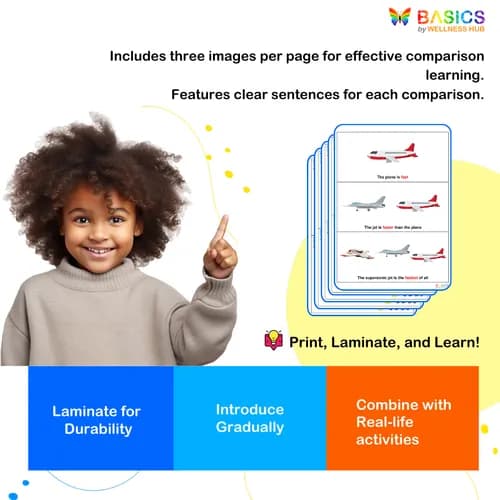
- Download and print the FAST & SLOW resource on standard A4 or Letter-sized paper.
- Consider laminating the pages for durability, especially for repeated use in classrooms or therapy sessions.
Step 2: Introduce the Concept
- Begin by explaining the terms "fast" and "slow" to the child.
- Use everyday examples to illustrate the concept (e.g., "A car is fast, while a bicycle is slow.").
Step 3: Explore Each Page
- Go through each page one at a time, discussing the three illustrated images.
- Read the descriptive sentences aloud and encourage the child to repeat them.
Step 4: Encourage Comparison
- Ask the child to identify which object is the fastest or slowest on each page.
- Prompt them with questions like, "Which one do you think is faster?" to stimulate critical thinking.
Step 5: Practice Speaking & Writing
- Encourage the child to create their own sentences using the comparison words.
- Have them describe other objects or animals they know, using the same structure (e.g., "The cat is fast. The dog is faster. The horse is the fastest.").
Step 6: Reinforce Learning with Games
- Incorporate fun activities such as matching games or drawing their own comparisons.
- Use the images to create a speed race game where children can guess which object would win based on the comparisons learned.
Step 7: Review Regularly
- Revisit the pages periodically to reinforce understanding and retention.
- Encourage the child to use comparison words in everyday conversations to solidify their learning.
Activities Using the Resource
1. Speed Comparison Chart
Objective: Visualize and categorize objects based on speed.
How to Play:
- Create a chart with three columns labeled "Fast," "Faster," and "Fastest."
- Use images from the resource to fill in the chart, placing each object in the correct column.
- Discuss why each object belongs in its respective category.
Skill Development:
- Categorization skills
- Understanding of comparative language
- Visual organization
2. Speed Race Predictions
Objective: Foster prediction skills and critical thinking.
How to Play:
- Present two or three objects from the resource (e.g., rabbit, dog, cheetah).
- Ask the child to predict which one would win in a race and explain their reasoning.
- After discussing, reveal the images and sentences to confirm or adjust their predictions.
Skill Development:
- Predictive reasoning
- Verbal articulation
- Analytical thinking
3. Create Your Own Comparisons
Objective: Encourage creative thinking and language use.
How to Play:
- Ask the child to think of their favorite animals or vehicles.
- Have them create their own comparison sentences using the structure from the resource (e.g., "The elephant is slow. The horse is faster than the elephant. The cheetah is the fastest of all.").
- Share their sentences with family or classmates.
Skill Development:
- Sentence structure
- Creative expression
- Vocabulary expansion
4. Illustrated Comparison Story
Objective: Develop narrative skills through comparisons.
How to Play:
- Choose three objects from the resource and create a short story involving them.
- Encourage the child to use comparison words throughout the story (e.g., "The turtle was slow, but the rabbit was faster.").
- Illustrate the story with drawings or by using images from the resource.
Skill Development:
- Storytelling abilities
- Use of descriptive language
- Imagination and creativity
5. Speed Matching Game
Objective: Reinforce understanding of speed comparisons through play.
How to Play:
- Create matching cards with images and sentences from the resource.
- Lay the cards face down and take turns flipping two cards to find matches (e.g., "The rabbit is fast." with the corresponding image).
- If a match is found, the player keeps the pair; if not, they turn them back over.
Skill Development:
- Memory and recall
- Visual discrimination
- Turn-taking and social skills
6. Speed Charades
Objective: Encourage physical expression and understanding of speed.
How to Play:
- Choose a speed-related word or phrase from the resource (e.g., "The cheetah is the fastest of all").
- The child acts out the speed of the object without speaking, while others guess what it is.
- Discuss the speed comparisons after each round.
Skill Development:
- Non-verbal communication
- Understanding of action-based adjectives
- Social interaction skills
Frequently Asked Questions
Q1: What age group is this resource designed for?
A1: The FAST & SLOW resource is designed for children aged 4-8, making it suitable for preschool through early elementary grades. The engaging visuals and simple sentences help young learners grasp the concept of speed and comparison in a fun and interactive way. This resource is perfect for introducing foundational language skills while keeping children entertained and engaged.
Q2: How can I use this resource in a classroom setting?
A2: This resource can be used in various ways, such as during whole-class discussions, small group activities, or individual learning stations. Teachers can encourage students to explore the pages together, ask comparison questions, and even create their own sentences based on the illustrations to enhance language development. Additionally, it can serve as a springboard for creative activities, such as drawing their own fast and slow objects or acting out the comparisons.
Q3: Can this resource be used for children with special needs?
A3: Absolutely! The FAST & SLOW resource is designed with visual learners in mind, making it accessible for children with various learning needs. The clear illustrations and straightforward language can help children who may struggle with traditional text-based learning. Furthermore, educators can adapt the resource by providing additional support or using hands-on activities to reinforce the concepts.
Q4: How do I access the resource after purchasing?
A4: After your purchase, you will receive an email with a download link to access the PDF resource. Simply click the link to download the file to your device. If you encounter any issues with the download, our support team is available to assist you. We recommend saving the file to a secure location for easy access during your lessons.
Q5: What is your refund policy if I am not satisfied with the resource?
A5: At Wellness Hub, we strive for customer satisfaction. If you are not satisfied with your purchase, please contact our support team within 30 days of your purchase for assistance. We will review your request and provide options for a refund or exchange based on your specific situation. Your feedback is important to us, and we want to ensure you have a positive experience.
Q6: Are there any licensing restrictions for using this resource in a classroom?
A6: The FAST & SLOW resource comes with a single-user license, which allows you to use it for your personal or classroom needs. If you wish to use it for multiple classrooms or share it with other educators, we offer bulk licensing options. Please contact our support team for more details on purchasing additional licenses or for any specific usage inquiries.
Q7: How can I contact support if I have questions or issues?
A7: You can reach our support team through the contact form on our website or by emailing us directly at support@wellnesshub.com. We strive to respond to all inquiries within 24-48 hours. Whether you have questions about your purchase, need assistance with a resource, or have suggestions for improvement, we are here to help.
Q8: What other resources does Wellness Hub offer?
A8: Wellness Hub provides a wide range of expert-led therapy resources, including flashcards, worksheets, and visual schedules to support parents and caregivers in continuing progress at home. Our library is designed to cater to various developmental needs, including speech and language therapy, occupational therapy, and behavioral support. We are committed to making high-quality care accessible to everyone.
Q9: Is the resource available in other formats besides PDF?
A9: Currently, the FAST & SLOW resource is only available in PDF format, which allows for easy printing and sharing. We recommend printing the pages on sturdy paper for durability, and you can also laminate them for repeated use in a classroom or therapy setting. If you have specific format requests, please let us know, and we will consider them for future updates.
Q10: How often do you update your resources?
A10: We regularly review and update our resources to ensure they meet the latest educational standards and best practices. Feedback from users plays a crucial role in this process, so we encourage you to share your thoughts and suggestions. By staying current, we aim to provide the most effective and engaging materials for educators, therapists, and families alike.
Usage Rights and Restrictions
Allowed Usage:
- Personal use by parents, teachers, and therapists.
- Printable for classroom, home, or therapy settings.
- Can be used in group or one-on-one learning sessions.
Not Allowed:
- Reselling, redistributing, or modifying the resource for commercial use.
- Sharing publicly (e.g., on blogs, social media, or websites) without permission.
- Uploading the file to public sharing platforms.
If you need a bulk license for schools or therapy centers, please contact us.
Conclusion
The FAST & SLOW – Learn Comparison Words resource is an essential tool for fostering early language development in children ages 4-8. Through engaging illustrations and simple, descriptive sentences, this printable PDF effectively teaches children about degrees of comparison, helping them articulate differences in speed with confidence. By using this resource, children will not only expand their vocabulary but also enhance their comprehension and critical thinking skills in a fun and interactive manner.
Ideal for parents, teachers, and therapists, this resource can be seamlessly integrated into home learning, classroom activities, or therapeutic sessions. Its visual approach caters to various learning styles, making it accessible for all children, including those with special needs. Invest in this resource today to empower young learners with the language skills they need to express themselves clearly and effectively.