


Asking for What I Need – Social Story for Kids
₹80
₹160
50% off
0 (0 ratings)
Grade Levels
Pre-K - Grade 3 (Ages 4-9)
Content Overview
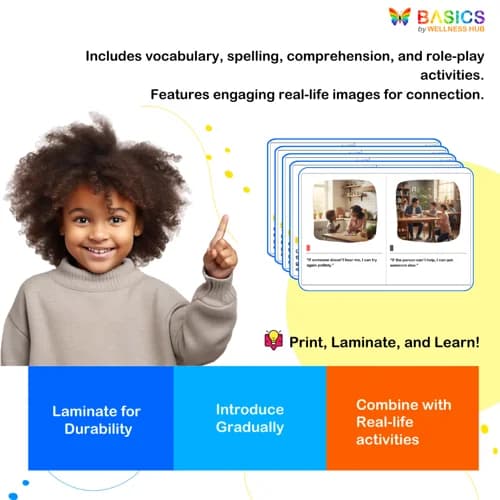
Format: Printable PDF, Total Pages: 11, Features: 16 segments with real images, vocabulary, spelling, comprehension questions, and role-play activities.
Categories
Share


About the Product
Introduction
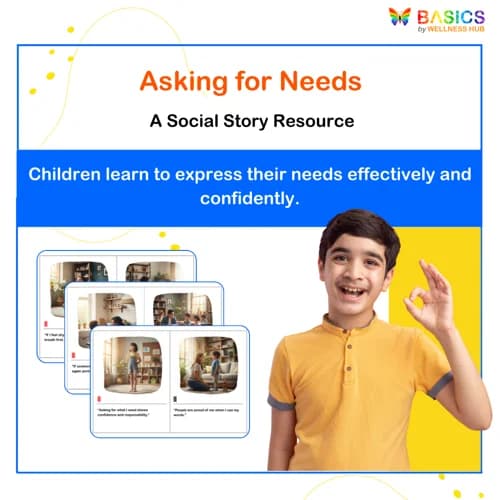
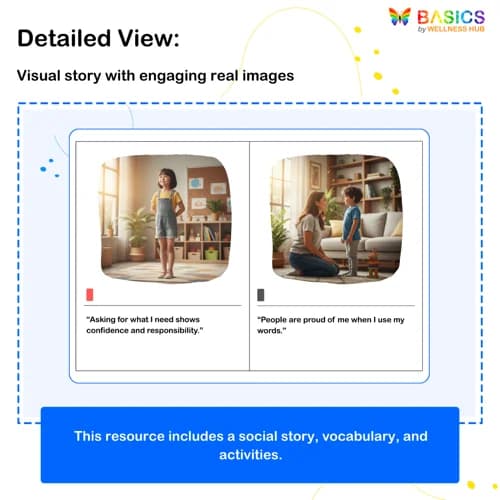
The "Asking for What I Need" social story is a valuable resource designed to help children understand the importance of expressing their needs in a clear and effective manner. This 11-page PDF is tailored for young learners, particularly those with social communication challenges, autism spectrum disorders, or developmental delays. By using first-person narratives and real images, this social story fosters a personal connection, making it easier for children to relate to the content and apply it to their own lives.
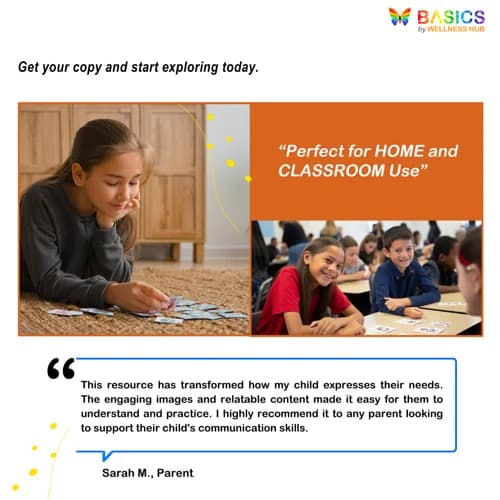
The first eight pages consist of 16 engaging segments that guide children through the process of asking for help or expressing their needs, reinforcing positive communication skills. Following the story, pages 9 through 11 include vocabulary exercises, spelling activities, comprehension questions, and role-play scenarios, all designed to deepen understanding and encourage practical application of the concepts learned. This resource is perfect for parents, teachers, and therapists looking to enhance social skills in home, classroom, and therapeutic settings.
Product Details
- Product Name: Asking for What I Need: A Social Story
- Format: Printable PDF
- Total Pages: 11
- Social Story Segments: 16 segments across the first 8 pages, each featuring real images and first-person sentences
- Vocabulary Section: 5 key words from the story with two meaning options for each
- Spelling Section: 5 words from the story with two spelling options (one correct, one incorrect) for each
- Comprehension Questions: Engaging questions to assess understanding of the story
- Role-Play Activities: Practical scenarios to practice asking for what one needs in real-life situations
- Designed For: Children with social communication challenges, autism, and developmental delays (ages 4-10)
Educational Benefits
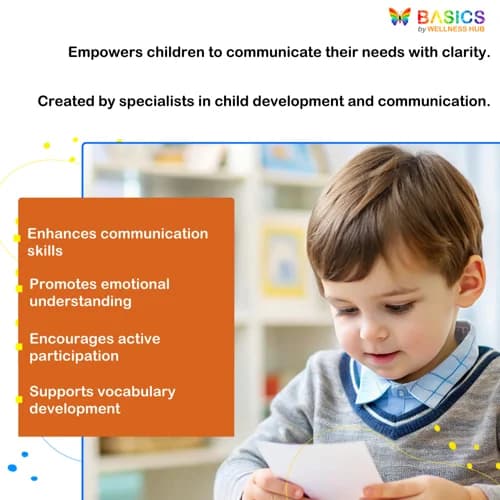
1. Enhances Communication Skills
- Teaches children how to express their needs clearly and effectively.
- Encourages the use of appropriate language in various social situations.
2. Builds Confidence in Social Interactions
- Helps children feel more comfortable asking for help or expressing their needs.
- Promotes self-advocacy and independence in social settings.
3. Supports Vocabulary Development
- Introduces key vocabulary words related to communication and needs.
- Reinforces understanding of words through matching meanings and spelling exercises.
4. Improves Comprehension and Critical Thinking
- Engages children with comprehension questions that assess their understanding of the story.
- Encourages them to think critically about their own needs and how to articulate them.
5. Facilitates Practical Application through Role-Play
- Provides real-life scenarios for children to practice asking for what they need.
- Encourages social skills development in a safe and supportive environment.
Instructions for Use
Step 1: Read the Social Story Together
- Begin by reading the social story with the child, page by page.
- Discuss each segment and the accompanying images to reinforce understanding.
Step 2: Vocabulary and Spelling Activities
- After reading, move to page 9 and review the vocabulary words.
- Ask the child to select the correct meaning for each word from the options provided.
- Have them choose the correct spelling for each word from the spelling section.
Step 3: Engage with Comprehension Questions
- On page 10, go through the comprehension questions together.
- Encourage the child to answer in complete sentences to practice articulation.
Step 4: Role-Play Scenarios
- Use the role-play activities on page 11 to practice asking for what they need.
- Set up different scenarios and encourage the child to use phrases from the story.
Step 5: Reinforce Learning in Real Life
- Encourage the child to apply what they've learned in everyday situations.
- Remind them to use their new skills when asking for help at home or school.
Step 6: Regular Review and Practice
- Revisit the social story periodically to reinforce concepts.
- Encourage ongoing practice with vocabulary and role-playing to build confidence.
Activities Using the Resource
1. Social Story Reading Circle
Objective: Enhance understanding through collaborative reading.
How to Play:
- Gather a small group of children and read the social story together.
- Discuss each segment, encouraging children to share their thoughts and feelings.
- Ask questions about the story to promote engagement.
Skill Development:
- Listening comprehension
- Group interaction skills
- Empathy and sharing perspectives
2. Vocabulary Match-Up
Objective: Strengthen vocabulary recognition and meaning.
How to Play:
- Provide children with the vocabulary words and their meanings from page 9.
- Have them match words to the correct definitions using a cut-and-paste activity.
- Review the matches together, discussing why each word fits its meaning.
Skill Development:
- Vocabulary building
- Critical thinking
- Word association skills
3. Spelling Bee Challenge
Objective: Improve spelling skills through interactive competition.
How to Play:
- Organize a mini spelling bee using the words from the spelling section on page 9.
- Call out each word, and have children take turns spelling them aloud.
- Provide hints or definitions if needed to support learning.
Skill Development:
- Spelling accuracy
- Confidence in verbal expression
- Listening and processing skills
4. Comprehension Discussion
Objective: Assess understanding and encourage articulation.
How to Play:
- Review the comprehension questions from page 10 with the child.
- Encourage them to answer in complete sentences and elaborate on their thoughts.
- Discuss why asking for help is important in various situations.
Skill Development:
- Critical thinking
- Articulation and expression
- Self-reflection on needs
5. Role-Play Scenarios
Objective: Practice real-life application of asking for needs.
How to Play:
- Use the role-play activities from page 11 to create scenarios (e.g., asking for help at school).
- Assign roles and encourage children to act out the scenarios using phrases from the story.
- Discuss the outcomes and feelings associated with each role-play.
Skill Development:
- Social skills development
- Confidence in communication
- Problem-solving in social situations
6. Real-Life Application Journal
Objective: Encourage practical use of learned skills in daily life.
How to Play:
- Have the child keep a journal to record instances when they successfully ask for what they need.
- Encourage them to write about their feelings and the responses they received.
- Review the journal together to celebrate successes and discuss areas for improvement.
Skill Development:
- Self-advocacy
- Reflective thinking
- Goal setting for communication
Frequently Asked Questions
Q1: How can I use this social story effectively with my child?
A1: Start by reading the social story together, discussing each segment and the accompanying images to reinforce understanding. After reading, engage in the vocabulary and spelling activities to strengthen word recognition. Follow this with comprehension questions to assess understanding, and use the role-play scenarios to practice real-life applications of asking for what they need. This interactive approach helps reinforce the concepts and makes learning enjoyable.
Q2: Is this resource suitable for children with autism or developmental delays?
A2: Yes, this social story is specifically designed for children with social communication challenges, including those on the autism spectrum. The first-person narrative and real images help create a personal connection, making it easier for children to relate to the content and apply it in their own lives. Additionally, the structured activities promote engagement and understanding, catering to various learning styles.
Q3: How many pages does the social story contain, and what can I expect from each page?
A3: The social story consists of 11 pages. The first 8 pages present the story itself, divided into 16 segments with real images and sentences to enhance comprehension. Pages 9 and 10 include vocabulary and spelling exercises, as well as comprehension questions to deepen understanding. Finally, page 11 features role-play activities that allow children to practice the skills they've learned in a fun and interactive way.
Q4: Can this resource be used in group settings or therapy sessions?
A4: Absolutely! This social story can be effectively utilized in both individual and group settings. In a group, children can share their thoughts and experiences related to the story, fostering social interaction and communication skills. Therapists can also incorporate the role-play activities to encourage collaboration and peer learning, making it a versatile tool for various therapeutic contexts.
Q5: Are there any suggestions for differentiating the activities for children with special needs?
A5: Yes, the resource can be easily adapted for children with varying needs. For instance, you can simplify vocabulary choices or provide additional visual supports for children who may struggle with reading. Additionally, consider using the role-play scenarios in smaller groups or one-on-one settings to provide more individualized support and encouragement, ensuring every child can engage meaningfully with the material.
Q6: What is your refund policy if the resource does not meet my expectations?
A6: Wellness Hub offers a satisfaction guarantee. If you are not satisfied with your purchase, please contact our support team within 14 days of your purchase for assistance. We will work with you to address your concerns and provide a refund if necessary. Our goal is to ensure that you have a positive experience with our resources.
Q7: How do I access the resource after purchase?
A7: Once you complete your purchase, you will receive an email with a download link to access the PDF resource. The file will be available for immediate download, allowing you to start using it right away. If you encounter any issues, our support team is here to help and can assist you in accessing your purchase without delay.
Q8: What kind of support does Wellness Hub provide if I have questions about the resource?
A8: Wellness Hub is committed to providing excellent customer support. If you have any questions or need assistance with the resource, you can reach out to our support team via email or through our website. We are here to help you make the most of our materials and ensure that you feel confident in using them effectively.
Q9: Do you offer bulk or school licensing for this resource?
A9: Yes, Wellness Hub offers bulk licensing options for schools and organizations that wish to purchase multiple copies of our resources. This allows educators and therapists to provide consistent support across their classrooms or therapy sessions. For more information on bulk pricing and licensing agreements, please contact our support team, and we will be happy to assist you.
Q10: Is the resource accessible for children with visual impairments?
A10: While the resource is primarily visual, we strive to make our materials as accessible as possible. We recommend using screen reader software to assist children with visual impairments in accessing the content. Additionally, you can read the story aloud and provide tactile materials to enhance understanding. If you have specific accessibility needs, please reach out to our support team for further guidance and suggestions.
Usage Rights and Restrictions
Allowed Usage:
- Personal use by parents, teachers, and therapists.
- Printable for classroom, home, or therapy settings.
- Can be used in group or one-on-one learning sessions.
Not Allowed:
- Reselling, redistributing, or modifying the resource for commercial use.
- Sharing publicly (e.g., on blogs, social media, or websites) without permission.
- Uploading the file to public sharing platforms.
If you need a bulk license for schools or therapy centers, please contact us.
Conclusion
The "Asking for What I Need" social story is a powerful resource that equips children with essential communication skills, helping them articulate their needs effectively. With its engaging first-person narrative and real images, this 11-page PDF fosters a personal connection, making the learning experience relatable and impactful. By incorporating vocabulary, spelling, comprehension questions, and role-play activities, this resource provides a comprehensive approach to understanding and practicing essential social skills.
Ideal for parents, teachers, and therapists, this social story can be seamlessly integrated into home, classroom, or therapeutic settings. By utilizing this resource, you can empower children to become confident communicators, enhancing their ability to express their needs in various social situations. Start using this valuable tool today to support your child's journey toward effective self-advocacy and improved social interactions.