


Saying No When I Need To – Social Story for Kids
₹80
₹160
50% off
0 (0 ratings)
Grade Levels
Pre-K - Grade 3 (Ages 4-9)
Content Overview
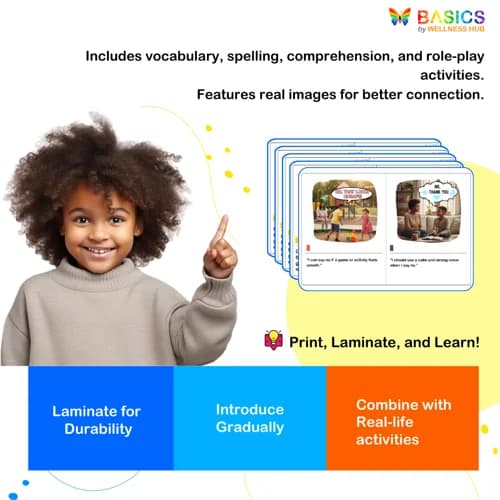
Format: Printable PDF, Total Pages: 11, Features: 16 segments with real images, vocabulary, spelling, comprehension, role-play activities
Categories
Share


About the Product
Introduction
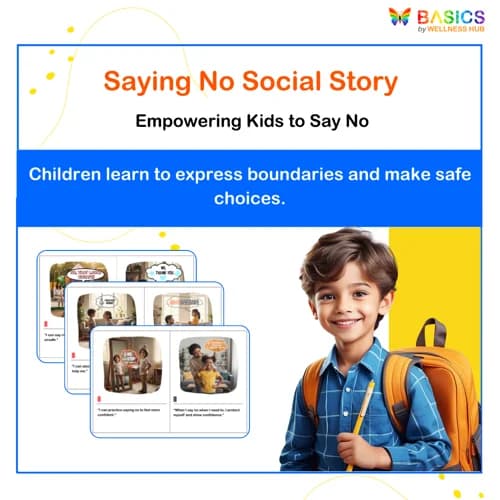
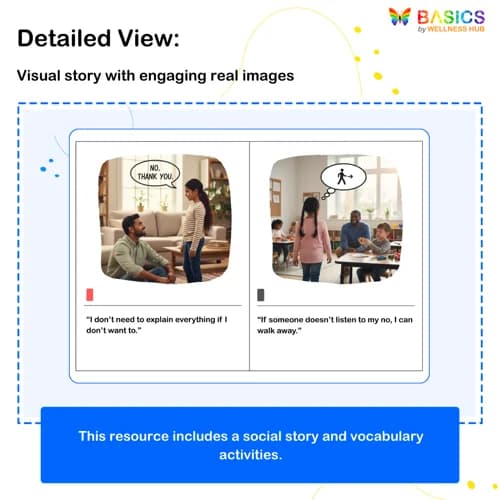
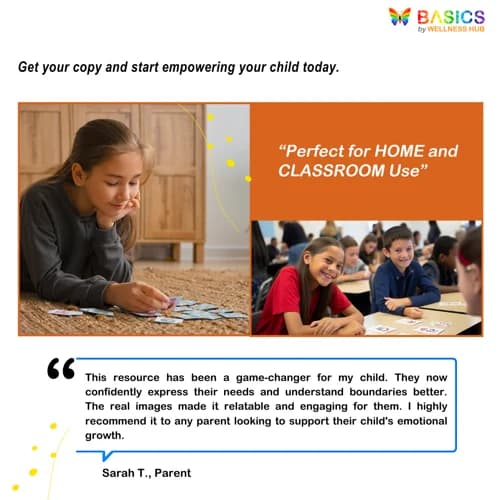
Learning to say "No" is an important skill for children, helping them set boundaries and express their needs confidently. The Saying No When I Need To: Social Story PDF is designed to guide children through understanding and practicing this essential life skill. Using real-life images and first-person narratives, this resource helps children relate to and internalize the scenarios presented. Perfect for home use, classrooms, and therapy settings, this social story supports children in developing assertiveness and communication skills in a safe and supportive manner.
Product Details
- Format: Printable PDF
- Total Pages: 11
- Social Story: 8 pages with 16 segments, each featuring a real image and a sentence in first-person narrative
- Vocabulary and Spelling (Page 9): Includes 5 vocabulary words with multiple-choice definitions and 5 spelling words with correct and incorrect options
- Comprehension and Open-Ended Questions (Page 10): Encourages understanding and personal reflection on the social story
- Role-Play Activities (Page 11): Provides practical scenarios for children to practice saying "No" in a supportive environment
- Ideal For: Speech therapy, social skills training, special education, and home learning
Additional Activities:
Educational Benefits
1. Enhances Assertiveness and Boundary Setting
- Teaches children how to express their needs and feelings effectively.
- Empowers them to say "No" in uncomfortable or unsafe situations.
2. Builds Confidence and Self-Esteem
- Encourages children to trust their instincts and make decisions that prioritize their well-being.
- Helps them understand that it's okay to refuse requests that make them uncomfortable.
3. Supports Language and Literacy Development
- Improves vocabulary and spelling through interactive activities.
- Enhances comprehension skills by encouraging children to reflect on the story and answer questions.
4. Promotes Social-Emotional Learning (SEL)
- Fosters self-awareness and emotional intelligence by helping children recognize their limits.
- Teaches empathy and respect for others' boundaries through role-playing activities.
5. Provides Real-Life Application
- Uses relatable scenarios and real images to help children apply what they learn in everyday situations.
- Prepares children for social interactions where they may need to assert themselves, such as:
- Declining peer pressure
- Refusing to share personal items
- Saying no to unwanted physical contact
Instructions for Use
Step 1: : Read the Social Story Together
- Sit with the child and read through the social story.
- Discuss each segment and image, ensuring they understand the context and message.
- Ask guiding questions like:
- "What would you do if someone asked you to do something you don't want to?"
- "How does it feel to say no when you need to?"
Step 2: : Vocabulary and Spelling Activities
- Review the vocabulary and spelling section on Page 9.
- Encourage the child to choose the correct meanings and spellings.
- Discuss each word and its relevance to the story to reinforce understanding.
Step 3: : Comprehension and Open-Ended Questions
- Explore the comprehension questions on Page 10.
- Encourage the child to think critically and reflect on the story's themes.
- Use open-ended questions to promote discussion and deeper understanding.
Step 4: : Role-Play Scenarios
- Engage in role-play activities from Page 11.
- Act out scenarios where the child practices saying "No" in a safe environment.
- Provide feedback and encouragement to build their confidence.
Step 5: : Reinforce Learning in Real-Life Situations
- Encourage the child to apply what they've learned in everyday interactions.
- Offer praise and support when they successfully assert themselves.
- Revisit the social story regularly to reinforce the skills and concepts learned.
Activities Using the Resource
1. Picture and Sentence Match-Up
Objective: Reinforce understanding of the social story through visual and textual connections.
How to Play:
- Print and cut out the segments from the social story.
- Mix them up and ask the child to match each picture with its corresponding sentence.
- Discuss why each picture and sentence pair is important in learning to say "No."
Skill Development:
- Visual literacy
- Comprehension
- Attention to detail
2. Vocabulary and Spelling Quiz
Objective: Enhance language skills through interactive learning.
How to Play:
- Use the vocabulary and spelling section on Page 9.
- Read each word aloud and discuss its meaning and correct spelling.
- Create a mini-quiz where the child picks the correct definition and spelling for each word.
Skill Development:
- Vocabulary building
- Spelling accuracy
- Critical thinking
3. Comprehension Discussion
Objective: Deepen understanding of the social story's themes.
How to Play:
- Review the comprehension questions on Page 10.
- Encourage open discussion about the story, asking questions like "Why is it important to say no sometimes?"
- Allow the child to express their thoughts and feelings about the scenarios.
Skill Development:
- Reflective thinking
- Emotional expression
- Communication skills
4. Role-Play Practice
Objective: Build confidence in saying "No" through real-world simulation.
How to Play:
- Choose scenarios from Page 11 and act them out with the child.
- Use props or simple costumes to make the role-play engaging.
- Provide supportive feedback and encourage the child to express themselves clearly.
Skill Development:
- Assertiveness
- Social interaction
- Empathy and understanding
5. Real-Life Application Journal
Objective: Apply learning to everyday situations and reflect on experiences.
How to Play:
- Encourage the child to keep a journal of situations where they successfully said "No."
- Discuss these experiences weekly, celebrating successes and discussing challenges.
- Use the journal to identify patterns and reinforce positive behavior.
Skill Development:
- Self-reflection
- Journaling skills
- Real-life problem-solving
6. Creative Storytelling
Objective: Encourage creative thinking and application of learned skills.
How to Play:
- Have the child create their own short story about a time they said "No."
- Use drawings or digital tools to illustrate the story.
- Share the story with family or classmates to build confidence and communication skills.
Skill Development:
- Creative writing
- Illustration
- Public speaking
Frequently Asked Questions
Q1: How can this social story be used effectively in therapy sessions?
A1: Therapists can integrate this social story into sessions by reading it with the child, discussing each segment, and engaging in role-play activities. This helps reinforce the concepts of assertiveness and boundary setting in a supportive environment. The real-life images and first-person narrative make it relatable and engaging for children.
Q2: Can this resource be used at home by parents?
A2: Yes, parents can use this resource to teach children about saying "No" in everyday situations. By reading the story together and discussing the vocabulary, parents can help children understand the importance of setting boundaries. The role-play activities and comprehension questions further support learning at home.
Q3: Is this social story suitable for children with special needs?
A3: Absolutely. The resource is designed to be inclusive, using clear images and simple language to cater to children with various learning needs. It is particularly beneficial in special education settings, speech therapy, and for children with autism or ADHD, as it supports social-emotional learning and communication skills.
Q4: How often should this social story be revisited?
A4: Regular revisiting is recommended to reinforce the skills and concepts learned. Depending on the child's needs, it can be reviewed weekly or monthly. Consistent practice through role-play and real-life application helps children internalize the ability to assert themselves confidently.
Q5: What is the licensing policy for this PDF?
A5: The PDF is intended for personal and educational use only. Redistribution or commercial use is not permitted. Educators and therapists can use it within their practice, but sharing with others outside the immediate educational or therapeutic context is prohibited.
Q6: How can I access additional support from Wellness Hub?
A6: Wellness Hub offers a range of support services, including speech and language therapy, occupational therapy, and behavioral therapy. You can schedule a free consultation through their website to discuss your child's needs and explore suitable therapy options.
Q7: What is the refund policy for digital resources?
A7: Due to the nature of digital products, refunds are typically not provided once the resource has been downloaded. However, if you encounter any issues with the file or content, Wellness Hub's support team is available to assist and resolve any concerns.
Q8: How does Wellness Hub ensure the quality of its therapy services?
A8: Wellness Hub employs qualified therapists who undergo regular training and assessments. Therapy sessions are personalized, and progress is tracked through assessments and feedback. The platform's digital tools, like Tele-BASICS, enhance the quality and engagement of therapy.
Q9: Can I use this resource in a classroom setting?
A9: Yes, this social story is ideal for classroom use. Teachers can incorporate it into social skills lessons, using the story, vocabulary activities, and role-play scenarios to teach assertiveness and boundary setting. It encourages group discussion and peer learning.
Q10: How can I provide feedback or ask questions about the resource?
A10: Wellness Hub welcomes feedback and inquiries. You can contact their support team via email or through their website's contact form. They are committed to ensuring customer satisfaction and are happy to assist with any questions or suggestions.
Usage Rights and Restrictions
Allowed Usage:
- Personal use by parents, teachers, and therapists.
- Printable for classroom, home, or therapy settings.
- Can be used in group or one-on-one learning sessions.
Not Allowed:
- Reselling, redistributing, or modifying the resource for commercial use.
- Sharing publicly (e.g., on blogs, social media, or websites) without permission.
- Uploading the file to public sharing platforms.
If you need a bulk license for schools or therapy centers, please contact us.
Conclusion
The Saying No When I Need To: Social Story PDF is a comprehensive resource designed to empower children with the skills to assert themselves and set boundaries confidently. Through engaging real-life images and first-person narratives, children learn to navigate social situations where saying "No" is important. This resource is ideal for parents, educators, and therapists seeking to enhance children's assertiveness, communication, and social-emotional skills. By incorporating vocabulary, spelling, comprehension, and role-play activities, this PDF offers a holistic approach to learning that is both practical and relatable. Whether used at home, in classrooms, or therapy sessions, it supports children in developing the confidence to express their needs and prioritize their well-being.