My Child Switches Hands or Avoids Using One Hand What Should I Do?
By Wellness Hub
Last Updated: February 18, 2026
You hand your child a crayon and they start with the right hand, then suddenly swap to the left. At snack time they reach across their body instead of using the closer hand. Or you notice one hand mostly “hangs out” while the other does all the work.
If you’ve been wondering whether you should correct this, encourage one side, or simply wait and see, you’re not alone. Many parents notice hand switching or a “less involved” hand during the toddler and preschool years, when coordination is still coming together.
The reassuring part is this: using two hands smoothly is a skill that develops over time. And in many everyday situations, what looks like avoiding one hand is actually your child figuring out comfort, balance, and control.
Why two hands matter even when the task looks one-handed
Many early hand skills are really two-hand skills.
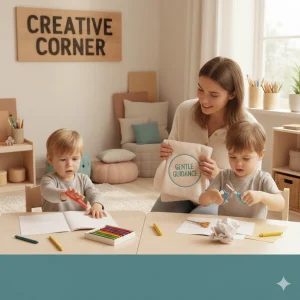
Even when a child is drawing, placing stickers, building with blocks, or trying to zip a jacket, one hand usually does the detailed work while the other hand provides support. You might hear this called a “working hand” and a “helper hand.” The helper hand is easy to miss because it is not doing the exciting part. But it plays an important role. It holds the paper steady, stabilizes the toy, or keeps a container from sliding away. That steadiness allows the working hand to use fingers with more precision.
When the helper hand is not joining in yet, the working hand has to do two jobs at once. It must control the object and manage fine finger movements at the same time. That can make tasks feel harder than they need to be. Some children respond by switching hands, changing their body position, or giving up on the activity.
Read more: Why Sticker Peeling Is So Hard And How It Helps Finger Control
Is it normal for my child to switch hands?
For many young children, yes. Hand preference often becomes clear gradually, not all at once. Some children try both hands for a while, especially when they are tired, excited, sitting differently, or working on something tricky.
You might notice your child uses one hand more for certain activities, like feeding, and the other hand for different activities, like throwing. You may also see more switching when a task needs extra control, such as cutting with scissors or drawing small shapes.
Instead of seeing hand switching as something to fix, it can help to see it as information. Your child is searching for the most comfortable and successful way to do the task.
Why a child may avoid using one hand without it being a big problem
Sometimes one hand seems to opt out, but the reason is often very practical.
Your child may be choosing the easiest solution. If the paper slides while they draw, they might move their whole body closer instead of holding the paper with the other hand. If opening a container feels hard, they might push it against their tummy or the table rather than using the helper hand. These are clever workarounds, not bad habits.
Other times, the helper hand simply does not feel automatic yet. Two-hand coordination is a rhythm that develops with experience: hold with one hand, work with the other, adjust, and repeat. That rhythm takes time and lots of everyday practice through play and routines. Sometimes your child is focused only on the main job, like drawing the picture, and has not yet added the supporting job of holding the paper. Many children build skills in layers like this.
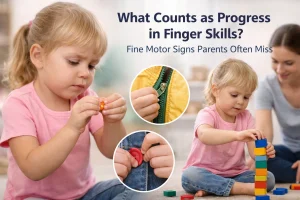
Read more: What Counts as Progress in Finger Skills? Small Signs Parents Often Miss
What good progress can look like in real life
Progress with two-hand use is usually subtle. It does not always look like a child suddenly choosing one hand and sticking with it. More often, it looks like small shifts over time, such as:
Your child holds the paper for a few seconds while coloring, then forgets and tries again later.
They use the helper hand when the task is bigger or heavier, like holding a bowl, even if they do not yet do it for small tasks. They rely less on pressing toys against their body because the helper hand is starting to take over. They seem more willing to try fiddly tasks like stickers, zippers, or building sets because it feels less frustrating.
These small changes matter because they support a bigger goal: using fingers independently and together to handle objects with ease. When the helper hand provides stability, the working hand can focus on finger control such as pinching, pressing, turning, and adjusting. These skills later support buttons, zippers, tool use, and early writing.
Gentle ways to encourage comfortable two hand use without making it a big issue
Most children respond best when support feels natural and pressure free. Instead of correcting or constantly reminding, it often helps to create situations where using both hands is simply the easiest option.
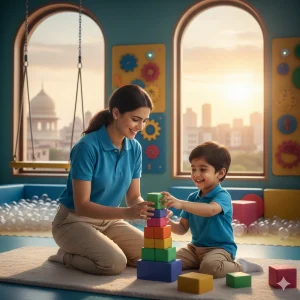
During everyday play, some activities naturally invite two hands. Building, playdough, opening containers, peeling stickers, and using simple tools often work better when one hand holds and the other works. The goal is not to train the helper hand, but to let your child discover, “This is easier when I hold it.”
Positioning also matters. When materials are centered in front of your child and at a comfortable height, both hands are more likely to join in. When things are off to one side, children often reach across with one hand and the other hand never gets involved. If your child avoids certain tasks, it can help to treat that as a clue rather than a battle. Sometimes the task is just a bit too demanding right now. It may be too slippery, too small, or too rushed. When the experience feels more manageable, children are often more willing to try again.
Should I tell my child which hand to use?
Many parents ask this, especially when they think about writing later on.
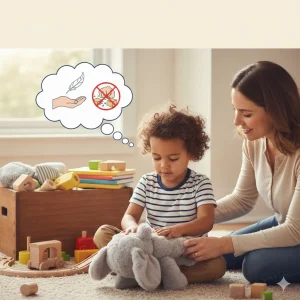
In general, it is best to avoid forcing a particular hand. Hand preference usually settles naturally with time. Children tend to do better when they can discover what feels most natural to them.
What you can gently support is the idea that both hands have a job. One hand helps, one hand works. If you want simple language at the moment, neutral phrases can help, such as “This hand can hold it,” or “Let’s keep the paper steady.” This supports the idea of two hands working together without making your child feel corrected.
Read more: How to Help Finger Skills During Dressing (Buttons, Zippers, and Fasteners Without a Battle)
When extra support may be helpful
Sometimes parents look for guidance not because something is wrong, but because daily tasks are becoming stressful or their child seems consistently uncomfortable.
Extra support can be useful if your child often avoids hands-on activities, becomes easily frustrated with things like fasteners or simple tools, or if two-hand tasks feel persistently hard in everyday routines such as dressing, eating, or play. You also deserve support if you simply feel unsure about what you are seeing. A calm conversation with someone who understands child development can bring a lot of clarity.
Some families like having a simple, parent-friendly way to focus on hand skills through everyday routines. Speech and Autism therapy apps like BASICS can help connect helper-hand stability with finger control and offer easy ways to support progress through play, without turning the day into therapy time.
A steady reminder for parents
When a child switches hands or does not yet use a helper hand automatically, it can look concerning, especially when you compare them with peers who seem more coordinated. But many children are still building the foundation: comfort using both sides of the body, learning how to stabilize objects, and developing finger control through that stability. You do not need to correct every hand swap or turn it into a test. The most helpful support is calm and consistent: offering everyday chances for two hands to work together, noticing small improvements, and keeping hands-on tasks relaxed.
Over time, as the helper hand becomes more automatic, the working hand usually becomes more precise. And when that happens, the whole experience feels easier for your child. That ease is what you are really aiming for, and it grows best with patience, real-life practice, and understanding.
Book your Free Consultation Today
Parent/Caregiver Info:
Client’s Details:
* Error Message