Why Does My Toddler Drop Things When They Seem Strong Enough to Hold Them?
By Wellness Hub
Last Updated: April 6, 2026
If you have found yourself thinking, “why does my toddler drop things when they can clearly pick them up,” you are not alone. It can feel confusing, especially when your child looks strong. They can carry a book across the room, lift a snack cup, or drag a toy bin, and then suddenly a toy slips, a spoon clatters, or a cracker falls right before it reaches their mouth.
Most of the time, frequent dropping is not about effort or “not trying.” It is often about control. Toddlers are still learning how to coordinate their hands and fingers, adjust grip pressure, and keep their attention on what their hands are doing while the rest of their body is busy moving, turning, and exploring.
Also read: What Fine Motor Control Really Means, Not Just Small Fingers and Tiny Toys
Why does my toddler drop things if their grip seems strong?
Strength and control are related, but they are not the same skill.
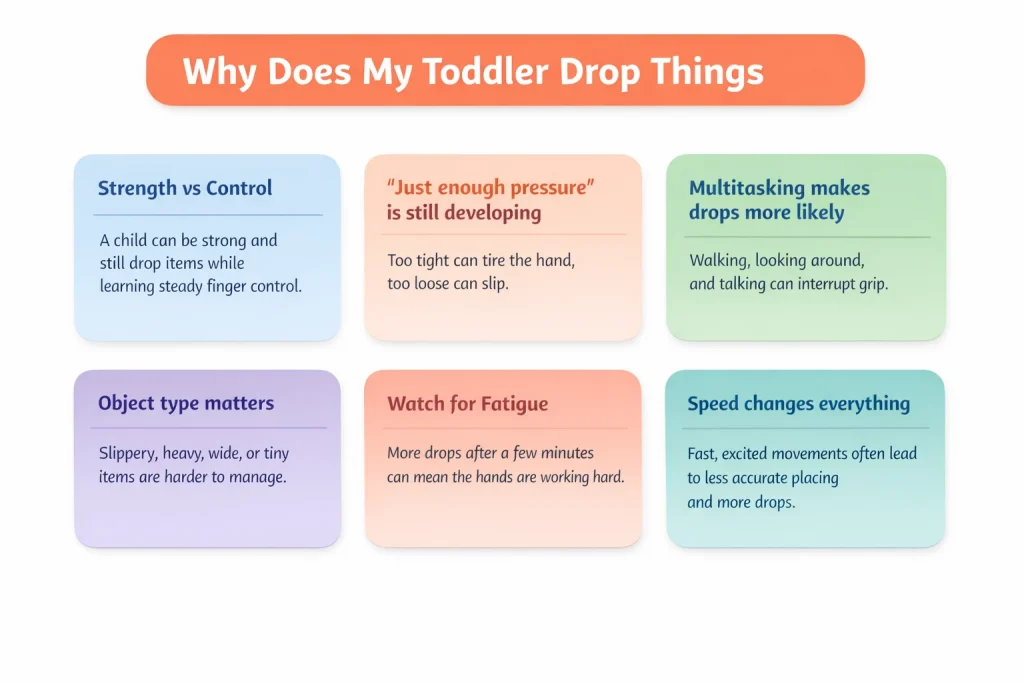
A toddler can have plenty of strength and still drop items because holding something steady takes more than squeezing. It takes tiny adjustments in the fingers, good timing between both hands, and the ability to use “just enough” pressure. Many toddlers use a grip that is either too tight or too loose, and both can lead to drops.
Here are a few common, very normal reasons it happens:
- Sometimes the grip is “all or nothing.” Your child squeezes hard to make sure the object stays put, then their hand gets tired or the object pops out unexpectedly. Other times they hold loosely, especially if they are distracted, and the item simply slides.
- The fingers may not be working as a team yet. Toddlers often rely on their whole hand instead of using the fingertips in a coordinated way. That makes it harder to keep an object stable when they move their arm, turn their wrist, or change position.
- Their wrist and hand may be a little “wobbly.” A stable wrist helps the fingers do precise work. When the wrist is still developing steadiness, the fingers have to work harder, and objects can slip.
- They are multitasking. Toddlers drop things more when they are walking, talking, looking around, or switching toys. Their brain is doing a lot at once, and hand control is still becoming automatic.
If this sounds familiar, it can help to reframe it as a skill that is under construction, not a sign that your child is careless.
Dropping can be about timing, attention, and just enough pressure
A helpful way to think about toddler fine motor control is that it is a mix of three things happening together.
First is timing. Your child has to open their hand at the right moment, close their fingers at the right moment, and keep adjusting as the object shifts. A cup is heavier when it is full. A toy is harder to hold when it is smooth. A cracker changes shape as it breaks. All of that requires quick, tiny timing changes.
Second is attention. Toddlers are wonderful at noticing everything. The dog walks by, a sound happens in the kitchen, a sibling calls their name, and the hand that was holding the toy relaxes for a second. That second is often when the drop happens.
Third is pressure control. This is the “just enough” piece. Too much pressure can make a child look rough or tense with objects, and it can also lead to dropping because the hand tires quickly. Too little pressure leads to slipping. Many toddlers bounce between the two while they learn.
You might notice this most during everyday moments like:
- carrying a cup across the room
- holding a spoon while turning their head to look at you
- picking up small snacks with slightly sticky fingers
- stacking or placing toys carefully, then getting excited and rushing
None of this means your child is behind. It usually means their system is practicing how to grade force and coordinate movement, which takes time and lots of real life repetition.
Learn More: When Should a Toddler Be Able to Stack Blocks Without Knocking Them Over?
What patterns to look for when your toddler drops things a lot
When parents tell me their toddler drops things a lot, I usually suggest looking for patterns before trying to “fix” anything. Patterns give you clues about what is hardest right now, and they also help you notice progress.
A few gentle questions to consider:
1. Does it happen more when your child is moving?
Dropping while walking, climbing, or turning often points to the challenge of coordinating the hands while the body is in motion. Many toddlers do better when seated or when their body feels steady.
2. Is it worse with certain objects?
Smooth plastic toys, heavy cups, wide items, or very small pieces can be harder to manage. If your child drops slippery items more than textured ones, it may be a grip adjustment issue rather than strength.
3. Do drops happen at the end of a task?
If your child starts off fine and then drops more after a few minutes, fatigue may be part of it. Hand muscles can tire quickly when a child uses extra effort to stabilize.
4. Do you see “crashing” or fast movements right before the drop?
Some toddlers move quickly and with big energy. When speed goes up, control often goes down. A drop in this case can be a sign that their hands are moving faster than their fingers can adjust.
5. Does one hand seem less coordinated?
Many toddlers have a preferred hand, but if one hand consistently drops more, looks more awkward, or avoids holding, that is useful information to keep in mind.
These observations are not about judging your child. They simply help you understand what their hands are working on right now.
What helps in real life, without turning it into “practice”
Parents often ask what they should do in the moment. The goal is not to correct every drop. It is to make daily life feel easier and help your child get more successful experiences with their hands.
A few supportive ideas that fit naturally into routines:
- Offer a steadier body position when possible. Many toddlers do better with hand tasks when they are sitting, leaning on a table, or supported at the hips. It is not about restricting movement, it is about giving their hands a calmer base.
- Choose objects that “forgive” wobbly grip. Items with a bit of texture, a wider handle, or a slightly squishy feel can be easier to hold. When a child gets more success, they often relax their grip and gain smoother control.
- Slow the moment instead of speeding it up. When adults rush, toddlers often tense. A calmer pace gives their fingers time to adjust. You might notice fewer drops when you pause and let them finish the action.
- Notice effort and control, not just the outcome. If your child places something carefully, even if it still falls, that careful attempt matters. Kids repeat what feels successful and safe.
If you are looking for play ideas that build this kind of control, many families like squeeze and release play, gentle press and pull toys, and pick and place games using everyday objects. You do not need a perfect setup. Repetition inside normal play is what counts.
Also read: 7 Easy Ways to Support Hand Strength Without Making Your Toddler Squeeze Harder
When dropping is more about frustration than hands
Sometimes the hardest part of frequent dropping is not the dropping. It is what it does to your child’s mood, and to yours.
A toddler who drops things repeatedly may start to:
- rush to “get it over with”
- avoid certain toys or utensils
- get upset quickly when something falls
- throw the item after it drops, more from frustration than behavior
If you are seeing this, it can help to treat the frustration as the main problem to solve in the moment. A calm reset, a short break, or switching to an easier object can protect your child’s confidence. When kids feel capable, they practice more. When they feel stuck, they often stop trying.
This is also where it helps to watch your own expectations. It is easy to assume, “You can do it, I saw you do it yesterday.” Toddlers have uneven days. Sleep, hunger, excitement, and growth spurts can all change how coordinated their hands feel.
When should I seek extra support for frequent dropping?
Many toddlers go through phases where dropping is common, especially during big bursts of movement and exploration. Still, you deserve support if daily routines are feeling harder than they need to.
You might consider reaching out to a pediatric occupational therapist or early intervention provider if:
- dropping regularly disrupts meals, play, or dressing, and it is not improving over time
- your child avoids using their hands for age appropriate play because it feels too hard
- frustration is high and your child cannot stay with hand tasks for more than brief moments
- you feel unsure what to try, even after simplifying and slowing down
Support does not have to be intensive to be helpful. Sometimes a few sessions focused on setup, object choices, and how to build control gently can make daily life feel much smoother.
Learn More: 9 Fine Motor Activities for Toddlers at Home That Build Gentle Hands
A reassuring closing: why does my toddler drop things, and what should I remember?
If you are still wondering, “why does my toddler drop things when they seem strong enough,” the simplest answer is that strength is only one piece. Your child is learning coordination, attention, and pressure control all at once, and that takes time.
Try to watch for small signs of progress: a slightly gentler grip, one more successful carry, a calmer hand when placing a toy, a longer stretch of play without fatigue. Those are real wins, even if the drops still happen.
And if you notice your toddler drops things more during busy, exciting moments, that is a useful clue, not a problem. It often means their hands do best when the pace is slower and their body feels steady. Over time, those steady moments tend to grow.
Book your Free Consultation Today
Parent/Caregiver Info:
Client’s Details:
* Error Message