When Should a Child Respond to Their Name With Eye Contact?
Last Updated: March 28, 2026
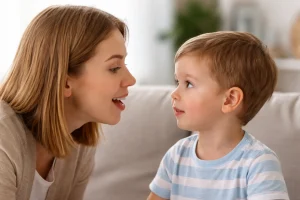
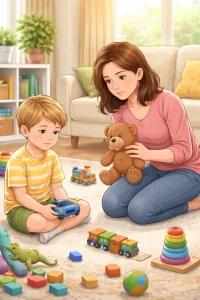
You say your child’s name, and they keep playing. You try again, a little louder, and still no look. If you have found yourself searching for “respond to name eye contact,” you are not alone. This is one of those everyday moments that can feel surprisingly big, especially when you are comparing your child to a sibling, a cousin, or a child at the park.
The reassuring truth is that name response is not a single skill that switches on one day and stays perfect. It is a mix of attention, interest, comfort, and timing. A child can hear you and still not look up in that moment, especially during busy play. What matters most is the overall pattern you see across the day, not one missed response when they are deep in their own world.
Also read: Eye Contact Milestones by Age, What’s Typical in Toddlers and Preschoolers
What does it mean to respond to their name with eye contact?
When parents picture “responding to name,” they often imagine a clear head turn and direct eye contact every time. Real life is usually messier and more subtle.
A name response can look like:
- A quick glance up, then back to the toy
- A small pause in movement, like their hands stop for a second
- A head turn without a long look
- A smile or a little sound as if they are checking, “Is that for me?”
- Looking toward your face after a short delay, especially if you are close by
Eye contact is only one part of the response. Some children orient with their body first, then look. Others look briefly but do not pause their play. Many toddlers give you a “drive by” glance that lasts half a second. That still counts as connection.
It also helps to remember that eye contact during play is often quick by nature. Young children are learning to coordinate their attention between what they are doing and who they are with. That back and forth is the real goal, not a long stare.
When should I expect respond to name eye contact to show up?
Most families start noticing name response emerging during the first year and becoming more reliable across the toddler years. Still, “reliable” does not mean “every single time.” Even adults do not respond instantly when they are focused, tired, or overwhelmed.
Instead of holding a strict age expectation in your head, it can be more helpful to watch for a few everyday signs:
- Your child responds more when you are nearby and face to face
- They respond more in calm moments than in high energy play
- They respond faster when your voice sounds warm and familiar
- They respond more when something fun is about to happen, like bubbles, a snack, or a favorite song
- They respond better in predictable routines than in brand new places
If you are seeing some responses, even inconsistent ones, that is meaningful. It suggests your child is building the “I heard you, and I know you are talking to me” connection. Consistency usually grows with time, relationship, and lots of low pressure practice in daily life.
Know More: What games help with eye contact during play when my child keeps moving?
Why might my child hear their name but not look up?
Parents often tell me, “I know they can hear me.” And they are usually right. Not looking up is often about attention, not hearing.
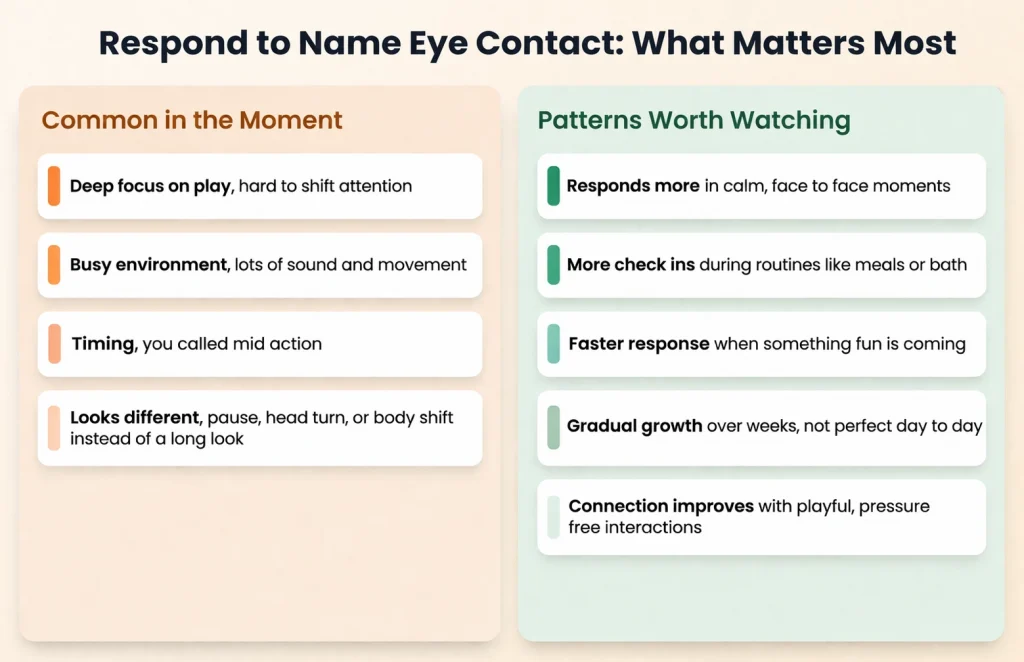
Here are some common, non alarming reasons a child might not look when called:
Play can be deeply absorbing
Toddlers can get intensely focused on a toy, a movement, or a pattern they are exploring. In those moments, shifting attention is genuinely hard work. It is not stubbornness. It is concentration.
Your child may be tracking you in a different way
Some children listen without looking. They might keep playing but adjust their body, slow down, or move closer to you. They are still “with you,” just not using eye contact as their main signal.
The environment is doing a lot
Noise, screens, multiple people talking, or even a busy room can make it harder to pick out your voice and shift attention. This is especially true in public places.
The timing may be working against you
If you call their name when they are mid action, like climbing, jumping, or dumping a bin, you are asking their brain to do two things at once. Many toddlers need a beat to finish the action before they can look.
They may be unsure what comes next
If name calls often lead to “no,” “stop,” or a demand, some children start to tune it out. Not because they are being difficult, but because the interaction has started to feel tense or unpredictable.
Temperament plays a role
Some children are naturally more cautious or more independent in play. They may check in less often, especially if they feel safe and settled.
If you are wondering whether this connects to “why won’t my child make eye contact,” it can. But it can also be completely situational. A child who avoids eye contact with strangers may still share lovely eye contact with a parent during routines like meals, bath, or bedtime.
What patterns matter more than a single missed response?
A missed response at the park, during a noisy family gathering, or while your child is lining up cars does not tell the whole story. I encourage parents to zoom out and look for patterns across the day.
Green flag patterns often look like:
- Your child responds sometimes, especially when you are close
- They look more during routines, like snack, dressing, bath, or bedtime
- They check in more when play is shared, like rolling a ball back and forth
- They respond better to a playful voice than a repeated, louder call
- The response is growing slowly over time, even if it is still inconsistent
Patterns that can feel harder, and may be worth extra support, look like:
- Responses are rare across many settings, even calm ones
- Your child seems to miss name calls even when you are right next to them
- It is difficult to get shared attention during play and routines, not just name response
- Interactions start to feel stressful for you, because you are working so hard to get a look
This is not about judging your child’s behavior. It is about noticing what helps them connect, and what makes it harder. Many families find that once they adjust the moment, like getting closer, lowering distractions, or using a warm pause, the response improves.
Gentle ways to support name response without turning it into a test
Most parents try repeating the name. Then repeating it again. Often, that creates more pressure and less connection.
Support tends to work best when it feels like play, not a quiz. Here are a few relationship friendly ideas you can weave into your day, without making it a “look at me” moment:
Get close before you call
Name response is easier when your child can see you in their side vision. If you are across the room, you are asking for a big attention shift. Up close, it is a small shift.
Use your face and your voice together
A warm expression, an expectant pause, and a gentle tone often invite a glance more naturally than volume. Many toddlers respond to the feeling of the moment.
Pause before the fun part
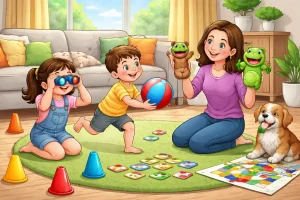
In playful routines, a tiny pause can create a natural reason to look. This is why games like peekaboo, bubbles, rolling a ball, silly sounds, or singing face to face often support eye contact during play without anyone demanding it.
Notice and respond to any “check in”
If your child glances for half a second, treat it like a success. Smile, continue the interaction, or respond warmly. Big, loud praise can sometimes interrupt the moment, so keep it simple and connected.
Try not to stack demands after the name
If every name call is followed by “come here,” “stop,” or “give me that,” your child may start avoiding the moment. Balance those necessary moments with plenty of name calls that lead to something pleasant, like a shared smile, a cuddle, or a fun routine.
Build it into routines that already happen
Eye contact during routines can be easier than during free play because the steps are predictable. Many children look more during snack, bath, dressing, or bedtime because they know what is coming next and feel safe.
If you want extra guidance without pressure, the BASICS App can be a gentle place to explore. It is parent guided and self paced, with short videos that model what “pause and wait” can look like in real homes.
When should I seek extra support, and what kind helps?
Sometimes parents just want reassurance that they are not missing something. Other times they want practical coaching because the day to day feels stuck.
You might consider extra support if:
- You have been watching this for a while and the pattern is not changing
- Your child rarely responds to their name in calm, familiar settings
- It is hard to get shared attention during play, not just during name calls
- You feel yourself getting more anxious or frustrated during interactions
- You would like a professional to observe routines and help you adjust the “how” of the moment
Support does not have to be intense to be helpful. Many families benefit from a few sessions focused on connection, routines, and communication. If you are looking for that kind of coaching from home, Tele-BASICS is one option for structured, therapist led support.
In some cases, families also consider a developmental screening to better understand communication delays or possible autism-related differences. This is not about jumping to conclusions. It can simply provide clarity and next steps if questions keep coming up.
A gentle closing thought: respond to name eye contact grows through connection
If your child does not look up every time you call, it does not mean you are doing anything wrong. It often means they are busy being a toddler, focused, curious, and absorbed in play.
Keep watching the overall pattern. Look for small “check ins,” shared smiles, and those brief moments of eye contact during play and daily routines. Over time, those tiny glances often become more frequent and more reliable. And if you still feel unsure, it is completely okay to ask for support. You deserve to feel calm and confident, not stuck in a loop of worry about respond to name eye contact.
About the Author:
Shravanaveena Gajula
M.Sc ., Speech and Language Pathology (5+ years of experience)
Shravanaveena Gajula is a dedicated Speech-Language Pathologist with a BASLP and an M.Sc in Speech and Language Pathology. With experience spanning multiple settings, including Wellness Hub , Veena specializes in a wide range of disorders from developmental issues in children to speech and language assessments in adults. Her expertise includes parent counseling, managing speech sound and fluency disorders, and creating individualized therapy programs. Veena is also PROMPT certified and an author of several insightful blogs on speech and language pathology, aiming to educate and assist caregivers in supporting their loved ones.
Book your Free Consultation Today
Parent/Caregiver Info:
Client’s Details:
* Error Message