When Do Babies Start Babbling During Play? A Parent-Friendly Timeline
By Wellness Hub
Last Updated: January 29, 2026
You’re playing on the floor together, and you catch yourself waiting for that sweet little “ba-ba” or “da-da” moment that feels like the start of “real” talking. And if it hasn’t happened yet or it’s happening sometimes but not consistently. Then, it’s common to wonder, “Should I be hearing more by now?”
Babbling during play is one of those milestones that parents notice in real time, because it shows up right in the middle of everyday life, like peekaboo, bath time, stacking blocks, bouncing on your knee. The reassuring truth is that babbling isn’t a pass/fail skill. It tends to grow gradually, in waves, and it often looks different from one baby to the next. This timeline is meant to be gentle and flexible, more like a “what you might notice next” guide than a checklist.
What counts as babbling during play?
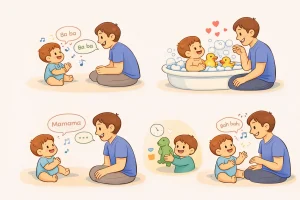
Babbling is your baby experimenting with sounds in a playful, social way. Early on, it might be simple and repetitive, like “ba-ba-ba” (often called repeating syllables). Later, you may hear mixed-up syllables like “ba-da” or “ga-ba” (a more varied sound pattern). During play, babbling often comes with bright eyes, little pauses, and that feeling that your baby is “talking with you,” not just making noise.
Remember that, babbling doesn’t have to sound like “ba-ba” to count. Some babies start with other sounds, squeals, growls, raspberries, or long strings of vowel-like noises. Those can be part of the path toward more speech-like babble.
A parent-friendly timeline: when playful babbling often shows up
Babbling tends to build in layers. Instead of appearing all at once, it usually shifts from simple sounds, to repeated syllables, to more varied “speechy” strings, especially when your baby is excited, comfortable, and engaged with you.
Around 3–5 months: I found my voice
In this stage, many babies begin making more intentional sounds during happy moments, like coos, squeals, and lots of experimenting with volume and pitch. During play, you might notice your baby vocalizing when you lean close, smile, or copy their sound back.
This often looks like: big grins, wide eyes, and a sound that seems to mean, “Did you hear that? I did that!” If you’re not hearing “ba-ba” yet at this age, that’s completely expected. This stage is more about discovering that making sounds is fun and that you respond.
Around 6–8 months: repeated syllables begin to pop up
This is the window many parents associate with classic babbling. You may start to hear repeated syllables like“ba-ba-ba,” “da-da-da,” “ma-ma-ma”, especially during playful routines. Some babies do it while bouncing, while chewing on a toy, or while you’re singing. Others save it for those cozy face-to-face moments.
A common pattern here is “bursts.” Your baby might babble a lot for a few days, then go quieter, then come back with new sounds. That back-and-forth rhythm is normal. Babies often shift their focus, one week it’s sounds, another week it’s rolling, crawling, or getting into everything.
Around 9–12 months: more variety and more “conversation”
As babies get closer to their first birthday, babbling during play often becomes more varied and social. You might hear mixed syllables (“ba-da,” “da-ga”), longer strings of sound, and more intentional “turn-taking,” where your baby makes a sound, pauses, and looks at you like they’re waiting for your reply.
This is also when many parents notice that babbling starts to sound like it has emotion or “meaning,” even if it isn’t words yet. Your baby might babble to protest, to get your attention, to keep a game going, or to show excitement when something fun happens. If your baby is looking at you while babbling, or babbling at you during play, that’s a lovely sign of growing social communication.
Around 12–18 months: babbling blends into early words (and still matters)
Even after the first words appear, babbling often continues. Many toddlers use a mix of real words, word-like sounds, and playful syllables, especially when they’re excited, tired, or deeply engaged in pretend play.
If your child has a few words but still babbles a lot, that can be part of the process. Babbling is practice. It’s your child exploring how their mouth, voice, and social attention work together.
What progress looks like over time without turning it into a test
Parents often expect a sudden switch from “no babbling” to “constant babbling.” More often, progress shows up in softer, more gradual ways. Over weeks and months, you may notice changes in three main areas.
- Babbling becomes more frequent during play. Instead of occasional sounds, you hear more vocal moments sprinkled throughout routines—during bath time, while stacking cups, in the stroller, or while you’re making silly faces.
- Babbling becomes more varied. You might hear new consonants, new combinations, or longer strings of sounds. It may go from “ba-ba” to “ba-da-ga” or from one favorite sound to a whole collection.
- Babbling becomes more interactive. Your baby starts to look at you while making sounds, pause as if it’s your turn, or babble to keep a familiar game going. This back-and-forth is a big part of what makes babbling during play so meaningful.
And, of course, quiet days still happen. A baby can be making great progress and still have stretches where they’re focused on movement, sleep changes, teething, new environments, or simply observing.
Why babbling during play matters beyond the cuteness
Babbling is one of the earliest ways babies practice being a communicator. During play and social moments, those joyful sounds help your baby learn, “When I make a sound, you respond. When you respond, I want to do it again.” That’s the beginning of the conversation.
It also builds confidence. When your baby experiments with sounds and sees your smile, your attention, and your delight, they learn that their voice matters. Over time, those playful sound experiments become a foundation for more complex communication.
“My baby babbles… but not during play.” Is that okay?
It can be. Some babies are “private practitioners” who babble more when they’re alone in the crib, in the car seat, or while exploring a toy independently. Others babble most when they’re excited or when a routine is predictable (like peekaboo or a favorite song).
Babbling during play often grows as babies realize play is social. If your baby is making sounds at other times, that’s still valuable vocal exploration. Many parents notice the social part, babbling with someone that builds gradually.
Gentle ways to encourage more playful babbling without pressure
The best support usually doesn’t look like teaching. It looks like enjoying your baby and making space for their voice.
Many parents find it helps to treat sounds like a shared game: you make a playful sound, your baby tries something back, and you respond warmly with smiles, eye contact, a little pause, and genuine interest. Songs, books with rhythm, silly faces, and familiar routines often invite more vocal experimenting because they’re predictable and fun.
If your baby babbles, responding as if they said something meaningful can keep the “conversation” going. You’re showing them that communication is a two-way street—one sound at a time.
When you might want extra support for clarity, not alarm
Sometimes parents don’t just want reassurance, but they want a clearer sense of what to watch for next, or how to make playtime feel more interactive. If you’re noticing that babbling isn’t increasing over time, or you’re simply feeling unsure what’s typical for your child, it can be comforting to get guidance.
Some families like having a simple tool that helps them notice communication skills in everyday routines. BASICS is one option parents use to understand goals like babbling during play and social interaction, with short videos and everyday examples that are meant to feel supportive, not overwhelming.
Reaching for support doesn’t mean something is wrong. It often just means you want to feel more confident about what you’re seeing and how to nurture it.
A calm reminder to hold onto
Babbling during play is not a performance. It’s a relationship skill growing in real time, through smiles, pauses, silly sounds, and the safety of being with you. If you haven’t heard “ba-ba” yet, or if it comes and goes, you’re not behind and your baby isn’t failing. Look for the gentle signs of growth: more sound-making, more variety, more back-and-forth. Those small shifts are often how big communication skills are built.
And if you ever find yourself listening closely during play, hoping to hear that next new sound, know that your attention, warmth, and presence are already part of what helps it emerge.
Book your Free Consultation Today
Parent/Caregiver Info:
Client’s Details:
* Error Message