Is It Normal If My Baby Mostly Makes Vowel Sounds When Babbling?
By Rajini D
Last Updated: February 26, 2026
You’re listening carefully, hoping to hear that sweet little “ba-ba” or “ma-ma”… but what you mostly get is “ahhh,” “ooo,” and long strings of open, sing-songy sounds.
If you’ve caught yourself thinking, Should there be more consonants by now? you’re far from alone. Many parents notice this “vowel-heavy” stage and quietly worry that their baby might be stuck or falling behind in communication development. In most situations, it helps to see babbling as a slow and curious sound journey rather than a checklist to complete. Babies often begin with the easiest, open-mouth sounds and slowly add new ones as their mouths, voices, and confidence grow. Your baby isn’t doing anything wrong. They’re learning in their own way.
Why vowel sounds often show up first in communication development
Vowel sounds like “ah” and “oo” usually come first because they’re simply easier on the body. Your baby can make them with an open mouth and a bit of voice. No careful lip popping or tongue placement is needed.
Consonants like b, m, d, g, p ask for more coordination. A “b” or “p” needs the lips to close and release at just the right time. A “d” asks the tongue to touch a very specific spot. That kind of control develops little by little, especially when babies are also busy learning so many other things at once: rolling, sitting, reaching, chewing, sleeping (or not sleeping), and soaking in everything around them.
So if your baby is vocal, expressive, and playing with their voice, even if it’s mostly vowels, that’s still a meaningful step in early communication development.
Also read: What Not to Do When Encouraging First Words: Common Mistakes That Can Shut Talking Down
What early consonant exploration can look like in real life
Many parents picture consonants arriving as clear, repeated syllables like “ba ba ba,” right on schedule. In real life, it’s often much quieter and more subtle than that.
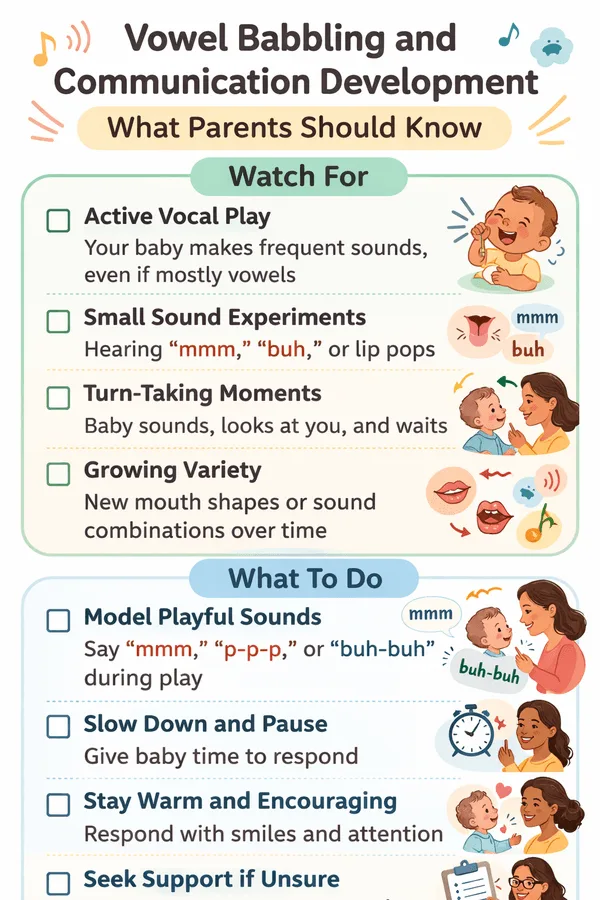
You might notice things like:
- A soft “mmm” when your baby is relaxed or eating
- A “buh” that shows up once and then vanishes for a week
- A tiny lip “pop” during play
- Growly or throaty sounds that come and go
- Short bursts of sound that don’t quite form a neat syllable yet
This is often how it begins. Small experiments mixed in with familiar vowel sounds. Babies try something new, decide how it feels, and then come back to it later.
It’s also very common for babies to have a favorite sound for a while. Some love “ahhh.” Others fall in love with squeals, raspberries, or low growls. Variety usually builds slowly, especially when babies feel calm, safe, and engaged.
Babbling is more than sounds—it’s connection
It’s easy to focus on what you haven’t heard yet, especially if you’re comparing your baby to another child or to what you imagined babbling would sound like.
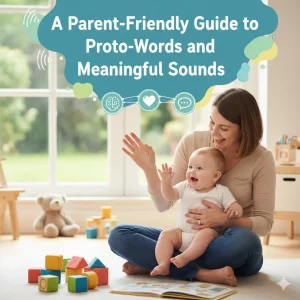
But babbling isn’t just about forming certain letters. It’s also about learning the rhythm of connection: making a sound, watching your face, hearing you answer, and trying again. When your baby vocalizes and you respond warmly, they discover something powerful: My voice matters. I can make something happen.
That feeling of safety and shared joy is often what gives babies the courage to try new sounds over time and supports healthy communication development.
How sound variety usually grows without pressure
Sound variety usually grows through ordinary moments, not structured “practice time.” Babies learn best when it feels like play, not work.
You may notice consonants appear more when:
- Your baby can see your face and watch your mouth move
- You’re being playful or animated (babies love this)
- Something fun happens, like a bubble popping or a toy moving
- You’re singing songs with familiar, predictable patterns
- Your baby feels comfortable, excited, and unhurried
Often, the biggest shift happens when parents stop listening closely for a specific sound and start enjoying the interaction itself. That relaxed feeling makes it easier for babies to experiment.
Gentle ways to invite consonants into everyday life
You don’t need to “teach” consonants, and there’s no need to correct your baby’s sounds. What helps most is giving your baby many chances to hear and play with different sounds in a warm, easygoing way.
During play, many parents naturally use fun sound effects: little “buh-buh” noises for bouncing, “mmm” for yummy food, “p-p-p” for popping bubbles, or “d-d-d” for a toy that drives. These playful sounds work well because they’re short, repeatable, and connected to something your baby can see and enjoy.
It can also help to slow down and give your baby time to answer. Some babies need an extra moment before they try a sound. A small pause after you speak can feel like a gentle invitation rather than a test.
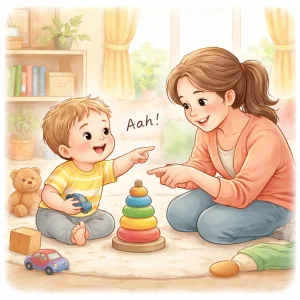
And if your baby responds with a vowel sound, that still counts. You can answer back as if it were a perfect turn in a conversation, because it is.
What progress might look like if your baby is mostly using vowels
When consonants start to appear, it may be very subtle. Progress often looks like more playfulness and variety, not a sudden jump to clear syllables.
Over time, you might notice:
- Your baby trying new mouth shapes
- More closed-mouth sounds like “mm” mixed with vowels
- Little bits of “b,” “p,” “d,” or “g” showing up now and then
- More sound combinations, even if they aren’t steady
- A look of pride or excitement when your baby makes a new sound
It’s also common for babies to use a new sound for a day and then seem to forget it. That doesn’t mean it’s gone. It often means they’re cycling through skills as they practice.
When it might be helpful to get extra support
Sometimes parents aren’t just looking for reassurance. They want clarity. If you feel unsure, stuck, or like you’ve been waiting a long time without seeing much change, it’s okay to ask for guidance.
Extra support can be helpful if your baby’s vocal play feels very limited over time, or if you rarely hear any new sound experimentation and aren’t sure how to encourage it in a way that still feels natural. If concerns continue, some families consider developmental screening to better understand communication development patterns or to gently rule out broader concerns such as autism.
Some families like having a simple plan they can use during daily routines, with ideas that stay playful and realistic. speech therapy app like BASICS can support goals such as expanding sound variety in babbling by showing parents gentle ways to model sounds in everyday moments, without turning your day into homework.
A calming note to end on
If your baby is mostly using vowel sounds right now, it doesn’t mean you missed a window or need to push harder. Vowels are often the doorway into babbling, and consonants usually arrive through time, connection, and playful interaction.
Keep enjoying your baby’s sounds. Answer them. Copy them. Add a little variety when it feels natural. Those small, warm exchanges are doing more than you can see. They’re building the foundation for communication, one joyful sound at a time.
About the Author:
Rajini Darugupally
M.Sc., Speech-Language Pathologist (9+ years of experience)
Rajini is a passionate and dedicated Speech-Language Pathologist with over 9+ years of experience, specializing in both developmental speech and language disorders in children and rehabilitation in adults. Driven by a desire to empower each individual to find their voice, Rajini brings a wealth of experience and a warm, genuine approach to therapy. Currently, at Wellness Hub, she thrives in a team environment that values innovation, compassion, and achieving results for their clients. Connect with Rajini to learn more about how she can help you or your loved one find their voice.
Book your Free Consultation Today
Parent/Caregiver Info:
Client’s Details:
* Error Message