How to Use Pauses So Your Child Has a Chance to Start the Interaction
Last Updated: February 12, 2026
If you’ve ever caught yourself doing this, you’re in very good company; your child looks at you, there’s a tiny quiet moment, and you jump in with a helpful prompt.
“Do you want the ball?”
“Say ‘mama’!”
“Tell me what you need.”
“Here, I’ll help.”
Most of us fill the silence without even thinking. We’re trying to be responsive, encouraging, and kind. And then, later, you might notice a pattern that feels confusing, thinking: “Why do I always have to start everything? Why doesn’t my child initiate with me?” Here’s the gentle truth: many children initiate more when they’re given a little more room. Not because they’re being “tested,” and not because you’re doing anything wrong, but because initiation needs space to appear. And one of the simplest ways to create that space is a warm, expectant pause.
This article focuses on one powerful strategy: using pauses so your child has a real chance to take the first step, whether that looks like a smile to start a routine, a sound to get your attention, bringing you a toy, or calling out to begin play.
Why initiation can be hard to see even when it’s starting
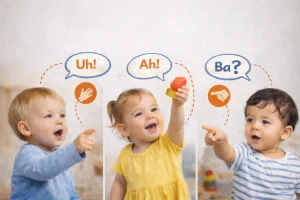
Initiating interaction with a caregiver can look like so many small, everyday things: bringing you an object, making a sound from across the room, smiling to start a familiar game, or tugging your sleeve and looking up.
But these moments are often quiet and quick. If you’re used to keeping things moving—asking questions, offering choices, anticipating needs, it’s easy to accidentally “step into” the moment where your child might have initiated.
It’s not that your child can’t initiate. Sometimes it’s that the opening disappears before they can use it. And it makes sense. Children often need a beat to process what’s happening, decide what they want, and then figure out how to show you. That beat is the pause.
Also read: What Counts as “Initiating”? Small Signs Your Child Is Reaching Out That Are Easy to Miss
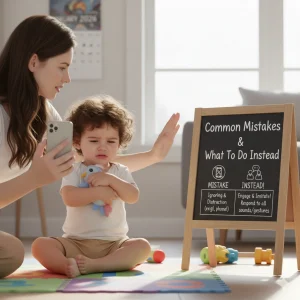
The common parent habit: repeating prompts and why it backfires
When a child doesn’t respond right away, most parents naturally try again, often with more words, more energy, and more help.
“Do you want it? Do you want it? Say ‘more’ more? Here, I’ll just give it to you.”
This comes from love. It also comes from real-life pressure: you’re trying to get out the door, make dinner, keep the peace, avoid a meltdown, or simply connect. But repeated prompting can quietly teach a child that the grown-up will always take the lead. Your child may learn, “I don’t have to start it, Mom will.” Or they may start waiting for the next clue, because the first moment didn’t feel like their turn yet.
A pause changes the rhythm. It sends a different message: “I’m here. I’m ready. I’m waiting for you.”
What a warm pause actually communicates
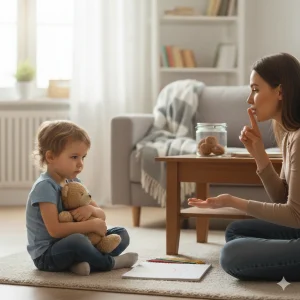
A pause isn’t ignoring. It isn’t withholding. It isn’t making your child “perform.”
A warm pause is more like holding the door open.
It’s your calm presence, your friendly face, your open body language paired with enough time for your child to step forward in whatever way they can. Sometimes that step is obvious, like bringing you a toy. Sometimes it’s tiny, like a glance, a grin, a little sound, or a shift of their body toward you. Those tiny starts matter. They’re often the early building blocks of bigger, clearer initiations later.
When you respond warmly to those small starts, your child learns something important: “When I reach out, it works. I can get a connection.”
What success can look like in real life
Parents sometimes imagine initiation as a clear, confident “Mom! Play!” But for many children, it begins much more subtly. You might start noticing that your child smiles at you before a familiar routine, like a tickle game or a bedtime song. They may bring you a toy more often, even if they don’t say anything. They might call out from another room, make a sound to get your attention, or look at you and then at something they want to share.
Over time, these initiations can become a more regular part of your day together, with more shared laughter and ease. And often, you’ll find you’re prompting less, not because you’re holding back, but because your child is stepping in more.
How to pause without making it feel awkward
Many parents worry that pausing will feel unnatural or tense. That’s a fair concern, especially if you’re used to being the “activity engine” in your home. The key is that the pause stays playful and connected. Think of it as a friendly, expectant moment rather than a silent standoff.
It can help to keep your face soft and interested, like you’re genuinely curious what your child will do next. If your child looks toward you, you can let your expression say, “I see you. I’m ready.” If they’re holding something, you can simply be available, with hands open, attention present, without rushing in with directions.
And if nothing happens right away, that doesn’t mean the pause “didn’t work.” It may just mean your child needs more time, or the moment wasn’t quite motivating, or they’re tired. Pauses are an invitation, not a guarantee.
What to do instead of repeating prompts
When you’re trying to support your child’s ability to initiate interaction, it can be surprisingly helpful to do less talking in the key moment. Instead of stacking questions (“Do you want this? What is it? Say it!”), many parents find it easier to offer one simple opening and then let the pause do the heavy lifting. The goal isn’t to get perfect words. The goal is to give your child a chance to start—through a smile, a sound, a look, a reach, or bringing something to you.
If your child does initiate, even in a small way, your warm response is the “reward.” A smile back. Joining the play. A delighted “You brought it to me!” That kind of response teaches your child that starting interactions is joyful and safe. And if your child doesn’t initiate, you can still keep the moment light. You can continue the routine, offer connections, and try again later. This is about building comfort and confidence over time, not capturing every opportunity.
Pauses during routines can be especially powerful
Play is a wonderful place for initiation, but routines are often where parents notice the biggest changes because routines repeat, and repetition gives children a sense of predictability.
Think about the little moments where your child already knows what comes next, like getting dressed, mealtime, bath time, a familiar song, a silly “ready, set…” moment before you do something fun. Those are natural places where a pause can create a clear “your turn” space without you needing to set anything up. Your child may begin to smile to start the routine, make a sound to keep it going, or look at you in a way that says, “Do it again.”
When you notice those moments and respond with warmth, you’re building a foundation for future communication that feels natural and enjoyable for both of you.
If pausing feels hard, you’re not alone
Some children are quick to jump in. Others are more cautious, more focused on objects, or simply slower to warm up. Some days your child will initiate more; other days they’ll initiate less. That’s normal.
And some parents find pausing emotionally hard because silence can feel like disconnection, especially if you’ve been working hard to get any interaction going at all. If that’s you, it’s okay. You’re not failing. You’re learning a new rhythm. Start by noticing just one moment a day where you could have filled the space, and try a gentle pause instead. Not perfectly. Not every time. Just enough to make room.
Optional support if you want a little guidance
If you like the idea of using pauses but you’re not sure what it looks like with your child’s personality and routines, some families appreciate having a simple framework to lean on.
Speech and Autism therapy Apps like BASICS can help parents choose a meaningful communication goal, like initiating interaction with a caregiver, and see examples of how to support it in everyday moments without pressure. It’s not something you need to do, but it can be reassuring if you want a clearer sense of what to look for and how to stay playful.
A calm reminder to end on
Your child initiating interaction isn’t about being more “independent” or doing things the “right” way. It’s about connection. It’s your child learning, little by little, that they can reach out and you’ll meet them there.
When you offer a warm pause, you’re giving your child a gift: time to notice, time to decide, and time to start. And when that first step comes , with a smile, a sound, a toy placed in your hand and you’re not just seeing communication. You’re seeing your child say, in their own way, “Come into my world.”
Book your Free Consultation Today
Parent/Caregiver Info:
Client’s Details:
* Error Message