How to Help Your Toddler Use Two Hands Together During Play
By Wellness Hub
Last Updated: April 2, 2026
If you are noticing your toddler uses two hands together only once in a while, or not at all, you are not alone. Many toddlers go through phases where one hand does most of the work, and the other hand sort of floats nearby or gets in the way. It can look like clumsiness, stubbornness, or even “they could do it if they tried,” especially when you know your child is smart and determined. Most of the time, it is simply a skill that is still coming together.
Using two hands as a team is one of those quiet building blocks that affects play, feeding, and early drawing. When it starts to click, you often see fewer drops, less frustration, and more “I can do it!” moments.
Learn More: 9 Fine Motor Activities for Toddlers at Home That Build Gentle Hands
What does it mean when a toddler plays one-handed?
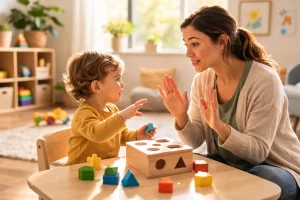
A lot of toddler play can be done with one hand, so it makes sense that some children default to it. Think about pushing a car, banging a drum, or tossing a ball. One hand can handle those jobs just fine. Two-hand coordination becomes more important when one hand needs to hold something steady while the other hand does the “work.”
You might notice one-handed play most in moments like these:
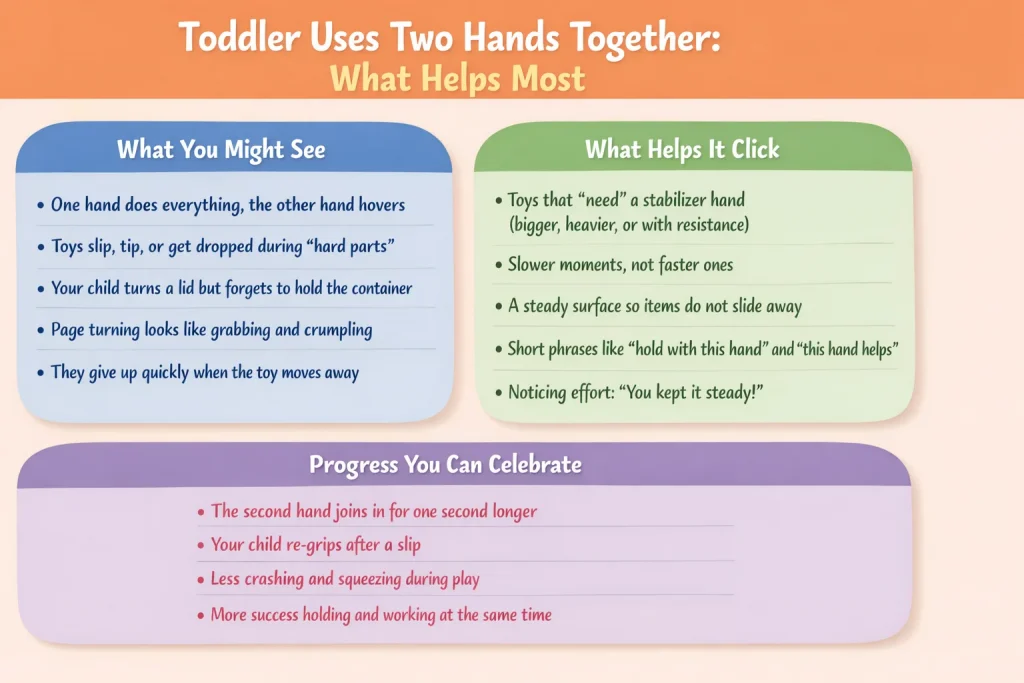
- Your child tries to open a container but keeps turning the lid without holding the bottom.
- They want to peel a sticker but cannot keep the paper still.
- They attempt to stack blocks, but the tower wobbles because the base is not stabilized.
- They hold a book, then struggle to turn pages without the book sliding away.
- They try to use a spoon, but the bowl moves around and spills happen quickly.
None of this means your child is not trying. It usually means their “helper hand” is still learning its role. That helper hand is the stabilizer. It holds, anchors, and adjusts, so the other hand can manipulate, place, pull, twist, or press.
This is closely connected to toddler fine motor control, because the hands are not just moving. They are grading force, timing movements, and coordinating fingers. When control is still developing, the stabilizing hand may press too hard, let go too soon, or not join in at all.
When Should the Helper Hand Show Up, and What Counts As Progress?
Parents often expect two hands together to look neat and consistent. In real toddler life, it is usually messy at first. Progress often shows up as quick little moments, then disappears again, then comes back.
Here are a few reassuring signs that the skill is moving in the right direction:
- Your child briefly holds a toy with one hand while the other hand explores it.
- They start to bring the second hand in when something is tricky, even if it is not effective yet.
- You see a pause before they act, like they are planning where to put their hands.
- They stabilize for one second longer than before, then let go.
- They adjust their grip after a slip, instead of abandoning the task.
It also helps to remember that toddlers are still figuring out which hand wants to lead. Some children switch hands often for a while. Some settle into a preference earlier. Switching does not automatically mean a problem. It can be part of experimenting and learning.
If you are comparing your child to another toddler who seems “so coordinated,” try to zoom in on your own child’s trend. Are they getting less frustrated?, or they staying with a task longer? Are they more willing to try again after a drop? Those are meaningful wins.
Read more: It’s Okay if Your Toddler is Messy With Hands, Control Comes Before Neatness
Why Your Toddler Uses Two Hands Together More in Some Toys Than Others
Two-hand play is not just about ability. It is also about the toy, the setup, and how demanding the task is.
Some toys almost “invite” two hands. Others accidentally encourage one-handed habits.
Two-hand friendly play usually has one of these features:
- It is bigger or heavier, so it naturally needs stabilizing.
- It has resistance, like pulling, pressing, or twisting.
- It has a clear job for each hand, like holding and placing.
On the other hand, toys that slide easily, are very small, or require fast movements can make it harder for the helper hand to join in. If everything is moving around, your toddler may choose the simplest strategy, which is to use one hand and chase the object.
Energy and regulation matter too. When a child is tired, hungry, or overstimulated, you may see more one-handed play and more dropping. That is not backsliding. It is a normal “today my body has less to give” moment.
If you have ever wondered, “why is my toddler so rough with toys,” sometimes the roughness is their way of trying to stabilize. They are using extra force because their hands have not yet learned “just enough.” That is a control skill, not a character trait.
Gentle Ways To Encourage Two-Hand Play in Everyday Routines
You do not need special tools to support this. You are mostly looking for small opportunities where your child can experience, “one hand holds, the other hand works,” in a way that feels doable.
During meals, two hands show up when one hand holds the bowl while the other scoops, or when one hand steadies food while the other uses a utensil. If the bowl slides, the task becomes much harder. A steadier bowl or a less slippery surface can make the helper hand feel “worth it,” because it actually works.
During dressing, the helper hand might hold the waistband while the other hand pulls fabric up. Or it might hold a shoe while the other hand tries to push the foot in. These are tricky tasks, so it is normal if your toddler wants you to do them. Still, even a brief attempt counts.
In bath time, squeezing and releasing a sponge, holding a bottle while trying to flip the cap, or gripping a toy while the other hand scrubs it can all bring the second hand into the action. Water play also gives natural feedback, because things slip if the grip is too light and splash if the force is too big.
In play, look for moments where your child already wants something badly. Motivation is your best friend. If they want the lid off, the sticker peeled, the piece pushed in, or the toy opened, they are more likely to tolerate the effort of coordinating both hands.
You might also notice that your child drops things a lot when they try to do “hold and work” tasks. That is common. Dropping is often a sign that the stabilizing hand is not yet steady, or the working hand is using too much force. The goal is not zero drops. The goal is fewer drops over time, and quicker recovery when it happens.
What To Say and What To Avoid When Your Toddler Resists Using Both Hands
Toddlers do not usually respond well to lots of corrections in the middle of play. Even when you are right, it can turn a learning moment into a power struggle or a shutdown. The most helpful language is short, calm, and focused on the job each hand can do.
Helpful phrases tend to be simple and predictable:
- “This hand holds.”
- “That hand works.”
- “Hold it steady.”
- “Slow hands.”
- “Try again, I will wait.”
Notice the tone here. It is patient, gives your child time. It also assumes they can try, without demanding perfection.
A few common habits can make two-hand coordination harder:
- Rushing your child because you are trying to “get it done.” Speed usually pulls kids back into one-handed grabbing.
- Fixing their hands every time. Constant repositioning can make them feel like they are failing.
- Offering tiny, fiddly toys too soon. If the object is too small, the helper hand has no chance to succeed.
- Doing the stabilizing for them all the time. It is kind, but it removes the exact experience they need to learn.
If you want one mindset shift that helps, it is this: aim for cooperation, not compliance. You are creating conditions where the helper hand is useful, not forcing it to appear.
When Extra Support Can Be Helpful, and a Reassuring Note To End On
If your toddler uses two hands together only rarely, it can still improve steadily with time and the right kinds of play. Support can be helpful if daily tasks stay consistently frustrating, if your child avoids hand-based play a lot, or if you feel stuck on what to try next. An occupational therapist can look at the whole picture, including posture, grip, and how your child manages force, and then help you find easier entry points.
If you prefer something self-paced, the BASICS App can be a gentle place to explore goal-based ideas without turning your day into “practice time.” Some families like having a simple plan to follow, especially when they are not sure what matters most.
Most importantly, try to hold onto this: two-hand coordination is built through real life. It grows in small moments that are easy to miss. When your toddler uses two hands together for one extra second, or stabilizes a toy just long enough to make something happen, that is the skill forming.
And yes, your toddler uses two hands together more easily when they feel calm, supported, and unhurried. You are not behind. You are building.
Book your Free Consultation Today
Parent/Caregiver Info:
Client’s Details:
* Error Message