Toddler Fine Motor Control Milestones – What to Expect From Ages 1 to 3
By Wellness Hub
Last Updated: April 2, 2026
If you have been searching for toddler fine motor control milestones, you are probably trying to answer a very normal parent question: “Is this what it is supposed to look like?” Maybe your child squeezes everything, drops toys a lot, or seems to switch hands constantly at the table. The toddler years can look messy and uneven, even when things are going well. This guide will give you a simple, realistic picture of what hand and finger control often looks like from ages 1 to 3, with plenty of space for your child’s own pace.
Also read: 7 Easy Ways to Support Hand Strength Without Making Your Toddler Squeeze Harder
What Do Fine Motor Control Milestones Really Mean in the Toddler Years?
When parents think of milestones, they often picture a neat checklist. Toddler development rarely follows a neat line. Fine motor control is not just about doing a skill once, it is about doing it with smoother, more purposeful movements over time.
In real life, this shows up as things like:
- – Using “just enough” force instead of crushing, flinging, or barely touching
- – Coordinating fingers so objects do not slip as easily
- – Slowing down when a task needs accuracy, like placing a block carefully
- – Staying with a hand task longer before getting tired or frustrated
It also helps to remember that toddlers are still learning their own strength. A child can be bright, curious, and motivated, and still look rough with toys because their hands are moving faster than their control can manage. Some days will look calmer and more coordinated, and other days will look like everything is being launched across the room. That swing is common.
If you are also noticing bigger body movement differences, like lots of crashing into furniture or constant climbing, that can affect hands too. A steady body makes steady hands easier. But even without that, hand control can take time.
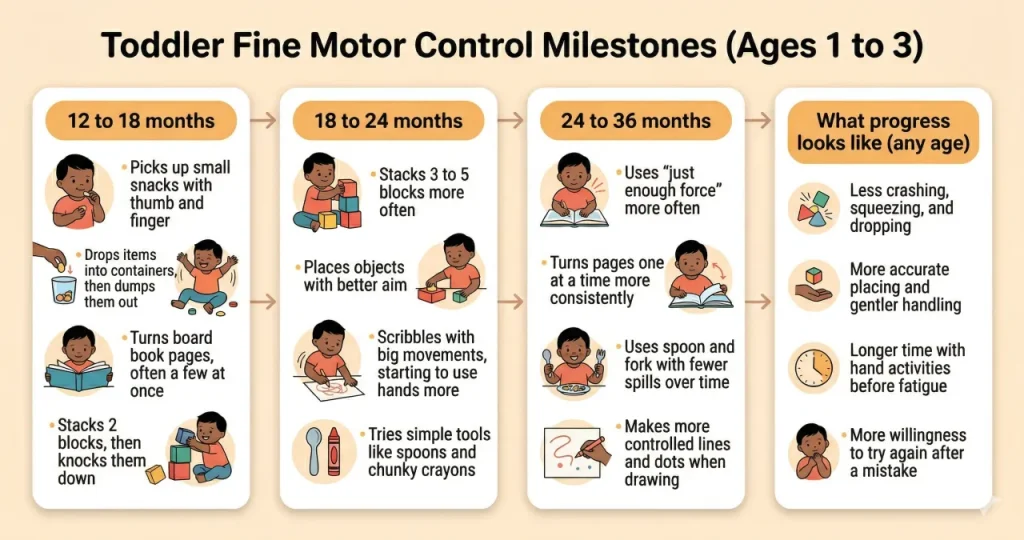
Toddler Fine Motor Control Milestones at 12 to 18 Months, What You May Notice
Around this age, many toddlers are in the “I want to do it myself” phase, even when their hands are still figuring things out. You might see short bursts of careful movement, followed by quick, impatient grabs.
Common signs of growing control in this window can include:
- Picking up small snacks using thumb and finger, even if it is slow
- Dropping items into a container, then dumping them out again
- Turning a few pages of a board book, sometimes several at once
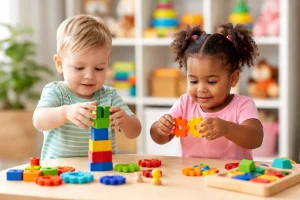
- Stacking a couple of blocks, then knocking them down with delight
- Bringing a spoon to the mouth with mixed success, with spills that are still very normal
What often surprises parents is how much “practice” is hidden inside play. Putting things in and taking them out, banging, mouthing, and tossing are not wasted time. They are part of how toddlers learn weight, texture, and force.
If your child seems rough at this stage, it does not automatically mean something is wrong. Many toddlers use extra force because they are still learning how to grade pressure. They are also learning through repetition, and repetition can look chaotic.
Learn More: How to Help Your Toddler Use Two Hands Together During Play
Toddler Fine Motor Control Milestones at 18 to 24 Months, More Purpose, Still Plenty of Mess
This is a big growth period for independence. Many toddlers start trying to manage objects with more intention, even if their hands still get ahead of their planning.
In this stage, you may notice:
- More consistent stacking, often three to five blocks, sometimes more on a “good hand day”
- Better aiming when placing items into a container, with fewer misses
- Early scribbling that may start as big arm movements and gradually become more hand-led
- Interest in simple tools, like chunky crayons, spoons, or toy tools that press and turn
- Attempts to peel, pull, or open things, with lots of trial and error
This is also a common age for parents to wonder, “Why is my toddler so rough with toys?” A lot of that roughness is a mix of excitement, speed, and developing body awareness. Toddlers often know what they want to do, but their hands have not yet learned the “volume control” for force.
If your toddler drops things a lot here, look at the whole moment. Are they rushing? Are they trying to carry too much? Are they distracted? Dropping can be part of learning, especially when attention is split.
What To Expect From 24 to 36 Months, When Control Starts To Look More Steady
Between ages 2 and 3, many children begin to look more coordinated in daily routines, but the range is still wide. Some children become careful and precise early, while others stay fast and enthusiastic and only show control in short moments.
You might see:
- More consistent page turning, closer to one page at a time, though impatience still happens
- Better utensil use, with fewer big spills, especially when the food is easier to scoop
- More controlled stacking and building, with less accidental knocking things over
- Interest in drawing that shifts from scribbles to more intentional marks, like dots, short lines, or “pretend writing”
- Improved ability to place and release objects gently, like setting a cup down without a crash
This is also when many parents notice the difference between strength and control. A child can have strong hands and still press too hard, tear paper unintentionally, or break crayons. Control is about matching force to the task, and that takes practice across lots of everyday materials.
If your child avoids certain hand tasks, it can help to think about effort. Some activities require more tiny adjustments than others. A child may happily build with big blocks but resist smaller pieces because it is harder work for their fingers. Avoiding does not always mean they cannot do it, sometimes it means it feels tiring or frustrating right now.
Signs Your Toddler Is Building Control, Even if the Skill Is Not Perfect Yet
Parents often miss progress because they are looking for a finished skill. In therapy, we look for small shifts that show the nervous system is learning. Those shifts matter.
Here are a few encouraging changes that often show up before a big milestone:
- Your child slows down for a second when something needs accuracy
- They adjust their grip instead of giving up right away
- They drop fewer items during a familiar routine, like snack time
- They use less force when placing toys, even if they still crash when excited
- They stay with a hand activity longer before switching away
- They tolerate “almost” without melting down, and try again
You may also notice that control appears first in the most motivating moments. A toddler might carefully place a tiny sticker, then immediately go back to throwing blocks. That does not cancel out the careful moment. It shows the skill is emerging.
If you are comparing your child to another toddler, try comparing your child to your child from two months ago. That is usually a kinder and more accurate measure.
How parents can support fine motor control without turning it into practice
Support does not have to look like drills. Most toddlers build hand skills best through real play and daily routines, especially when they feel unhurried.
A few gentle ways to think about support:
- Notice pace. Many toddlers get rough when they are rushing. Slowing the moment often helps more than correcting.
- Notice object size. Bigger, easier-to-grab items can let your child succeed while control catches up.
- Notice resistance. Some kids learn “just enough force” by squeezing, pressing, pulling, and releasing different materials in play.
- Notice fatigue. When hands get tired, control drops. Short, satisfying attempts often go better than long stretches.
If you are looking for ideas, you do not need complicated supplies. Things like playdough, sponges in the bath, paper to crumple and open, simple containers to open and close, droppers in water play, or toys that press and turn can all support smoother hand use. The goal is not perfect output. The goal is more purposeful movement and a calmer feel in the hands.
If meals are the hardest time, it can help to choose moments when everyone is less rushed. A toddler who struggles with spoon use often does better when they have time to experiment, even if it is messy. Over time, that experimenting becomes skill.
A gentle note if you are worried, and how to use toddler fine motor control milestones wisely
Milestones are meant to guide, not grade. If your toddler is not doing one specific skill right on schedule, it can still be completely okay, especially if you are seeing gradual change.
You may want a bit of extra support if you notice patterns like:
- Daily tasks that rely on hands stay very hard for a long time, with little change
- Your child avoids most hand-based play, not just one disliked activity
- Frustration regularly shuts down participation, even with help and time
- You feel stuck and unsure what to try next
Support can be simple. Some families like a parent-guided tool such as the BASICS app to get ideas that fit their day and to feel less alone in what they are noticing. Others prefer a more structured plan or a professional check-in. There is no “right” choice, only what feels helpful for your family.
Most importantly, toddler fine motor control milestones are not a test your child passes or fails. They are a moving picture. When you look for steadier hands, gentler force, and growing persistence, you are looking in the right place.
Book your Free Consultation Today
Parent/Caregiver Info:
Client’s Details:
* Error Message