My Child Makes Sounds but Not Words Yet How Can I Encourage First Words Without Pressure?
Last Updated: February 25, 2026
If your child is making lots of sounds but no clear words yet, it can feel oddly confusing. On one hand, you hear all this babbling and personality. On the other hand, you’re waiting for something you can recognize as a real word “mama,” “up,” “more” and it hasn’t landed yet. Many parents also wonder, quietly, if they’re supposed to be “teaching” words more directly, the way they might in speech therapy for kids. Should you repeat words more? Ask them to say it? Hold back what they want until they try? And if you’ve tried those things and it felt uncomfortable for both of you, you’re not alone.
Here’s the reassuring truth: the space between babbling and first words is a real stage. It’s not nothing. It’s not “behind.” It’s an in-between season where communication is growing often in small, easy-to-miss ways.
Does babbling count if there aren’t words yet?
Yes. Babbling counts because it’s practice. It’s your child experimenting with sound, rhythm, volume, and back-and-forth. It’s also often the first time you’ll notice your child using their voice on purpose—to get your attention, to protest, to join in, to show excitement.
Even when it doesn’t sound like a word, babbling can be meaningful. A child might use the same sound every time they want to be picked up, or make a particular squeal when they see the dog, or repeat “ba-ba-ba” while reaching for a ball. Those patterns matter. They’re part of communication development and how early words and proto-words begin.
Proto-words are those early “almost words” that a child uses consistently to mean something. They might not be perfectly formed, but they’re intentional. Think “ma” for mama, “uh” for up, “mo” for more, “ta” for take/thanks, or “uh-oh” when something drops. These are powerful because they’re your child’s first steps into shared meaning: “I’m saying something, and you understand me.”
Also read: When Do Babies Start Babbling During Play? A Parent-Friendly Timeline
What first words really grow out of
It can help to think of early words as the tip of a much bigger iceberg. Underneath are skills your child builds through everyday life: noticing you, sharing attention, taking turns, using gestures, and learning that sounds can change what happens next.
Often, first words show up when three things start coming together:
Your child has a reason to communicate, like wanting help, wanting more, or wanting to show you something. They have a familiar sound or pattern they can reach for, even if it’s not clear yet. They experience a warm, predictable response from you that makes communication feel worth it. That’s why words often arrive in routines and repeated moments, snack time, getting picked up, bath, bedtime, favorite songs. These moments give language a “home.” The word isn’t floating in space; it’s attached to something your child already understands.
The “in-between” signs that your child is getting closer to words
When parents imagine progress, they often picture a clear word appearing overnight. But the lead-up is usually quieter and more gradual.
You might notice your child starting to do things like looking at you right after they make a sound, as if checking whether you got the message. Or they may repeat a sound when you respond, like they’re practicing a tiny conversation. Some children begin pairing sounds with gestures—reaching up while making a little “uh,” or pointing while saying “da.” Others start using the same sound in the same situation again and again.
These moments are worth noticing because they show intent. Your child isn’t just making noise; they’re experimenting with communication.
How to invite first words without turning it into a test
Most parents don’t want to pressure their child. They just want to help. The good news is that the most effective support often feels like connection, not instruction — the same principles used in supportive speech therapy approaches.
One gentle approach is simply letting your child hear a few “starter words” again and again in real moments, especially words that naturally fit your day. Words like “up,” “more,” “mama,” “dada,” “hi,” “bye,” “no,” “uh-oh,” and “help” tend to work well because they’re short, useful, and emotionally meaningful.
For example, when your child reaches up, you might warmly reflect on the moment with, “Up!” If they hold out their snack hand, you might say, “More?” If a toy falls, “Uh-oh!” Not as a quiz more like you’re giving their experience a simple label.
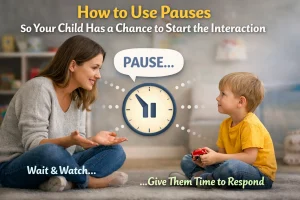
It also helps to leave a little space after you say a word, not because you’re waiting with expectation, but because many children need an extra beat to process and decide if they want to try. That tiny pause can be an invitation without any pressure attached. And when your child does attempt a sound, whether it’s clear or not, responding as if it mattered can be incredibly encouraging. If they say “mm” while reaching for more crackers, you can treat that as communication: “More! You want more.” This teaches a powerful lesson: using your voice works.
Why “making them say it” often backfires
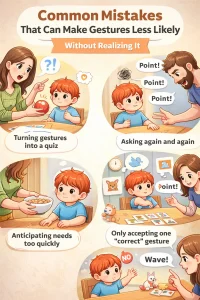
It’s understandable to want a clear word, especially when you know your child is capable of making sounds. But for many young children, being asked to perform on demand can make the moment feel tense. Some children shut down, some get silly, and some simply avoid trying because it suddenly feels like a pass/fail situation.
Communication grows best when your child feels safe to experiment. Words are more likely to emerge when the focus is on sharing a moment together, not getting it “right.”
If you’ve ever found yourself saying, “Say mama… say it… say ma,” and your child looks away or fusses, that’s not a sign you did anything wrong. It’s just a sign that your child may do better with language that’s offered gently and repeatedly, without expectation.
Using gestures and sounds together is a good thing
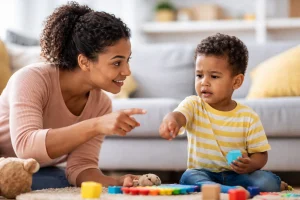
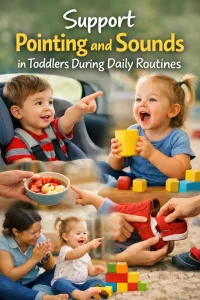
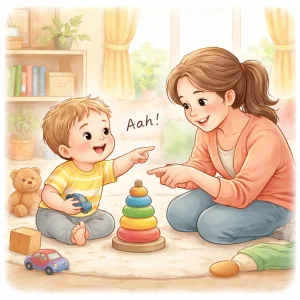
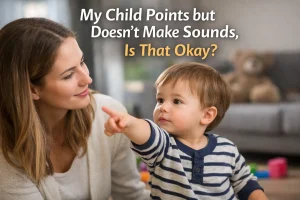
Some parents worry that if their child points, reaches, or uses signs, they’ll talk later. In everyday development, gestures usually help language along because they give your child a way to communicate successfully while speech is still forming.
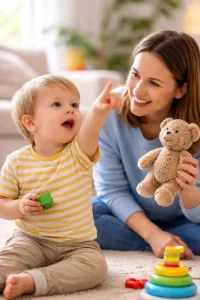
When a child points and you respond, they learn, “I can share what I’m thinking.” When you add a simple word to that gesture “Ball!” “Up!” “More!” you’re connecting their idea to language in a natural way.
This is how early words become meaningful. They aren’t just sounds; they’re connected to intent.
Keeping the focus on connection, not performance
If you’re in this in-between stage, it can help to choose a mindset that feels sustainable: you’re not trying to “get” words out of your child. You’re building a communication relationship where words can appear when they’re ready.
That might look like enjoying playful sound exchanges in the bath, responding enthusiastically to “uh-oh” moments, or noticing when your child seems to want help and offering a simple “help” in that exact moment. It might look like celebrating a tiny “m” sound as if it’s meaningful because it is. Over time, those small exchanges add up. Your child learns that sounds and early words create connection, and connection is the reason most children keep trying.
When you want a little extra guidance
Sometimes what parents want most is reassurance that they’re supporting this stage in a balanced way, without overthinking every sound. If that’s you, speech and Autism therapy apps like BASICS can be a helpful option. It’s designed to support early communication goals through everyday moments, with simple guidance that keeps things calm and doable at home.
If concerns about speech delay continue or you simply want reassurance, some families choose a gentle developmental screening to rule out communication differences, including autism, while also learning how to support language growth.
You don’t need a perfect plan to help your child. You need a relationship where communication feels safe, noticed, and worthwhile.
A gentle note to end on
If your child is making sounds but not words yet, it doesn’t mean nothing is happening. This stage is full of growth, even when it’s hard to see day to day. Babbling, gestures, shared looks, and little “almost words” are all part of the path toward meaningful early words like “up,” “more,” and “mama.”
Keep it warm. Keep it real. Keep it pressure-free.
Your child doesn’t need to be tested in talking. They need to feel that their voice—exactly where it is today, matters to you.
About the Author:
Anuradha Karanam
Speech-language pathologist (7+ years of experience)
Anuradha Karanam is a skilled speech-language pathologist with over 6 years of experience. Fluent in Tamil, Telugu, Hindi, and English, she specializes in parent counseling, speech sound disorders, fluency assessment, and speech-language evaluations. Anuradha excels at working with children with developmental disorders, offering creative and effective therapy programs. Currently, at Wellness Hub, she holds a BASLP degree and is registered with the RCI (CRR No A85500). Her patience, ambition, and dedication make her a trusted expert in her field.
Book your Free Consultation Today
Parent/Caregiver Info:
Client’s Details:
* Error Message