How to Support Pointing + Sounds During Everyday Routines Without Adding Extra Work
By Rajini D
Last Updated: February 24, 2026
Have you wondered, “My child points… but stays quiet,” or “They make sounds, but don’t really show me what they mean,”? Many parents notice that gestures and sounds don’t always show up together at first. A child might reach for a snack without looking at you, or babble happily while playing but not use those sounds to “tell” you something. In early communication development and speech therapy for kids, this is a very common pattern.
The encouraging part is that combining gestures with sounds often grows best in the middle of real life, like for snacks, shoes, car rides, cleanup , but not in special practice time. When you start noticing the tiny moments your child is already communicating, you can respond in a way that makes it easier for them to try again. This isn’t about getting your child to perform on cue. It’s about making space for those early “I want that!” and “Look!” moments to land—warmly and successfully.
What “pointing + sounds” really looks like and why it matters
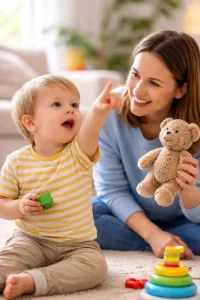
This goal is simply about your child using a gesture and a sound together to communicate intent. That might look like pointing and adding a little “eh!” or “ah!”, reaching while vocalizing, or holding up an object with an excited sound. Sometimes you’ll hear early proto-words mixed in, too, little approximations that aren’t fully formed words yet, but clearly carry meaning in the moment.
These combinations matter because they’re powerful connection builders. When your child points and adds a sound, they’re not just asking for something, they’re inviting you into their world. They’re practicing the back-and-forth rhythm of communication: “I show you,” “you respond,” “I respond again.” Over time, those small exchanges can turn routines into shared moments instead of one-way tasks.
And it’s worth saying plainly: if your child isn’t doing this consistently yet, it doesn’t mean you’re behind or missing something. This skill often appears gradually and unevenly, especially when children are busy, tired, hungry, or deeply focused. Families sometimes explore speech therapy when a speech delay continues, but many children build this skill step by step.
Also read: https://www.mywellnesshub.in/blog/child-makes-sounds-but-doesnt-point/
What progress can look like it’s often subtle
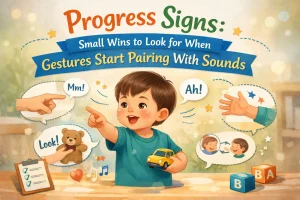
Parents sometimes expect a clear “before and after,” but early communication usually grows in small, quiet steps. You might notice your child starting to reach and make a sound at the same time, or pointing while glancing at you as if to check, “Did you see?” They may show you something and add a bright “ah!” or use a simple sound repeatedly in a way that clearly means “more” or “help.”
You may also feel more shared excitement with those little bursts of connection where you both understand each other without needing perfect words. That counts. Those moments are the whole point.
Why routines are the easiest place to support this without adding work
Routines naturally create three things that make communication more likely:
First, routines have predictable “pause points.” The snack bag doesn’t open instantly. Shoes don’t appear on feet by magic. The car seat buckle takes a moment. These tiny delays create natural opportunities for your child to gesture, look, point, or add a sound.
Second, routines involve real motivation. Your child actually cares about the cracker, the favorite cup, the bubbles in the bath, the toy they want before you leave. Motivation is a powerful communication booster and you don’t have to manufacture it.
Third, routines repeat every day. That repetition gives your child lots of low-pressure chances to try again, with the same people, in the same places, with the same comforting rhythm.
In other words: you’re not “adding practice.” You’re simply noticing what’s already there and responding in a way that invites one more step.
Snack time: built-in chances to point, reach, and vocalize
Snack time is full of natural moments where your child might want something specific. Often, children will reach or fuss first. That’s not “bad communication”—it’s early communication. The gentle shift is helping them discover that showing you with a gesture plus a sound works really well.
This can be as simple as holding back the next bite for a brief moment and looking expectant not demanding, then responding warmly when your child reaches, points, or makes any sound. When you reflect what you think they mean “You want that one?” or “Oh, more!” you’re not testing them. You’re giving language to their message and showing that their attempt worked.
Even choosing between two options can create a natural reason to point. Some children point right away; others look, lean, or grab. Any of those can be a starting place, especially when you respond like it’s meaningful.
Getting dressed: small “help” moments that invite communication
Getting dressed is full of tiny problems to solve: the sock won’t go on, the shirt gets stuck, the zipper needs help. These are the kinds of moments that often spark reaching, showing, and vocalizing, especially when you pause for a beat before swooping in.
Many children will communicate “help” without a word long before they can say it. They might hold up a shoe, tug at a sleeve, or reach toward you with a frustrated sound. When you treat that combination as a real message “Oh! You need help” you’re teaching your child that gestures + sounds are powerful and understood.
And if mornings are rushed, it’s okay. This doesn’t have to happen every time. Even one calm moment a day where your child feels successful can be enough to support growth over time.
Car rides: low-pressure connection when you’re side-by-side
Car rides can be surprisingly rich for communication because you’re together without the intensity of face-to-face demands. Your child may notice something out the window, hold up a toy, or make a sound to get your attention.
If your child points at something outside or makes an excited noise, responding as if you’re joining their discovery can encourage more of that “show + sound” communication. “You see it!” or “Oh wow!” can be enough. You’re building the feeling of shared attention, like “we notice things together, and you can tell me about them”. Even if your child doesn’t point yet in the car, you may notice them shifting their body, leaning, or making a particular sound when something interesting happens. Those are early forms of “I’m telling you something.” Your warm response helps those signals grow clearer.
Cleanup and transitions: when your child has a reason to communicate
Cleanup is often where parents feel least patient and that’s understandable. But transitions are also moments when children have strong opinions. They may want one more turn, want help putting something away, or want to keep a favorite item.
In these moments, your child may reach out, protest, show you the toy, or add a sound that clearly means “no” or “mine.” You don’t have to turn that into a lesson. You can simply acknowledge the message and reflect it back: “You want it,” “You’re not done,” “You need help.” When your child feels understood, they’re more likely to stay engaged with you, even if the transition still needs to happen.
Over time, children often begin to use more intentional gestures and sounds in these high-motivation moments, because they learn that communication changes what happens next.
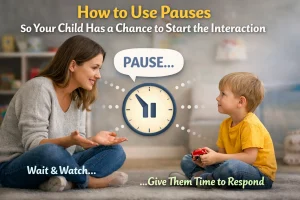
The most supportive “technique” is often just a pause and a warm response
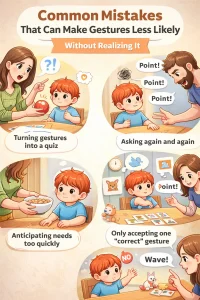
It can be tempting to ask for “say” or to repeat prompts when you’re hoping for progress. But many children do best when they feel invited rather than pressured.
A small pause gives your child time to process and initiate. A warm, confident response tells them their attempt worked. And your simple words, matched to what they’re doing, help connect their gesture and sound to meaning. If your child’s sound is unclear, that’s okay. You don’t need to correct it. You can respond to the intent: “You want that!” or “You found it!” Communication grows when it feels successful. Many speech therapy strategies focus on this same responsive approach.
If your child isn’t doing this yet, you’re not failing
Some children are big movers and do lots of reaching with fewer sounds. Others are big sound-makers and don’t point much yet. Some children are cautious communicators and need extra time to warm up. None of these patterns say anything negative about your child or about you. It just varies from child to child. This goal is about building a joyful interaction, not perfect performance. When your child learns that pointing plus a sound gets a warm, helpful response, they’re more likely to try again. That’s how confidence grows.
If concerns persist, some families consider developmental screening to rule out communication delays or autism.
Optional support if you want ideas that fit your day
If you like having examples to lean on, Speech and Autism therapy apps like BASICS can support parents with simple, routine-based ideas for goals like combining gestures with sounds, so you’re not left guessing what to do at the moment. Some families also explore guidance from speech therapy professionals. Some families enjoy having that kind of gentle structure; others prefer to keep it informal. Either way is completely okay.
A calm takeaway to hold onto
You don’t need extra time, special toys, or “drills” to support pointing and sounds. The opportunities are already built into your day: a snack you haven’t opened yet, a shoe that needs help, a toy your child wants, a moment of shared noticing on a car ride.
When you pause briefly, watch what your child does, and respond warmly to any gesture-plus-sound attempt, you’re teaching something deeply important: “Your communication matters here.” Supportive everyday interaction is often the foundation parents build alongside speech therapy for kids.
And that message repeated in small, everyday ways is what helps early communication grow.
About the Author:
Rajini Darugupally
M.Sc., Speech-Language Pathologist (9+ years of experience)
Rajini is a passionate and dedicated Speech-Language Pathologist with over 9+ years of experience, specializing in both developmental speech and language disorders in children and rehabilitation in adults. Driven by a desire to empower each individual to find their voice, Rajini brings a wealth of experience and a warm, genuine approach to therapy.
Currently, at Wellness Hub, she thrives in a team environment that values innovation, compassion, and achieving results for their clients.
Connect with Rajini to learn more about how she can help you or your loved one find their voice.
Book your Free Consultation Today
Parent/Caregiver Info:
Client’s Details:
* Error Message