The Truth About Saying Look at Me To Get Eye Contact During Play
Last Updated: March 30, 2026
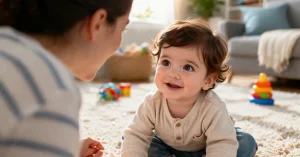
If you have ever wondered, “should I say look at me” when your child is busy playing and not glancing up, you are in very good company. Parents ask this because they care, and because eye contact can feel like the quickest way to know your child is connected with you. The tricky part is that the phrase can work in some moments, and completely fall flat in others, especially when a child is deeply focused, tired, or already feeling pressured.
This is not about blaming the words. It is about protecting the connection underneath them.
Read More: How Children Learn To Look Back and Forth Between a Toy and Your Face
Why look at me feels like the obvious thing to say
Most of us grew up hearing it. Teachers say it. Relatives say it. Even well meaning parenting advice can make it sound like eye contact is the main proof that a child is listening.
So when your child is lining up cars, flipping pages, or running off mid game, it makes sense that “look at me” pops out. It is short, direct, and you are trying to bring your child back to you.
There is also a tender emotional piece here. When your child does not look up, it can feel personal, even when you logically know it is not. Many parents describe it as, “I just want to feel like we are doing this together.” That desire is healthy. Wanting shared moments is exactly what builds eye contact during play over time.
The goal is not to erase the phrase from your vocabulary forever. It is to understand when it helps, when it adds pressure, and what to lean on instead so play stays warm.
Should I say look at me, or can that backfire?
For some children, “look at me” is neutral. They glance up, you smile, and you both move on. No problem.
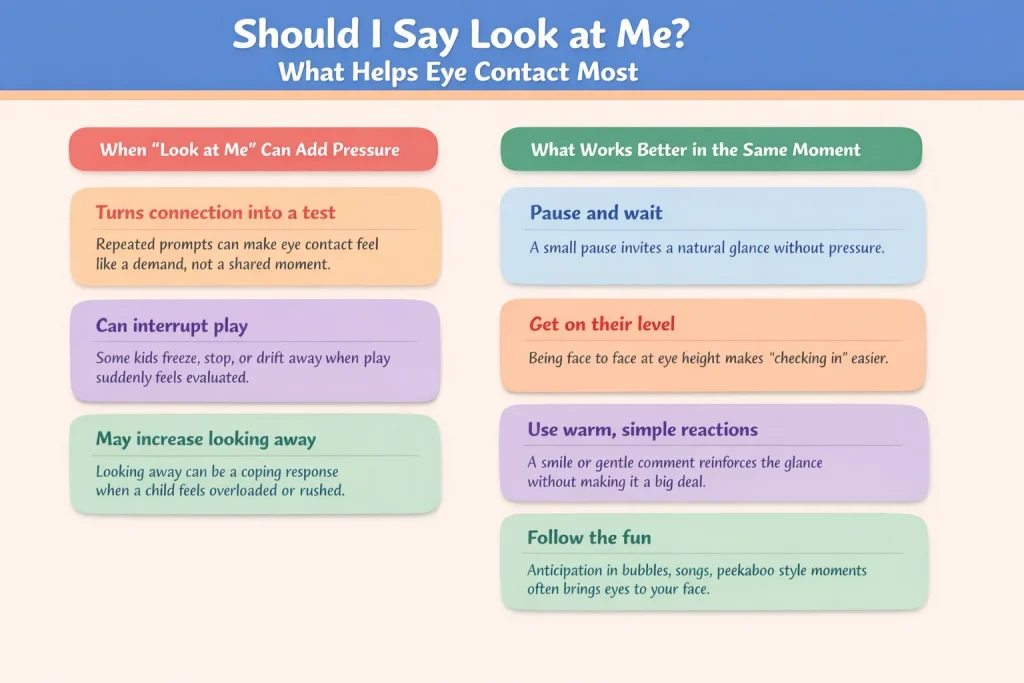
For other children, repeated requests can accidentally turn eye contact into a demand. When that happens, a few common patterns show up:
1. Some kids look away more
If a child is already working hard to manage attention, sound, movement, or excitement, a direct request can feel like one more thing to do. Looking away can be their way of coping, not refusing.
2. Some kids freeze or stop playing
Play is where many toddlers feel most competent. If the moment starts to feel like a test, you might see the play pause, the body get still, or the child drift away.
3. Some kids learn to “perform” eye contact
A quick glance that says “Are you happy now?” is different from a natural check in that says “Did you see that?” The first one can become a habit if the child learns that looking is mainly about avoiding correction.
4. Some parents feel stuck in a loop
You ask, your child does not look, you ask again, and suddenly the interaction is about compliance instead of connection. Nobody feels good there.
Here is the gentle truth: eye contact is a relationship skill, not a rule. It grows best when a child feels safe, not evaluated.
Learn More: My Child Look at My Mouth but Not My Eyes
What counts as eye contact during play, even if it is brief
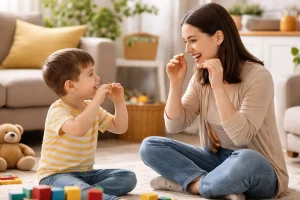
Many parents picture eye contact as sustained looking, face to face, for several seconds. In real life, especially for toddlers, it is often much smaller and still meaningful.
- A quick glance up before your child does something funny
- A shared smile after a silly sound
- Looking at your face for half a second while reaching for help
- Shifting gaze from a toy to you, then back to the toy
- A little “check in” during a routine like snack, bath, or getting shoes on
Those tiny looks are the building blocks of eye contact during play. They are also easier for a child to offer because they do not interrupt the fun. When you start noticing them, you often realize your child is connecting more than you thought, just in quick flashes.
This is also why some kids seem to “avoid eye contact” when adults are watching closely. The attention can make the moment feel heavier than it needs to be.
What to do in the moment instead of repeating the phrase
Parents often tell me, “Okay, but what do I do right then, when my child will not look up?” You do not need a perfect script. You need a different feel.
Think of it as inviting, not requesting.
1. A small pause can be powerful
In many classic toddler games, the pause is the whole point. The pause before you blow bubbles. The pause before you roll the ball back. The pause before the “boo” in peekaboo. That tiny moment of anticipation often pulls a glance naturally because your child is checking, “Is it happening yet?”
2. Your face becomes part of the game
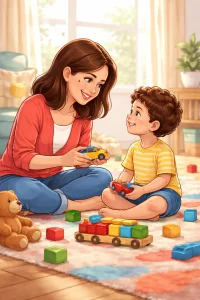
If your child has to work hard to find your face, they will not do it often. When you are at their eye level, close enough, and emotionally “available” with a soft expression, looking becomes easier.
3. Warm reactions beat big praise
A huge “Good looking!” can sometimes make kids self conscious. A simple smile, a gentle “I see you,” or continuing the fun right away often lands better. It tells your child, “That glance worked. This is safe.”
4. Comments help more than questions
Questions can feel like pressure, even when you are being kind. A calm comment like “You made it go!” or “Uh oh, it is stuck” can keep the interaction shared without demanding a response.
If you want language that still feels direct, you can try a softer invitation once, then let the moment breathe. Many families find they need fewer words, not more.
Learn More: When Should a Child Respond to Their Name With Eye Contact
Common parent worries, and what is usually going on
1. “I feel rude not asking for eye contact.”
You are not being rude. You are being responsive. You are choosing connection over control. That is respectful parenting.
2. “But my child needs to learn to look when someone is talking.”
Over time, yes, kids learn social expectations. The foundation is comfort and trust. When eye contact is built through positive moments, it becomes more available later in group settings, learning moments, and conversations.
3. “Why won’t my child make eye contact with me during play?”
Sometimes it is simple focus. Toddlers can get absorbed in objects and movement. Sometimes it is temperament. Some kids are more observant from the side. Sometimes it is sensory. Faces are visually complex, and busy environments can make it harder to look up. And sometimes your child saves their best “checking in” for routines, like meals or bedtime, because those moments are predictable.
If you notice that eye contact shows up more when your child is relaxed, that is a useful clue. It means the skill is there, and comfort helps it come forward.
How to encourage eye contact during play without making it a power struggle
If you want a simple north star, use this: make it easy, make it worth it, make it safe.
1. Make it easy
Be close enough. Get at eye level when you can. Reduce competing distractions in the moment if your child is already struggling to stay regulated.
2. Make it worth it
Kids look when something interesting is happening with you. Not because you demand it, but because you are part of the fun. This is why playful routines work so well. Bubbles, songs, silly sounds, mirror moments, and rolling games naturally create “look then go” moments without you having to ask.
3. Make it safe
Avoid turning eye contact into a performance. Skip physically guiding your child’s face. Try not to stack prompts. If your child looks away, you can stay calm and keep the interaction friendly. You are showing, “You are okay with me, even when you do not look.”
If you want to build this into daily life, eye contact during routines is often the easiest place to start. Routines have natural pauses built in. Waiting for the spoon, the towel, the shoe, the water to pour. Those are real life moments where a quick glance makes sense.
A gentle closing thought if you are still asking, “should I say look at me?”
If the phrase slips out sometimes, you have not harmed anything. Parenting is real life, and you are doing your best in busy moments. Still, if you find yourself stuck in the question “should I say look at me,” it can help to remember what you are really asking: “How do I help my child connect with me right now?”
Connection usually grows faster when you invite it. A pause, your face at their level, and a warm response to any tiny glance can do more than repeated commands.
If concerns persist and you feel unsure about your child’s social connection or communication, some families consider a developmental screening to better understand communication differences or possible autism-related differences. Support can be practical and relationship focused, and it can give you fresh ideas that fit your child’s style.
For today, you can let brief looks count. Shared smiles count too. You are building something important, one small check in at a time.
About the Author:
Shravanaveena Gajula
M.Sc ., Speech and Language Pathology (5+ years of experience)
Shravanaveena Gajula is a dedicated Speech-Language Pathologist with a BASLP and an M.Sc in Speech and Language Pathology. With experience spanning multiple settings, including Wellness Hub , Veena specializes in a wide range of disorders from developmental issues in children to speech and language assessments in adults. Her expertise includes parent counseling, managing speech sound and fluency disorders, and creating individualized therapy programs. Veena is also PROMPT certified and an author of several insightful blogs on speech and language pathology, aiming to educate and assist caregivers in supporting their loved ones.
Book your Free Consultation Today
Parent/Caregiver Info:
Client’s Details:
* Error Message