Should I Correct My Child’s Proto-Words (Like “Ba” for Ball) or Accept Them?
By Rajini D
Last Updated: February 26, 2026
If your child says “ba” while pointing at a ball, it can spark an immediate parent dilemma: Do I correct it so they learn the real word, or do I accept it so they keep trying?
Many parents carry a quiet worry in these moments. If I repeat “ba,” am I teaching it wrong? If I correct them, will they stop talking? And if I do nothing, will they get “stuck” on baby talk?
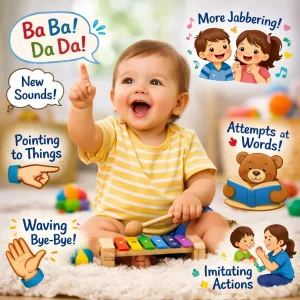
Here’s the reassuring truth: proto-words (early word-like sounds your child uses consistently and meaningfully) are a normal, helpful part of learning to talk and an important step in communication development. They’re not mistakes to stamp out. They’re your child’s way of saying, “I have something to tell you,” before their mouth and speech skills can fully match what their brain wants to communicate.
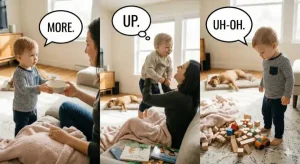
The goal at this stage isn’t perfect pronunciation. It’s meaningful connection your child using early words or proto-words like “mama,” “up,” “more,” “ta,” or “uh-oh” to ask, share, or comment during everyday moments.
What are proto-words, really?
Proto-words are those “close-but-not-quite” words that still clearly mean something. Your child might say “ba” for ball, “wa” for water, “nana” for banana, or “uh-oh” when something drops. What makes them special is that they’re not random sounds. They’re purposeful.
When a child uses a proto-word, they’re doing something big: they’re pairing a sound with an idea and using it to communicate with you. That’s the foundation of language. And for many children, proto-words show up before clearer words do because speaking is a coordination task. Their understanding often grows faster than their ability to shape sounds with their lips, tongue, and breath. So the message may be strong even if the word is still under construction.
Should you correct proto-words?
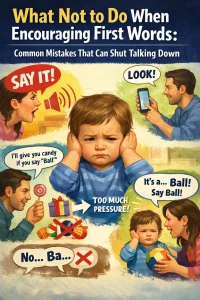
In most everyday moments, “correcting” in the traditional sense isn’t necessary and it can sometimes make talking feel risky for a child.
That doesn’t mean you have to pretend “ba” is the official word for ball forever. It just means the most helpful response usually isn’t, “No, say ball.” The most helpful response is: “I hear you, and I understand you,” paired with a gentle model of the clearer word.
Think of it like this: your child is offering you a bridge into conversation. If you meet them on that bridge, warmly and confidently, they’re more likely to keep building it. A proto-word is a sign that communication is working. Your child is learning that sounds can move the world: sounds can get a snack, start a game, bring you closer, or make you laugh together. That feeling of “My words matter” is what fuels more talking over time.
The fear behind correcting: “Will I teach it wrong?”
This is one of the most common concerns parents share, and it makes sense. You’re careful with what you model because you want to support your child well.
The good news is that responding to your child’s proto-word does not “lock in” the unclear version. Children don’t learn language only by copying one moment. They learn through hundreds of warm, repetitive, real-life experiences snack after snack, bath after bath, ball after ball.
When you respond as if their message matters, you’re teaching something even more important than pronunciation: you’re teaching that communication is worth trying. And when you naturally include the clearer word in your response, you’re still giving their brain the accurate map. You’re just doing it without turning the moment into a test.
Also read: 10+ Simple Home Activities That Encourage Early Words Like “More,” “Up,” and “Uh-Oh”
What does a supportive response sound like?
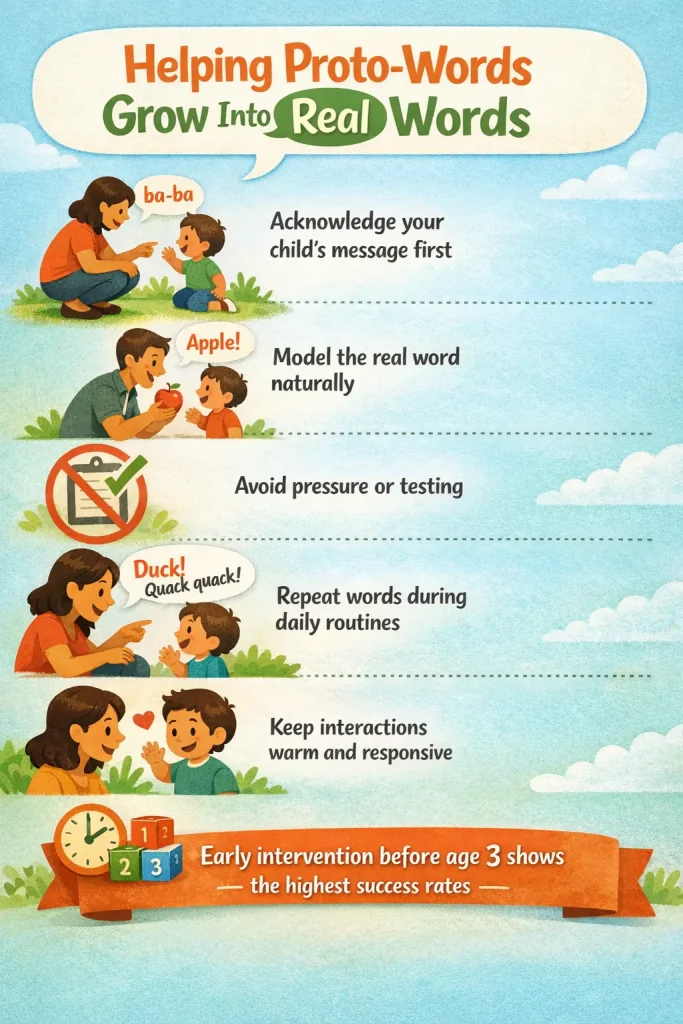
In real life, this often looks like a simple pattern: acknowledge what your child meant, then model the clearer word in a natural way.
If your child says, “Ba!” while reaching, you might respond with something like, “Ball! You want the ball,” or “Yes, ball, here it is!” Your child gets two powerful messages at once: you understood them, and you’re showing them the next step.
The same idea works for everyday early words like “up,” “more,” “ta,” or “uh-oh.” If your child says “mo,” you can respond warmly and include the full word: “More? More crackers.” If they say “uh-oh,” you can share the moment: “Uh-oh! It fell down.” This kind of response keeps the conversation flowing. It doesn’t interrupt your child’s confidence, and it still surrounds them with clear language.
Why acceptance builds more talking
Children are more likely to use early words when it feels safe to try. Proto-words are often a child’s best effort at that moment. When their best effort is met with connection eye contact, a smile, a response they learn that trying works.
Over time, you may notice your child looking to you after they use a proto-word, almost like they’re checking, “Did you get it?” That’s a wonderful sign. It means they’re learning that communication is shared.
This is what success often looks like in the early word stage: your child uses simple words or proto-words during play and routines, uses them to ask for things or show excitement, and begins to repeat sounds after you because they’re interested in the back-and-forth. The words don’t have to be crisp to be meaningful.
When might a parent choose to be more specific?
There are moments when being a little more specific can help especially if you truly don’t know what your child means.
If “ba” could mean ball, bottle, or bath, it’s okay to pause and offer gentle clarity in a calm way. Not as a correction, but as a way of saying, “Help me understand.” Many parents naturally do this by naming what they think the child means and watching their child’s reaction.
You can also notice whether your child seems frustrated. Sometimes frustration isn’t about being corrected it’s about not being understood. In those moments, your steady, patient guessing and warm language can be very reassuring. You’re showing them: “We’ll figure this out together.”
What if relatives keep correcting or teasing “baby talk”?
This can be a tender spot. Parents often feel caught between wanting to support their child and wanting to manage other people’s opinions.
It may help to remember: proto-words aren’t your child being lazy or “cute on purpose.” They’re a real stage of communication. If you want a simple way to explain it, you can say something like, “That’s their early word for ball right now. We answer them and also say the real word so they keep learning.” You don’t need to defend every sound your child makes. Your calm confidence sets the tone and your child benefits most from feeling safe to communicate with you.
A gentle way to think about your role
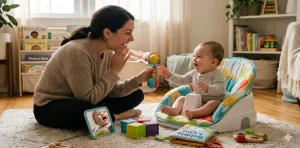
At this stage, you’re not a speech judge. You’re a conversation partner.
Your child is learning to express needs and feelings using early words during everyday moments. They’re learning that words can ask, share, and connect. When you respond with warmth and model the clearer word naturally, you’re supporting both confidence and growth in communication development.
If you ever feel unsure what to say in the moment, or you’d like ideas for how to support early words during routines without turning your day into “practice,” Speech and Autism therapy apps like BASICS can help you choose a simple communication goal and see what support can look like in real family life. It’s meant to feel doable, not demanding.
If concerns persist or your child rarely tries to communicate at all, some families choose developmental screening to rule out communication delays or autism in a supportive, proactive way.
A calm takeaway for parents
You don’t have to choose between accepting your child’s proto-words and helping them learn clearer speech. You can do both at the same time.
Accept the message. Celebrate the attempt. Respond like their words matter because they do. And keep gently surrounding them with the clear word in everyday moments. Proto-words are not the end point. They’re the starting line of a child who is learning, bravely and imperfectly, to share their world with you.
About the Author:
Rajini Darugupally
M.Sc., Speech-Language Pathologist (9+ years of experience)
Rajini is a passionate and dedicated Speech-Language Pathologist with over 9+ years of experience, specializing in both developmental speech and language disorders in children and rehabilitation in adults. Driven by a desire to empower each individual to find their voice, Rajini brings a wealth of experience and a warm, genuine approach to therapy. Currently, at Wellness Hub, she thrives in a team environment that values innovation, compassion, and achieving results for their clients. Connect with Rajini to learn more about how she can help you or your loved one find their voice.
Book your Free Consultation Today
Parent/Caregiver Info:
Client’s Details:
* Error Message