It’s Okay if Your Toddler is Messy With Hands, Control Comes Before Neatness
By Wellness Hub
Last Updated: April 2, 2026
If you have ever watched your child grab a snack with a full fist, smear yogurt across their cheeks, or “help” with a craft by crumpling everything at once, you are not alone. When toddler fine motor messy hands show up at playgroup or in front of family, it can feel surprisingly personal. You might wonder if other kids are somehow more coordinated, or if you should be correcting it more.
Here is the gentle truth. Messy hands often mean your toddler is doing real learning. Control usually comes first in tiny moments, and neatness comes later, after the brain and body have had lots of chances to experiment.
Also read: Why Does My Toddler Grip Everything So Tight, Even Soft Toys and Snacks?
Why Messy Hands Can Still Be a Good Sign
Toddlers are not aiming for neat. They are aiming for information.
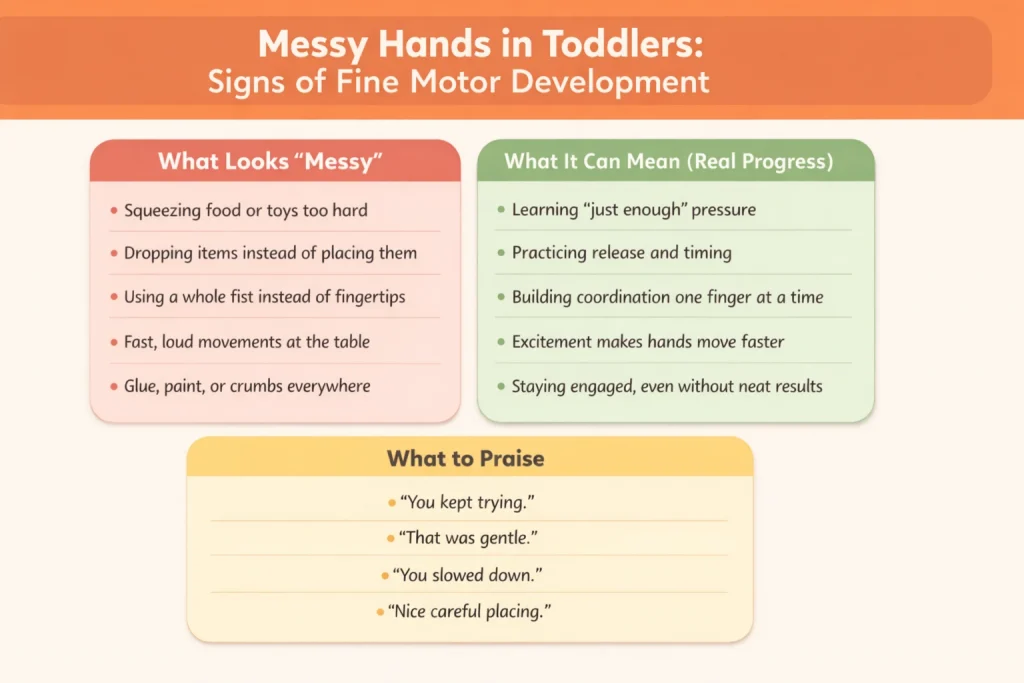
When your child squeezes too hard, drops something, or uses their whole hand instead of fingertips, their body is collecting feedback. How slippery is this banana? How much force does it take to pull open this container? What happens if I press harder? That “trial and error” is not misbehavior. It is practice.
A lot of early hand skill is about learning to grade force. That means using just enough pressure, not too much and not too little. It is also about timing, coordination, and staying calm while the hands work. Those pieces develop at different speeds, and they often look messy while they are coming together.
It can help to remember this: neatness is a result. Control is a skill. Your toddler can be building the skill even when the result looks chaotic.
My toddler fine motor messy hands look wild, what you are really seeing
When parents describe messy hand use, they are usually noticing one of these patterns:
- Some toddlers use a lot of force. Toys get banged, crushed, or launched. Food gets squeezed. Crayons snap. This is often a “too much power” moment, not a “won’t be gentle” moment.
- Other toddlers look unsure. They hover, poke with one finger, or switch hands a lot. They may drop things often, especially if the object is small, slippery, or requires two hands to manage.
- Many toddlers do both depending on the day. If they are hungry, tired, excited, or in a new place, their hands can look less coordinated. That is common. Regulation and fine motor control are connected. When the body is revved up, hands tend to move faster and with less precision.
- You might also notice that your child can do something neatly at home, then looks much messier in public. New environments add pressure. There is more noise, more watching, and more “hurry up.” Even adults get clumsier when they feel rushed.
If you are also wondering about toddler fine motor control in general, it may help to think of messy hands as one snapshot, not the whole picture. The bigger question is whether your child is experimenting, improving in small ways, and willing to try again.
What Matters More Than Neatness in Toddler Fine Motor Control
Neatness is easy to compare. It is also easy to misread.
A toddler who makes a perfect sticker line might have strong hand skills, or they might simply be cautious and prefer activities they already know. Another toddler might smear glue everywhere because they are brave enough to try, adjust, and try again. Both are learning. They are just showing it differently.
If you want a more meaningful way to “read” your child’s progress, look for signs of growing control, even inside the mess:
- You may see a brief pause before they place something down, like their brain is planning the movement.
- You might notice fewer full-body movements. Instead of the whole arm crashing down, the hand starts doing more of the work.
- They may begin to open their fingers to release an object, rather than dropping it.
- They might adjust their grip without you prompting, especially during play they love.
- You could see longer engagement. Even if it is messy, they stay with it a bit more before getting frustrated.
These are the building blocks that lead to neater outcomes later. They are also the parts that support independence, like feeding, turning pages, stacking, and early drawing.
Why Comparison at Playgroup Feels So Hard, and How To Reframe It
It makes sense to feel self-conscious when your child is the one knocking over the block tower or smearing the snack. Public spaces can turn normal development into a performance, even when nobody is judging.
A helpful reframe is to separate “social neatness” from “developmental value.”
- Social neatness is about what looks acceptable in the moment. Developmental value is about what your child’s hands and brain are learning. Those two do not always match.
- If your toddler is allowed to explore a little, you are giving them something important: the chance to learn from their own hands. When adults step in too quickly to keep things tidy, toddlers often miss the part where they feel the object, adjust their grip, and try again. That is where control grows.
- This does not mean you have to tolerate chaos everywhere. It just means you can choose moments where learning matters more than appearances. Many families find it easier to do this at home first, then gradually in public settings once they feel more confident.
If you catch yourself thinking, “Other kids are so neat,” try swapping it for, “My child is practicing.” It is a small shift, but it can take the sting out of comparison.
Learn More: Your Toddler is Not Behind If Fine Motor Control Looks Rough Some Days
How to support more control without turning it into a correction loop
Most toddlers do better when support feels like teamwork, not critique. If every attempt gets corrected, many kids either rush more or avoid the activity altogether. Neither helps control.
What tends to help is slowing the moment down in a way that feels natural. Think of it as creating space for your child’s hands to “think.”
You can also aim your attention at effort and control, not the final product. Comments like “gentle hands” or “slow hands” can be more useful than “no, not like that,” because they give your child a simple idea to try again. Even better is noticing the exact moment they show control, like when they place a block carefully or release a piece of food without squeezing.
It is also okay to choose materials that are easier to manage when you are out in public. Some toddlers look messier simply because the item is tricky. Slippery foods, tiny pieces, or stiff packaging can make any child look uncoordinated. When the object is a better match, your child gets more successful practice without feeling pressured.
If your child tends to be rough with toys, it can help to remember that “rough” is often a signal. sometimes it is excitement. Sometimes it is seeking strong feedback through their hands. Sometimes it is just the fastest way they know to get the toy to work. Over time, with repeated experiences, many toddlers learn that gentler movements work better.
A gentle note for parents: messy practice still builds skill
If toddler fine motor messy hands are the theme in your home right now, you are not failing, and your child is not “behind” just because things are not neat. Many toddlers need lots of real-life practice before their hands look smooth and controlled. That practice often includes spills, smears, and the occasional dramatic squeeze.
When you zoom out, progress usually looks like more calm moments mixed into the mess. A slightly lighter grip. A brief pause before placing. Less crashing. More trying again.
If you ever feel stuck, or daily routines like eating and simple play feel consistently hard, it can be reassuring to get another set of eyes. Some families like using a parent-guided tool like the BASICS App to explore supportive ideas at their own pace, especially when they want guidance without pressure.
For today, the most important message is this: toddler fine motor messy hands can be part of healthy learning. Control comes before neatness, and your child is allowed to practice in the middle.
Book your Free Consultation Today
Parent/Caregiver Info:
Client’s Details:
* Error Message